Is India's Population About to Drop? The Surprising Truth Behind the Numbers
India’s national Total Fertility Rate has dropped to 1.9, falling below the stable 2.1 threshold. Driven by rising female literacy, the population is projected by the UN to peak at 1.7 billion in the early 2060s before shrinking
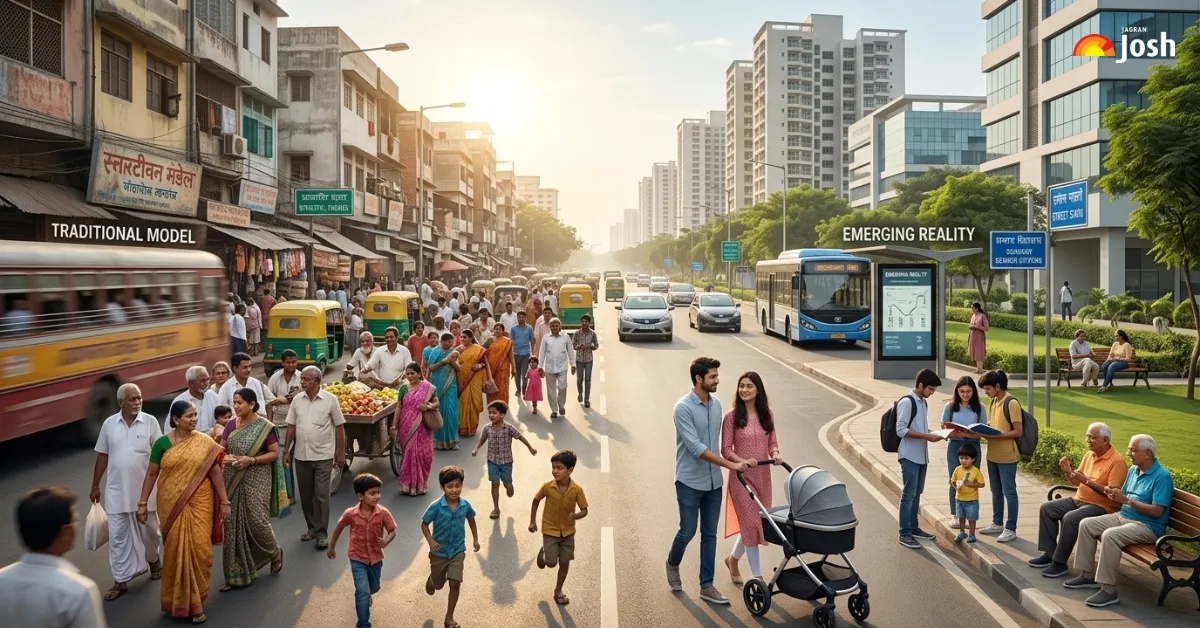
India is the most populous country in the world, with over 1.4 billion people. Having such a huge population brings a lot of energy, but it also puts a tonne of pressure on jobs, housing, and natural resources. For a long time, India maintained its position as the most populated country. This subcontinent surpassed major nations like the USA and China, taking the top spot on the list of the world's most populous countries. But something unexpected is happening. Recent data shows that India's population growth is slowing down fast, and a decline is actually on the horizon. Why would a country that is growing so quickly suddenly start to shrink? In this article, we'll explore the surprising reasons behind this shift.
Why is India's Population Projected to Shrink So Suddenly?
To understand why India's population is projected to shrink, we have to look at a number that demographers obsess over: the Total Fertility Rate (TFR). Simply put, TFR is the average number of children a woman will have in her lifetime.
For a population to perfectly stabilise, meaning it replaces itself from one generation to the next without growing or shrinking, that number needs to be exactly 2.1. This is known as the replacement level.
In simple terms, imagine a country where every pair of parents needs to have exactly 2 children to replace themselves when they grow old. If they have fewer children, the population shrinks. If they have more, it grows.
So, the number 2.1 means they actually need about 2.1 children on average. That 0.1 covers the sad fact that some children don't make it to adulthood. India maintained the number 2.0 for the years 2023 and 2024. Though India saw a decline in 2025, it still maintained the TFR of 2.0.
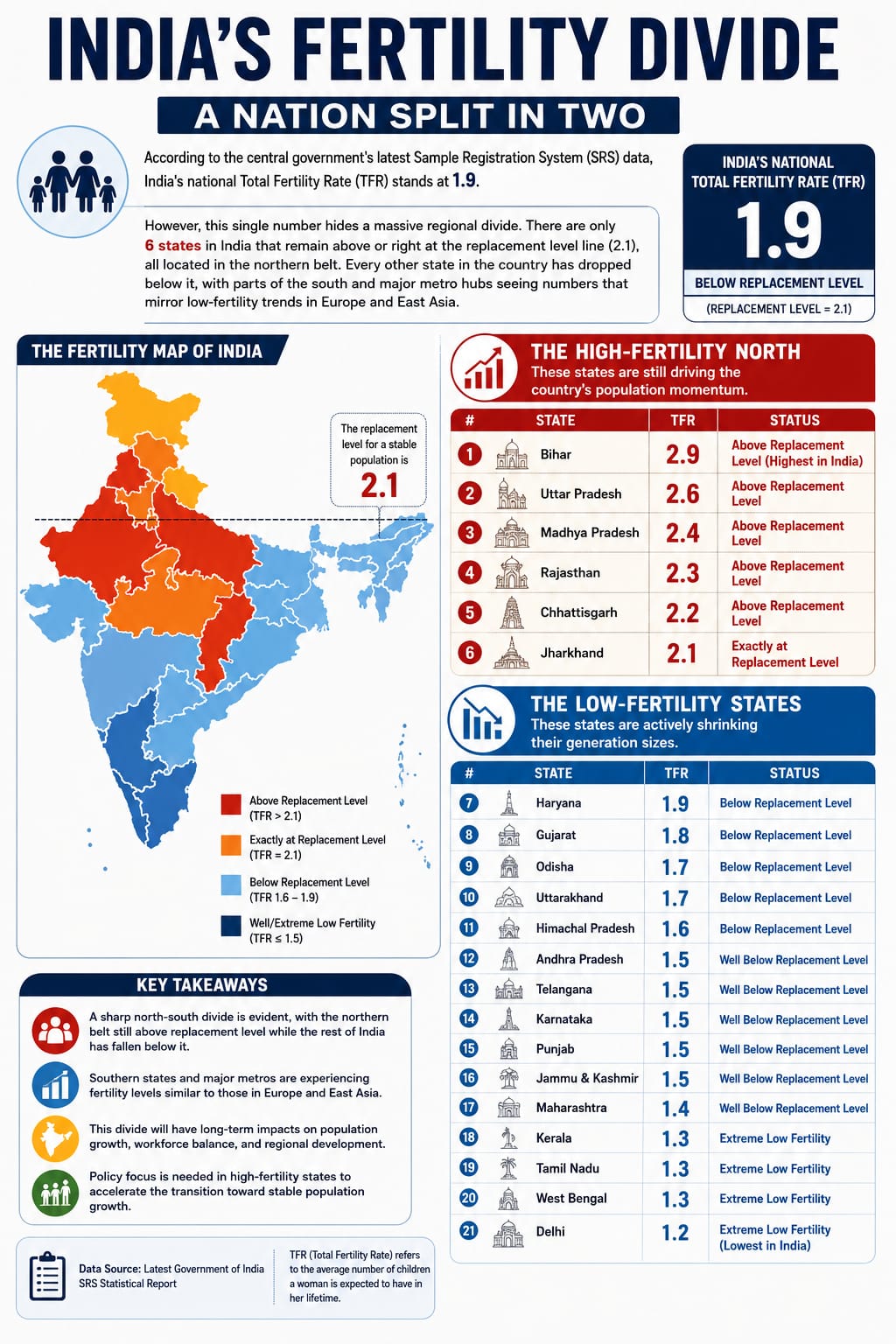
However, here's a surprising fact for you: the official data from the Government of India's Sample Registration System (SRS) shows that India's national TFR has plummeted to 1.9. This closely matches the central government's National Family Health Survey (NFHS-5), which recorded the national drop to 2.0.
What does this mean in plain terms? It means Indian families are having fewer children than ever before. Mathematically, the baby boom is officially over, and India has crossed below the replacement threshold.
i. The Big Paradox: If Birth Rates are Low, Why is India Still Growing?
This is the exact question that trips many people up. If the birth rate is already so low, why isn't India's population shrinking right now? Why are the numbers still going up every day? This brings us to a core concept often tested in civil services exams: demographic momentum.
Demographic momentum (or population momentum) is the tendency of a population to continue growing or shrinking for several decades, even after birth rates immediately drop to replacement level.
Think of Demographic Momentum like a massive, speeding freight train. Even if the engineer slams on the brakes (the birth rate drops), the train cannot stop instantly. It keeps gliding forward for a long distance because of its sheer weight and speed (the size of the young population).
Because India had very high birth rates a few decades ago, the country currently has the largest generation of young adults in its history. Millions of young people are currently in, or just entering, their prime reproductive years.
Even though these young couples are choosing to have significantly fewer children (often just one or two), there are simply so many couples having babies right now that the total number of births still outpaces deaths.
ii. Mapping the Timeline: The Peak and the Slide
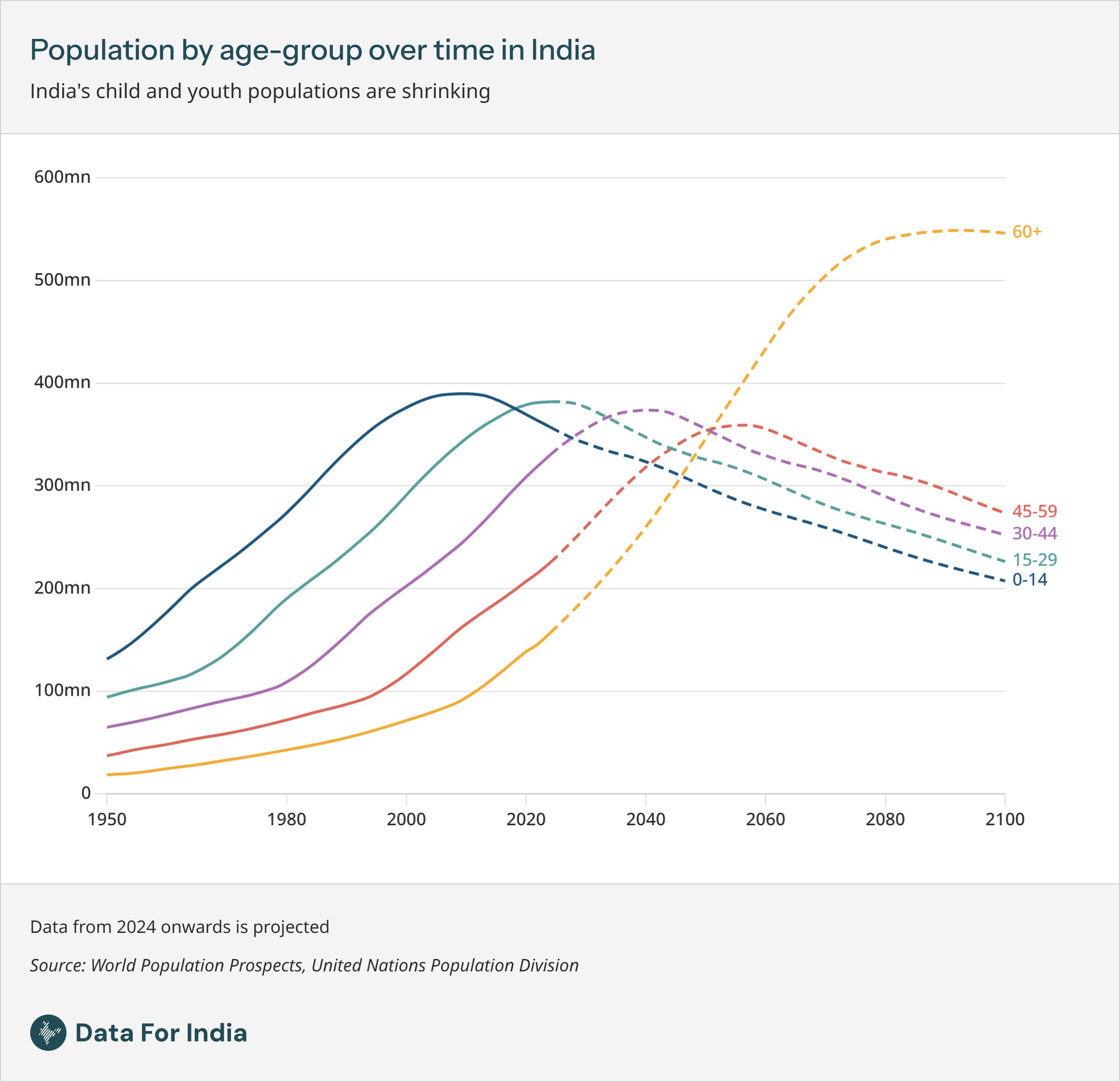
Because of this built-in momentum, India's population will continue to rise for a few more decades. According to the United Nations World Population Prospects, India's population is projected to peak in the 2060s at around 1.7 billion before officially beginning its decline.
To help visualise this shift, here is how the internal breakdown looks across India right now:
| Dynamic | What the Data Shows | The Future Outlook |
| The National Average | India's TFR has hit 1.9 (Below the 2.1 stability line). | The population will eventually peak and contract. |
| The Urban Reality | Urban India's TFR has dropped to roughly 1.5-1.6. | Cities are mirroring low-fertility trends seen in parts of Europe. |
| The Generational Shift | First-born children now account for 66.4% of live births in the country. | Large families with 3 or more children are fast becoming a thing of the past. |
Even though people are having fewer babies, the population won't crash overnight because it still has "momentum" from earlier years. However, the deep-down foundation has totally changed. The population will hit its highest point soon, and after that, it is predicted to start shrinking.
What Factors Are Behind India's Declining Fertility Rate?
This drop in population didn't just happen by accident. It is happening because millions of regular families across India made their own personal choices over the last few decades.
If you look closely, you can see that the way people live and earn money is quietly changing all over the country. The old picture of a giant family living together is being replaced by a brand new way of life.
1. The Power of Female Education
If you look at the single most powerful driver behind falling fertility rates, it is female literacy.
Data from the National Family Health Survey (NFHS-5) reveals a clear and undeniable link: women with no schooling have an average of 2.8 children, whereas women with 12 or more years of education have an average of just 1.8 children.
When young girls stay in school and pursue higher education, two things happen simultaneously:
- Delayed Marriage: The median age of marriage naturally pushes upward.
- Career Aspirations: Women gain access to formal employment and financial independence, which naturally leads to planning smaller, well-spaced families.
2. The Great Urban Shift
Urbanisation completely changes how a family lives and thinks. According to the latest data, the fertility rate in rural India is right at the 2.1 threshold, while in urban areas it has plummeted to an astonishing 1.63.
In rural agricultural settings, having a larger family historically meant more hands to help work the land. However, city life flips this math entirely on its head. As millions of people migrate into cities, the "quality over quantity" mindset takes over.
Parents realise that in a highly competitive urban environment, it is much wiser to pour all their resources into providing the absolute best lifestyle and career foundation for 1 or 2 children, rather than stretching resources thin across a large family.
3. The Surging Cost of Raising Children
Let's talk about the pure economics of modern parenting. Raising a child today is incredibly expensive, and the two biggest financial drains are private healthcare and quality education.
From high preschool fees and coaching classes to the rising costs of housing in safe urban neighbourhoods, the financial commitment is staggering.
Young couples look at their monthly budgets, calculate the immense cost of competitive schooling, and make a conscious, highly calculated decision: "We can only truly afford to give one or two children the future they deserve."
The UPSC Lens: Societal Evolution and Human Rights
If you want to understand how India's families came to have 1 child instead of 2 or 3, it really comes down to two big shifts in how people live.
i. From Joint Families to Urban Nuclear Setups
In the past, most families in India lived together under one roof with grandparents, aunts, and uncles. This made taking care of the kids much easier because everyone helped out with cooking, playing, and watching the babies. So, having 2 or more children didn't feel like a burden.
Today, many parents are moving to big cities for work, leaving those large family networks behind. Instead, they live in small "nuclear families" – just parents and kids.
When both mom and dad work full-time jobs in the city, taking care of children without any family nearby to help becomes incredibly exhausting and stressful. So, most Indian parents have one kid.
ii. The Shift to Voluntary Family Planning
For a long time, the Indian government tried to control population growth by making strict rules about how many babies a family could have.
You must remember the "Hum 2 Hamare 2" family planning slogan introduced by the Government of India in the late 1960s to promote a two-child norm and slow population growth.
But recently, India tried a much better idea: instead of forcing people with laws, they gave them choices and information. They focused on helping women and families make their own decisions about when to have children.
The math shows this plan is a huge success:
- More protection: The number of married women using family planning tools jumped from 54% to 67%.
- Fewer obstacles: In the past, many women wanted to pause or stop having babies, but couldn't get the healthcare they needed. Now, that problem has dropped down to just about 9%.
This proves that when you give people good healthcare and honest information, you don't need strict laws. Parents will naturally choose to have smaller, healthier families all on their own.
Who Will Bear the Burden of India's Fast-Ageing Society?
As we obsess over the sheer size of India's population, a massive internal shift is happening under the radar. The country is ageing faster than ever before, and this shift is revealing a seismic geographical fault line.
I) The Great North-South Demographic Divide
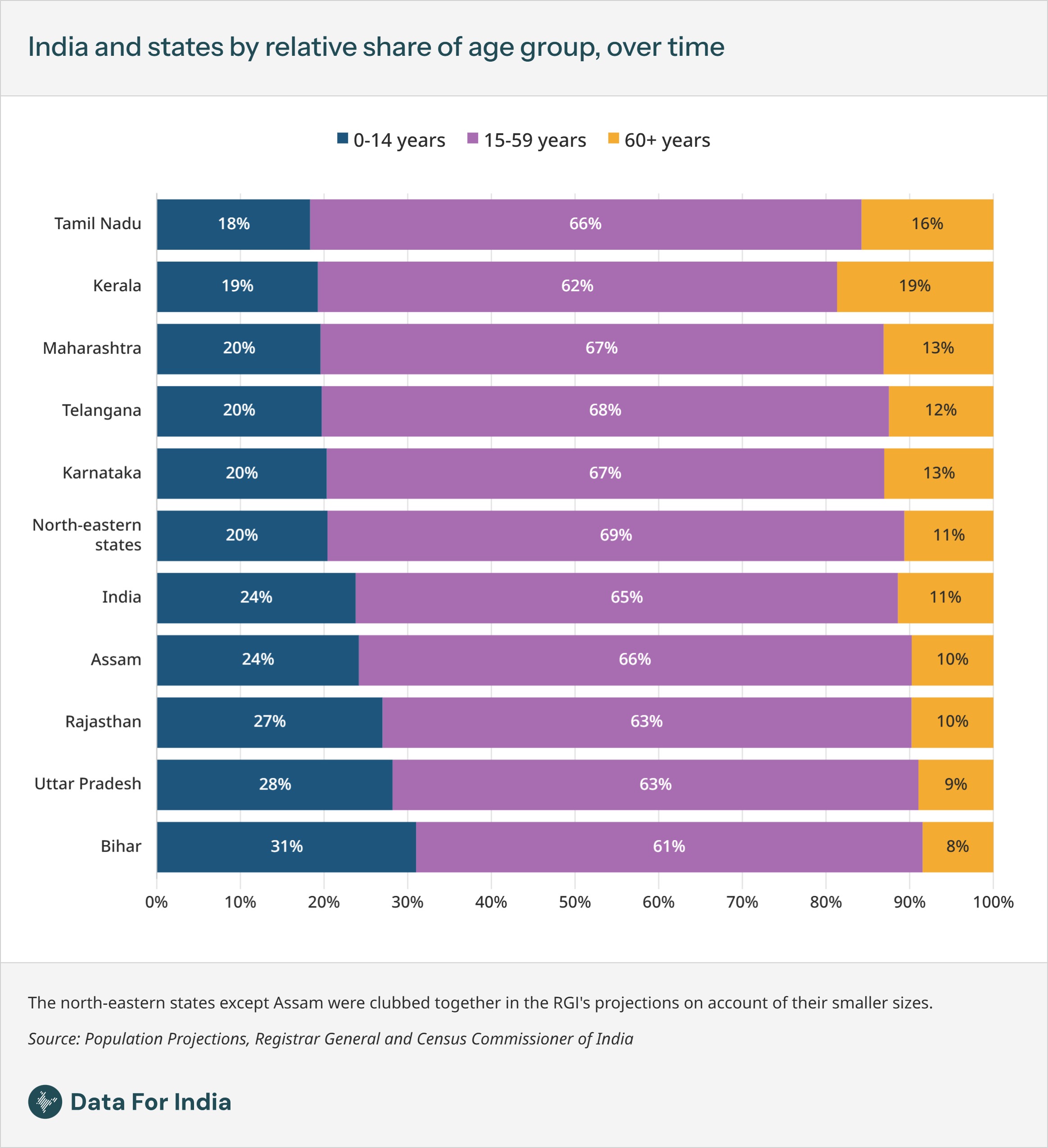
Right now, India is like a country split into two completely different stories. The southern part of India is actively working on education, healthcare, and family planning more rapidly than northern India.
- The Ageing South: In southern states like Kerala and Tamil Nadu, people started focusing heavily on school, hospitals, and smaller families a long time ago. Because of that, they are having far fewer babies. Now, their population is getting older very quickly, much like countries in Europe or North America.
- The Youthful North: On the other hand, northern states such as Bihar and Assam are home to many children and young people. Families are still much larger, which keeps the country's average age very young. So, while one half of India is growing grey hair, the other half is just getting ready to start working
> Elderly Population Share (60+ Years) by State
- Kerala: 15.1%
- Tamil Nadu: 14.2%
- National: 9.7%
- Bihar: 7.8%
This divide creates a complicated economic puzzle. While the ageing South faces sudden labour shortages and mounting healthcare pressures, it increasingly relies on young, migrant workforces moving down from high-fertility northern states to sustain its manufacturing, construction, and service sectors.
The UPSC Lens: The Silver Economy and the Care Dilemma
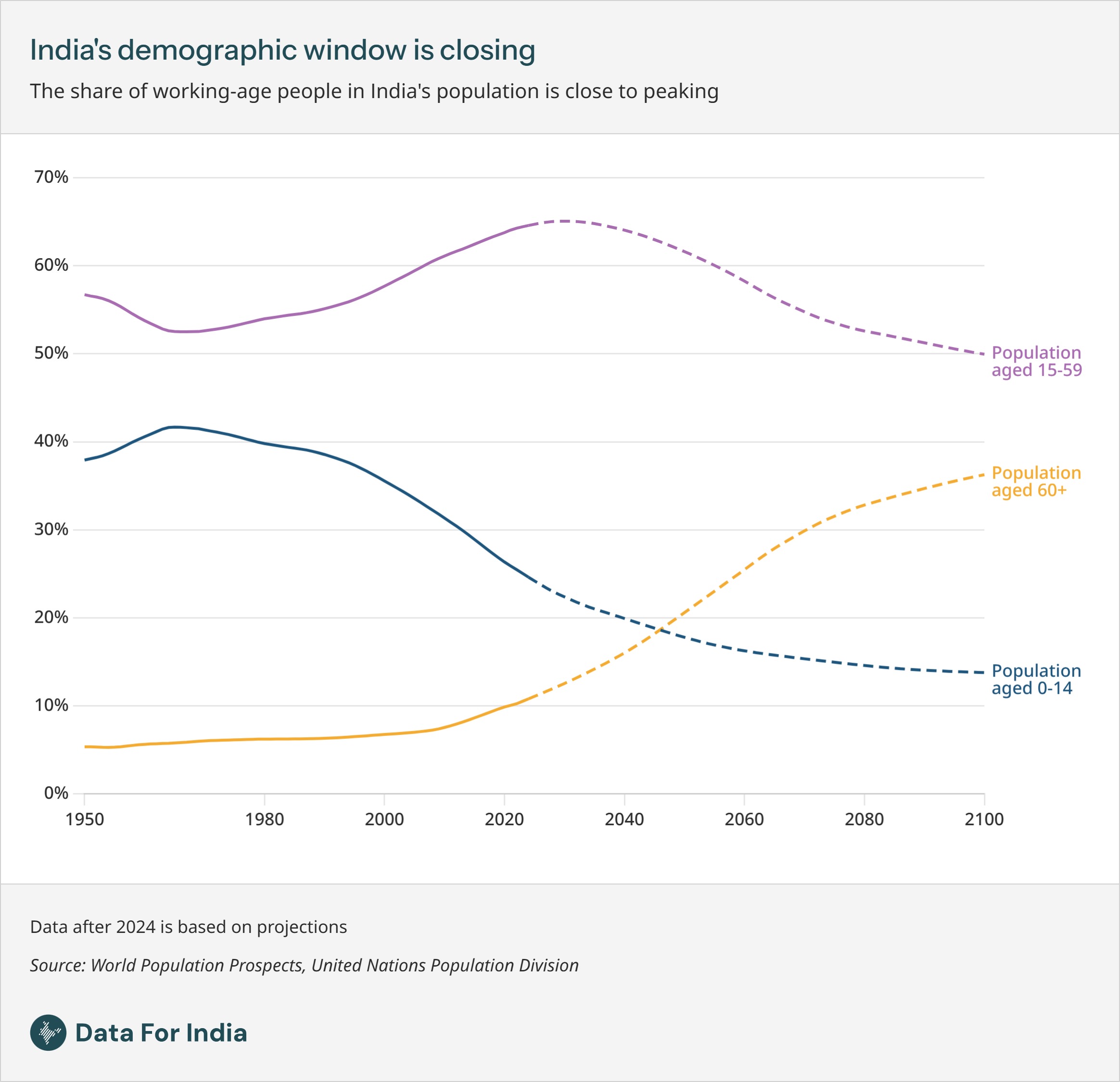
This change encourages policy experts to rethink the country's social fabric, leading to two essential structural ideas.
i. Navigating the "Silver Economy"
As millions of people reach retirement age, India needs to quickly build what experts call a "Silver Economy." This simply means creating businesses, housing, and financial systems designed specifically to support older adults.
Right now, the numbers show a tough reality. A major report by the United Nations Population Fund and the Ministry of Social Justice revealed that more than 40% of India's elderly belong to the poorest financial segments. On top of that, nearly 18.7% of seniors live without any independent income of their own.
To fix this, the country cannot just rely on old habits. It requires a major upgrade in regular pension systems, easier access to savings tools, and smart public services tailored directly for senior citizens.
ii. The Formal Care Economy vs. The Invisible Burden
Historically, caring for the elderly in India has been a deeply personal, family matter. Joint families looked after grandparents quietly at home, and the system worked because the responsibility was shared.
But today, families are shrinking and moving into small, urban apartments. Because of this, the old math is breaking down.
Think about a young couple today who decides to have only one child. When that child grows up, they face a massive emotional and financial weight: they will eventually have to care for two parents and four grandparents, all on their own.
Traditionally, this invisible burden of full-time caregiving fell squarely on women. But times have changed for the better.
More women are pursuing higher education and entering the professional workforce. They can no longer be expected to act as full-time, unpaid, stay-at-home carers.
This new reality means India urgently needs a formal "Care Economy." The country can no longer rely entirely on families to handle eldercare behind closed doors. The government has to step in and build a strong public system for senior citizens. This means the country must invest heavily in three critical areas:
- Geriatric Wards: Setting up specialised units in public hospitals explicitly trained to treat age-related illnesses.
- Assisted Living: Creating state-subsidised senior living homes where older adults can live safely and affordably.
- Community Care: Developing local networks that offer palliative care and support to families dealing with serious, long-term health issues.
India is currently a young country, but that window of opportunity is closing fast. To stop this current youth population from turning into an elderly crisis later on, the foundation for a dignified, official safety net needs to be laid right now.
How Can India Take Advantage Of Its Shrinking Population?
Right now, India has a massive advantage because more than half of its people—nearly 70 out of every 100 people—are at the perfect age to work and earn money. This gives the country a huge economic boost that almost no one else has.
But this special superpower has an expiration date.
Experts say this advantage will reach its peak around 2040. After that, the population will start getting older. This means India is in a race against time: it needs to create good jobs and train its young people right now, or else the country will grow old before it becomes wealthy.
I) The Shift from Quantity to Quality
When we look at this situation closely, a clear truth comes to light: India has to completely change the way it thinks about its population advantage.
For a long time, the focus has been entirely on something experts call a "demographic dividend". In simple terms, this means relying on a large working-age population to drive economic growth.
But today, simply having a massive crowd of young people isn't enough anymore. The real goal now must be achieving a "productivity dividend".
A productivity dividend is less about how many workers a country has and much more about how skilled, healthy, and capable they actually are.
Think about it this way: a million workers who don't know how to use computers or heavy machinery cannot build a modern economy. But a smaller group of highly trained, skilled workers can do amazing things.
Right now, India faces a huge gap here. The latest Periodic Labour Force Survey highlights a tough reality: only about 4.2% of the country's workforce has ever received formal vocational or technical training.
To make it simpler for you, this data shows that out of every 100 workers in India, only about 4 have attended a special school to learn a specific trade or technical skill.
To turn these raw numbers into true economic strength, the nation needs to make a massive, deliberate shift in how it trains its youth.
II) The Three Pillars of a Productivity Dividend
To successfully pull off this transition, policy experts point to three non-negotiable areas where the nation must invest heavily.
1. Reshaping Education and Industry Skills
Schools need to stop forcing kids to just memorise facts for tests and start teaching them real-world skills they can actually use in a job.
With modern technology like robots and artificial intelligence (AI) changing how the world works, young people need to learn how to use computers, build advanced machines, and master specific trades. It is all about learning by doing, not just reading out of an old textbook.
2. Strengthening Public Health
To have a strong economy, workers first need to be healthy. India cannot build a successful country if its young people are dealing with preventable illnesses.
To fix this, the country needs to spend a lot of money on local doctors, cheap medical tests, and healthy food for kids. This support must start from the time they are babies to stop serious problems like the following:
- Stunting: When children do not reach their full height because they don't get enough nutritious food.
- Anaemia: A blood condition that makes people feel incredibly tired and weak because they lack vitamins and iron.
By keeping kids healthy early on, they will grow up strong enough to learn, work, and succeed.
3. Unlocking the Female Workforce
Right now, women are India's biggest unused superpower. Even though official jobs data shows that things are moving in the right direction, with the share of women working or looking for work rising to 40%, a huge gap still remains when you look at men, whose participation stands at 79.1%.
To understand why so many women are missing from the workforce, the data points to a clear answer:
| Primary Reason for Remaining Out of the Labour Force | Percentage of Females | Percentage of Males |
| Childcare and Homemaking Commitments | 44.4% | Minimal / Negligible |
| Continuing Formal Studies | Varied | 69.8% |
Unlocking this hidden power is not just a nice thing to do for fairness; it is something the country absolutely must do to stay wealthy. To make this happen, women need three main things:
- Safe public transportation: Reliable buses and trains so they can travel to work without worry.
- Affordable daycare: Safe places to leave their babies and children during the working day.
- Flexible jobs: Work options that allow them to balance their careers with their families, like working from home.
If India can build the right support systems, it can bring millions of smart, educated women into the workforce. This would give a massive boost to the country's total wealth (its GDP) and secure a rich future before the population gets too old.

Kriti Barua is a skilled content writer with 4+ years of experience in creating clear, engaging, and informative content. She began her writing journey as a Creative Writer Intern at Wordloom Ventures. She holds a BA degree from Delhi University and has completed a one-year diploma in TV Production and Journalism, which adds depth to her research and reporting style.
Kriti has worked across brand writing, marketing content, and digital media, building strong expertise in articles that connect with readers and perform well online. At Jagran New Media, she writes for the GK section, covering national news, international stories, and query-based articles that answer what people actively search for. Her work focuses on easy language, reliable information, strong keywords, and reader-friendly storytelling, making her content both helpful and search-friendly.


