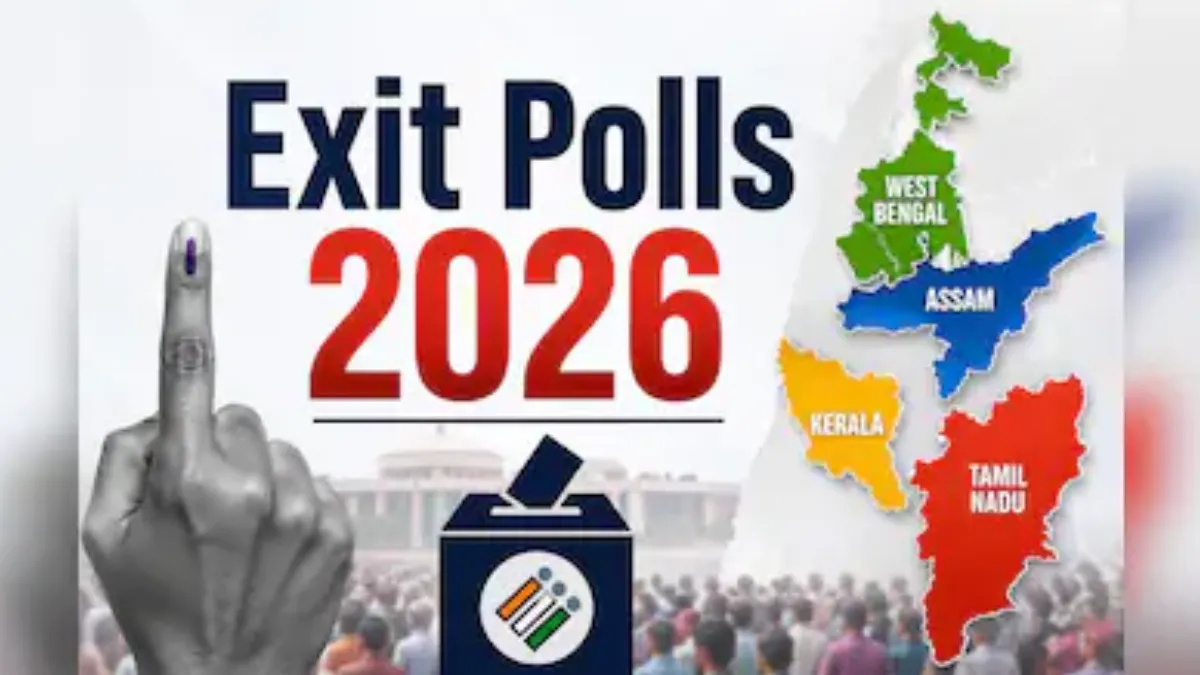
Exit polls refer to polls carried out by polling agencies after the voters have exited the voting booth, and whose aim is to forecast the outcome of an election even before counting takes place. While opinion polls try to establish the intentions of the voters a few weeks before the election, exit polls concentrate on what actually happened during the voting process.
Researchers conduct face-to-face interviews with a sample of voters based on age, caste, gender, and other characteristics, asking them which political party they voted for.
“Exit Polls 2026” thus denotes opinion polls undertaken in the year 2026 in connection with the state assembly elections like those taking place in states like West Bengal, Tamil Nadu, Kerala, Assam, Puducherry, etc. The data generated from such exit polls give information about party-wise seat estimates and vote percentages of various parties.
The first ever instance of conducting exit polls in India occurred in 1957 during the Second General Elections of the Lok Sabha in which the Indian Institute of Public Opinion conducted a survey of voters leaving their booths.
How Exit Polls Are Conducted in 2026?
1. Sampling and Polling Units
Polling agencies adopt the strategy of selecting a representative sample of polling booths from different constituencies. In most cases, the sampling technique used could be random sampling or stratified sampling, so that there is representation of the various demographics and regions. At the polling booths, some people coming out of the booth will be randomly selected by the interviewer.
As for the 2026 assembly elections, large polling agencies will target thousands of polling booths, with millions of voters, especially those in states such as West Bengal, Tamil Nadu, and Kerala.
2. Questionnaire Design
The questionnaire is short and focused on:
-
Which party or candidate the voter chose.
-
Reasons for voting (leadership image, local performance, law and order, economic issues, etc.).
-
Basic demographic details (age group, gender, occupation, area type) without revealing identity so that voting secrecy is preserved.
Questions are framed neutrally to reduce social‑desirability bias (where voters may shy away from revealing support for a less‑popular party).
3. Fieldwork and Data Collection
Field agents are positioned close to polling booths armed with tablets or forms. Their roles include:
-
Interacting randomly with each voter.
-
Undertaking interviews immediately after the voter leaves the booth based on recollection.
-
Respecting confidentiality as well as ensuring no disruption of the electoral process as required by the ECI.
All information is typically entered directly online for immediate analysis.
4. Timing Relative to Polling
In the case of multi-phase elections, exit polls are conducted at all phases, but these surveys cannot be published before the completion of the last phase. For instance, in the year 2026, surveys may be conducted for voters in West Bengal, Tamil Nadu, and Kerala on the date of voting; however, the results can be released only after the conclusion of all voting phases.
The results can usually be made available during the evening hours.
However, the importance of exit polls in the upcoming election scenario does not just end in projecting possible winners of seats but is rather considered as an essential tool that acts as a sociological mirror that reflects the pulse of the voters right then and there. While these polls help gauge the likely winners in states such as West Bengal and Tamil Nadu, the real importance of exit polls comes from the information gathered about the voters and their changing allegiances.
Even with the highly advanced methods used in sample surveys and computerized data gathering, exit polls still remain as estimates with some margin of error and the “silence” from some voter segments. In any case, the end result will only be known as exit polls lead up to the results revealed after the entire voting process.