Detect Kidney Disease Early: IIT Madras, CMC Vellore Researchers Develop AI Model For Risk Prediction


IIT Madras and CMC Vellore researchers have developed three AI-based technologies for the early detection and assessment of kidney diseases, including CKD risk prediction, kidney image classification and personalised 3D kidney modelling.
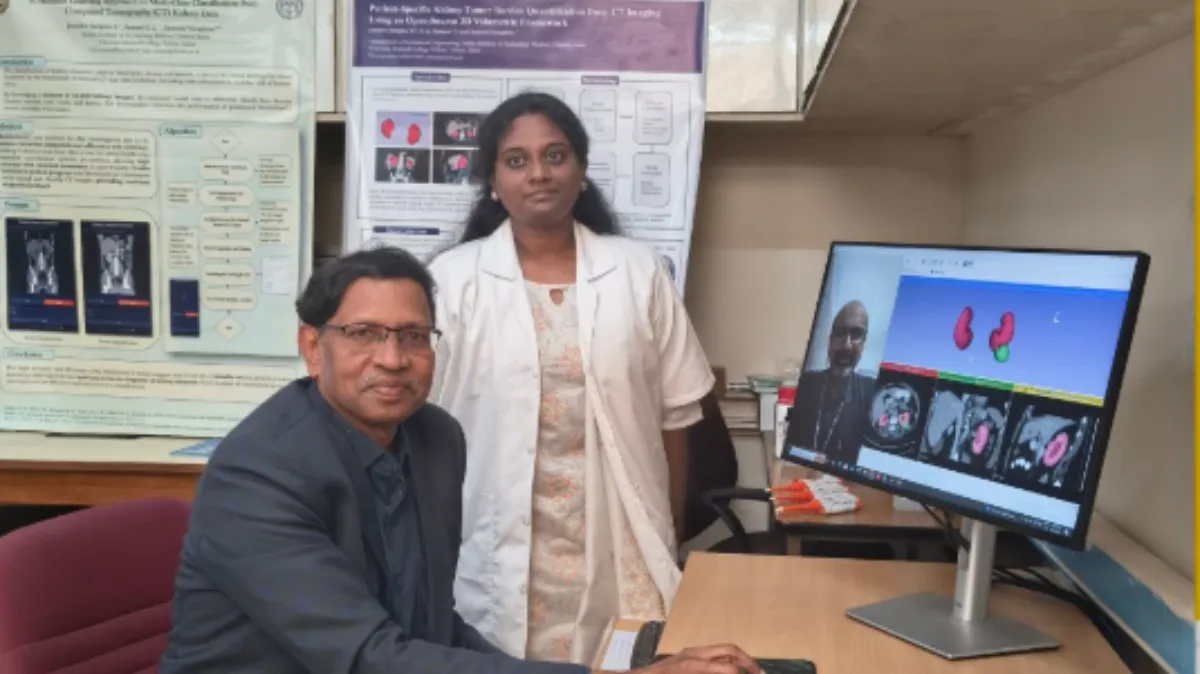
Researchers from the Indian Institute of Technology (IIT) Madras and CMC Vellore have developed three AI-based technologies aimed at supporting the early detection and assessment of kidney diseases.
The technologies include a machine learning model that can predict the risk of Chronic Kidney Disease (CKD), a deep learning model trained on more than 12,000 kidney images, and an imaging-based system that can generate personalised 3D models of individual kidneys.
AI Technologies For Early Kidney Disease Detection
The researchers have developed three distinct AI-based systems, each addressing a different aspect of kidney disease assessment. The first uses clinical and laboratory parameters to identify patients who may be at risk of Chronic Kidney Disease (CKD). A prototype interface has also been developed to present the model’s findings in a way that can be easily interpreted by healthcare professionals, with further improvements planned to enhance its reliability and clarity.
The second system applies deep learning to CT scans and has been trained using over 12,000 kidney images. It can identify and differentiate between four conditions: healthy kidneys, kidney cysts, kidney stones and kidney tumours. The research involving this multiclass classification approach using CT images was showcased at the International Society of Nephrology’s World Congress of Nephrology.
The third technology is focused on creating detailed, patient-specific 3D representations of kidneys from CT scan data. By analysing these models, the system can provide estimates of tumour size and calculate how much of the kidney has been impacted. This could offer clinicians a more detailed understanding of disease severity than conventional measurements alone.
The research was led by Professor G.L. Samuel and Ms Jennifer Delighta from IIT Madras, in collaboration with Professor Santosh Varughese of CMC Vellore.
“The team aimed to develop intelligent systems that would help clinicians make quicker and more informed decisions. We used machine learning along with clinical knowledge to develop tools that would assist in the earlier detection of kidney diseases and give more detailed information specific to the patient,” said Professor G.L. Samuel.
The researchers believe that these technologies could form the foundation for a kidney Digital Twin in the future. Such a patient-specific virtual representation could potentially help doctors track the progression of kidney disease, anticipate changes and make better-informed treatment decisions.
Jennifer Delighta said “Early detection is of paramount importance when dealing with kidney diseases; these AI tools can help detect at-risk patients early and plan their treatment more effectively. The patient-specific imaging framework is of significant promise as it goes beyond the standard measurements to give a more comprehensive picture of the extent of the disease.”
Despite the potential applications, the technologies are not yet ready for routine use in clinical settings. The researchers noted that the systems will need to undergo further testing and validation with larger and more diverse patient datasets before they can be considered for wider clinical deployment.
Sahil Behl is an education journalist at Jagran with over a year of experience in journalism. Prior to joining Jagran, he worked as a Sub-Editor in NDTV's Education department, where he was responsible for writing and editing education-related content as well as managing the department's social media presence. At Jagran, he covers a wide range of education topics, including board examinations, school updates, admissions, and job notifications, while leveraging his editorial expertise and strong understanding of digital content strategy.
Sahil holds a Bachelor's degree in Business Administration and has also completed an eight-month certification program in Data Science. Passionate about emerging technologies, particularly artificial intelligence, he closely tracks their growing role in journalism and explores how they are transforming shaping the future of the media industry.


