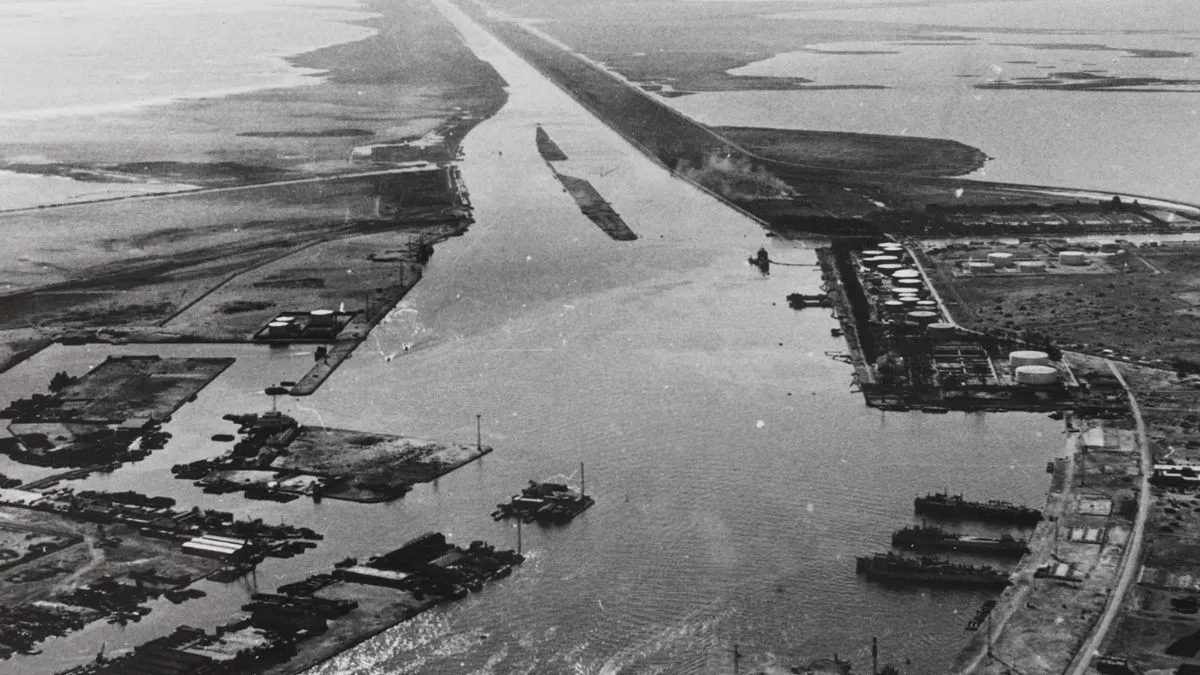
The Suez Canal is an artificial sea-level waterway in Egypt, connecting the Mediterranean Sea to the Red Sea through the Isthmus of Suez. The canal bifurcates Africa and Asia and the Sinai Peninsula from the rest of Egypt. Let us briefly understand the significance of the Suez Canal first.
The 193.30-kilometre-long Suez Canal is a key trade route between Europe and Asia, providing a direct route between the North Atlantic and northern Indian Oceans via the Mediterranean Sea and the Red Sea. The canal reduced the voyage distance from the Arabian Sea to London by approximately 8,900 kilometres.
The Suez Canal was a brainchild of the French diplomat Ferdinand de Lesseps in 1858. The construction of the Suez Canal was approved under the authority of Sa'id Pasha, who was the Ottoman Viceroy (Khedive) of Egypt and Sudan then.
| Did you know? The construction of the Suez Canal lasted for 10 years. The construction of the canal began on 25 April 1859 and was completed and officially opened on 17 November 1869. |
In 1854, Sa'id Pasha granted the concession to French diplomat Lesseps, while the construction began in 1859. On 17 November, 1869, Sa'id Pasha's successor, Khedive Ismail Pasha, inaugurated the canal.
Inaugurated in 1869, the Suez Canal became one of the world's critical maritime chokepoints. The canal facilitates approximately 12 per cent of global trade and about 30 per cent of global container traffic. Today, the canal is operated and maintained by the Suez Canal Authority of Egypt.
But in the year 1956, the Middle East witnessed a significant event called the Suez Crisis. And it all began due to a series of events involving Egypt, France, and Britain.
What were the events that led to the Suez Crisis in 1956?
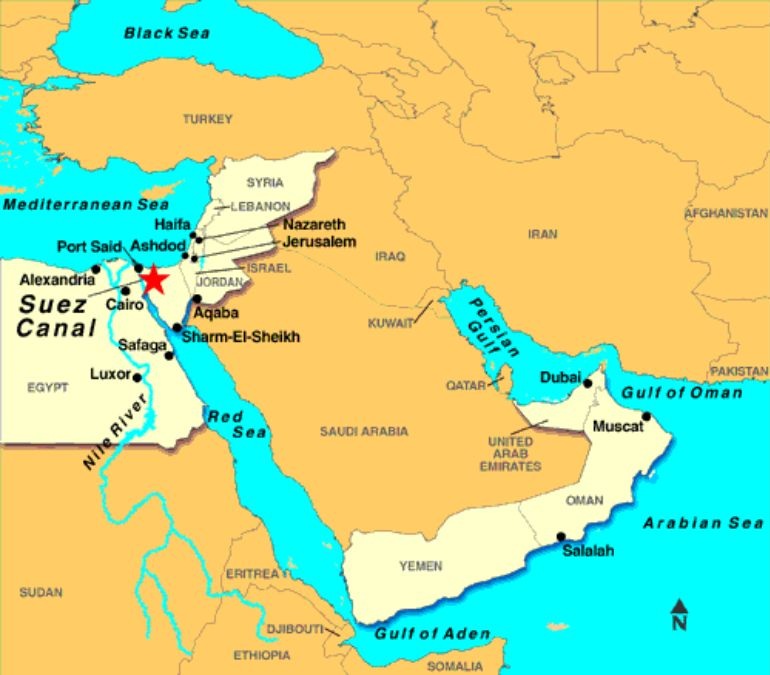
The Suez Crisis of 1956, also known as the Tripartite Aggression, the second Arab-Israeli war, or the Sinai War. In the post-World War II, the Suez Crisis is a pivotal point that symbolised the end of an era for British imperialism.
The Suez Canal at its time of opening in 1869 was financed by the French and Egyptian governments. The canal was operated by the Suez Company, an Egyptian-chartered company. But as a result of debt and financial crisis, Egypt had to sell its shares in the company to the British government in 1875.
The Suez region was an important chokepoint for Britain's strategic positioning in the Middle East. With the 1882 invasion of Egypt, the British took control of the country as well as the canal. The British and French owned and operated it until the nationalisation of the canal in July 1956 that led to the Suez Crisis of 1956.
Withdrawal of Aswan Dam Funding: Due to Egypt's increasing diplomatic relations with the Soviet Union, the US and the UK withdrew the funding of the Aswan High Dam project in July 1956.
Nationalisation of Suez Canal: On 26 July 1956, the then Egyptian President Gamal Abdel Nasser responded with announcing the nationalisation of the Suez Canal Company, which was the joint British-French enterprise which had been operating the canal since its construction in 1869. He transferring it to the Suez Canal Authority in order to fund the dam using the revenue from the canal. Nasser also closed the Straits of Tiran to all Israeli ships.
The Secret Protocol of Sèvres: In October 1956, the Britain, France, and Israel agreed to invade Egypt and overthrow President Nasser. The Israeli army did invade Sinai Peninsula on 29 October 1956. British and French forces successfully captured Port Said and Port Fuad. However, intense diplomatic and economic pressure from the United Nations and the US led to the withdrawl of the Anglo-French-Israeli military in the Suez region on 22 December 1956. The Israeli forces withdrew in March 1957.
The Suez Crisis of 1956 elevated the then Egyptian President Gamal Adbel Nasser to an iconic regional leader of Arab nationalism in the Middle East. The nationalisation of the canal was seen as reclaiming national sovereignty from foreign powers. In the aftermath, Britain and France influence in the middle east grew weaker.



-1774434825765_t.webp)
Comments
All Comments (0)
Join the conversation