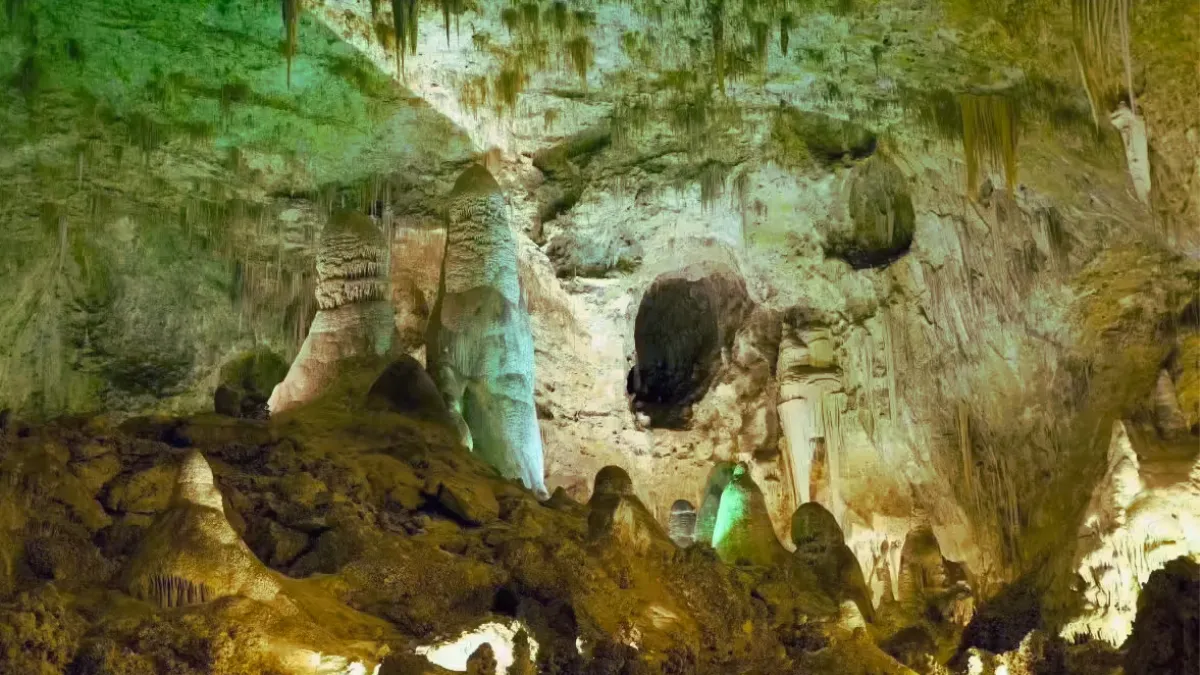
The neon green wall found in Carlsbad Caverns defies the belief about the location where living things will flourish, and that cyanobacteria are photosynthesizing in complete darkness with invisible light near-infrared.
According to this 2018 discovery by researchers Hazel Barton and Lars Behrendt, microbial adaptations occur in harsh underground conditions.
Where was the Neon Green Wall Originally Discovered?
The discovery was made in a 2018 expedition in Carlsbad Caverns National Park, New Mexico by researchers Hazel Barton, a professor of geological sciences at the University of Alabama, and Lars Behrendt, a microbial biologist at Uppsala University.
They had peered deep in one of the alcoves, not upon the walkways, and out of the light of nature, to see an intense neon green growth of microbes on limestone walls.
The location is absolutely black, and no light could penetrate it, and the colonies were extremely bright when exposed to artificial torchlight. Follow-up sampling of various caves in the park found similar green formations.
What Does the Green Wall Look Like?
The wall is indistinguishable to the naked eye, and it is possible to prove that there are thick cyanobacteria blankets by using a light source.
They grow well in the stable environments of the park which are nutrient deficient and not affected by surface inputs.
Cyanobacteria and Adaptation of Photosynthesis
The green color is due to the single-celled cyanobacteria that have chlorophyll d and f, which is specialized and traps the near infrared (NIR) wavelengths of light (700-780 nm) to synthesize oxygen.
These pigments help in getting energy when normal chlorophyll a and b are not able to do so as there is no visible light.
These microbes are in contrast to the normal photosynthesis that depends on the use of sunlight, their process depends on NIR scattered and reflected by limestone surfaces.
This is an adaptation that makes the photic zone go deep into dark caves.
Light Dynamics in Caves
The NIR levels in the dark alcove were found to be up to 695 times greater than at the cave entrances, as a result of many reflections within the cave walls of the pale limestone. Big colonies were concentrated at the very point of NIR peak and disappearance of visible light.
This process stratifies microbial life just as light does in surface ecosystems except that the process is driven by invisible cave-trapped radiation.
How was the Green Wall Researched and Discovered?
It was found in the 2020 peer-reviewed article Life in the dark: far-red absorbing cyanobacteria extend photic zones deep into terrestrial caves published in Environmental Microbiology (DOI: 10.1111/1462-2920.14774).
It describes four of the Carlsbad caves with the quantification of light spectra, pigment profiles, and microbial communities.
Supporting experiments employed spectroscopy, pigment extraction and metagenomics in order to validate the existence of NIR-controlled photosynthesis at intensities never attempted before.
Who were the Lead Researchers?
Hazel Barton was formerly at University of Akron and is currently at University of Alabama and is a specialist in the field of cave geomicrobiology, such as her reviews, such as Geomicrobiology in Cave Environments (Journal of Cave and Karst Studies, 2007).
Lars Behrendt of the Uppsala University works on the light adaptations of microbes.
Their work was based on the long study of Carlsbad that was carried out by Barton and combined biology, geology, and optics.
Estimated Timeline
These colonies are probably preserved in their original form over 4-9 million years under the protection of the geologically stable microclimate of the cave with minimum disturbance. Behrendt observed that they have been untouched in this niche.
The structures are a primitive, persistent ecosystem that depends on NIR recycling, and reflects primitive survival strategies of microbes that do not need external energy. The lack of genetic influx of surface life does not enhance their ancient isolation.
The boundary of photosynthesis is pushed to the neon green wall of the Carlsbad Caverns, proving that life thrives on the cave-reflected NIR in complete darkness. Barton points at its contribution to the detection of oxygen as a biosignature on exoplanets, calling on sophisticated astrobiology frameworks.
ALSO READ| What is the State Flower of Uttarakhand?



Comments
All Comments (0)
Join the conversation