Show Key Points
The Treaty of Purandar 1665 is not just a pact between the Marathas and Mughals which represents the most critical turning point in Indian history. The first treaty of Purandar 1665 was signed between Chhatrapati Shivaji Maharaj and the Mughal Empire. The second Treaty of Purandar was signed in 1776 between the Maratha Empire and the British East India Company. These treaties led to power shifted in the Indian subcontinent over two centuries.
What is the Treaty of Purandar 1665?
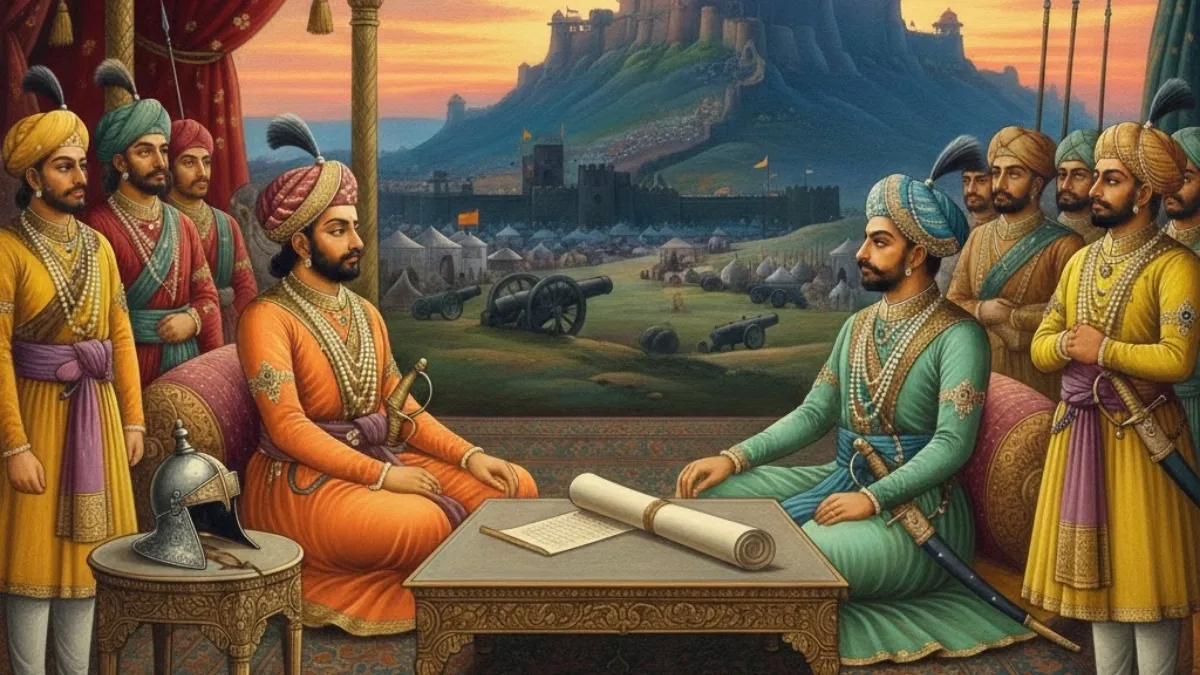
In 1665, the Maratha ruler Chhatrapati Shivaji Maharaj was forced into a diplomatic coup after the Mughal Emperor Aurangzeb sent a massive army led by the Jai Singh I, Shivaji’s fortress at Purandar, Maharashtra was besieged to prevent further bloodshed and the destruction of his kingdom, Shivaji entered negotiations and signed Treaty of Purandar, signed on June 11, 1665. Key points of the treaty were
-
Territorial Surrender by Shivaji surrendered 23 of his 35 forts to the Mughal Empire.
-
The surrendered forts yielded an annual revenue of 40 huns ( a currency of that time) to the mughal empire.
-
Allowed to retain control over the remaining 12 forts and remain loyal to the Mughal Empire.
-
On Jai Singh's advice, Shivaji decided to transfer his eight-year-old son, Shambhaji to the Mughal court in exchange, Shambhaji received a mansab (military rank) of 500 and an honourable position.
-
The Mughal agreed on the Shivaji request to govern the Bijapur ruled provinces of Konkan and Balaghat.
-
Shivaji agreed to help the Mughals in their campaign against the Bijapur Sultanate.
-
Shivaji agreed to meet Aurangzeb at the Mughal court in Agra and was captured by him which famously led to his daring escape later.
Historical Background of Treaty of Purandar 1665:
Maratha supremacy rose under the leadership of Chhatrapati Shivaji Maharaj, the Maratha Empire had become a major force in the Deccan directly challenging Mughal authority by capturing numerous strategic forts, before the treaty of Purandar Shivaji challenges the Mughal Supremacy in the Deccan
-
Shivaji successfully defeated Bijapur general Afzal Khan and expanded his control over the Deccan
-
In 1663 Shivaji conducted a raid on Shaista Khan’s camp in Pune which led to the Mughal humiliations,
-
In 1664, Shivaji launched a massive raid on Surat, one of the wealthiest Mughal trading cities, which forced the Mughal Emperor to take decisive military action and economic impact on the sack of Surat.
The Mughal Counter-Offensive to curb Maratha expansion, the Mughals dispatched a massive army under the Rajput general Raja Jai Singh I of Amber including Dilir Khan, Rai Singh and Daud Khan to reclaim control of the Deccan region.
The Siege of Purandar immediate cause was the intense military pressure during the Battle of Purandar, where the Mughal forces successfully besieged the fort, making further Maratha resistance unsustainable at that moment. The battle was concluded by the signing of the Treaty of Purandar between Shivaji and Jai SIngh.
Why was Significance of Treaty of Purandar 1665?
The Treaty of Purandar 1665 was historically significant because it marked the first major formal diplomatic interaction between the rising Maratha power in Deccan and the peak of the Mughal Empire under Aurangzeb. The 1665 treaty is a landmark in military and political history for several reasons:
-
Strategic Preservation: By surrendering 23 forts, Shivaji Maharaj saved his people from a prolonged, devastating siege and preserved the core of his administration.
-
Mughal Recognition: For the first time, the Mughal Empire had to officially negotiate with the Marathas as a formidable political entity in the Deccan rather than mere "rebels."
-
The Agra Incident: The treaty paved the way for Shivaji’s visit to Agra and Shibaji’s legendary escape from Aurangzeb’s house arrest afterward became the catalyst for the Maratha war of independence.
-
Shift in Deccan Politics: It forced a temporary alliance between the Marathas and Mughals against the Bijapur Sultanate altering the balance of power in Southern India
What is Treaty of Purandar in 1776?
The Second treaty of Purandar was signed between the Marathas and the British on March 1, 1776 between the British East India Company was represented by the Calcutta Council and the Maratha Empire was represented by Nana Fadnavis on behalf of the Peshwa.
| Feature | Treaty of 1665 | Treaty of 1776 |
| Primary Parties | Shivaji Maharaj & Jai Singh I (Mughals) | Nana Fadnavis & British East India Co. |
| Context | Mughal expansion into the Deccan | First Anglo-Maratha War |
| Major Outcome | Shivaji surrendered 23 forts | British recognized Peshwa Madhavrao II |
| Long-term Impact | Led to Shivaji's escape from Agra | Temporarily halted British expansion |
The Treaty of Purandar 1665 was signed between Shivaji Maharaj and Mughals Empire to ensure survival of the Maratha resistance, eventually which led to the rise of the Maratha Empire. The Treaty of Purandar (1776) served as a diplomatic intervention by the British East India Company to settle internal disputes.



Comments
All Comments (0)
Join the conversation