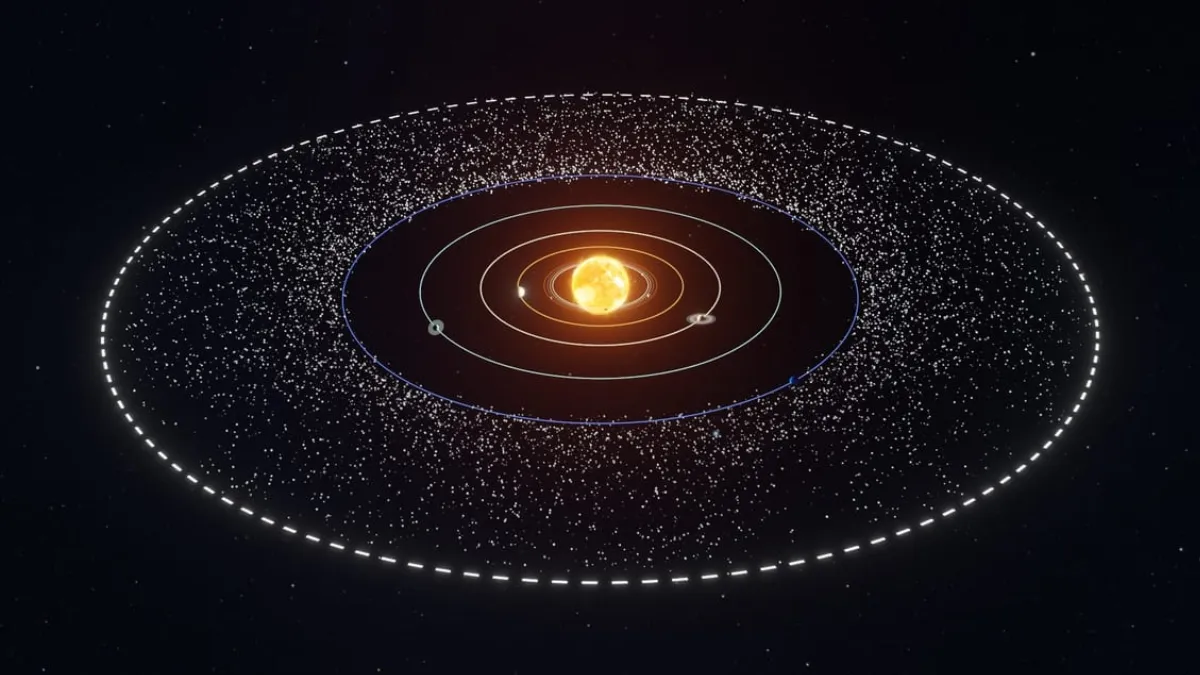
Suppose we have around our Sun an enormous ring of ice, rock, and mystery that is well above the known planets and that contains secrets as to the origin of the solar system. This doughnut shaped disk of frozen material is the Kuiper Belt of frozen material, which is found to be between 30 and 55 astronomical units (AU) away from the Sun, beginning right after the orbit of Neptune.
It contains trillions of little icy bodies such as dwarf planets such as Pluto and is the main source of the short period comets which brighten our skies.
This belt was discovered with the help of decades of predictions and observations and it transforms our perception of the outer solar system as a dynamic and icy world not a void in space.
Its secrets have been revealed through NASA space missions called New Horizons that have confirmed it to have a dustier and extended structure than earlier expected.
What is the Discovery of the Kuiper Belt?
The idea of a remote reservoir of comets developed during the 1940s during confusions about the origin of comets. Short-period comets are proposed to be replenished by icy planetesimals beyond Neptune, and are suggested to have been proposed by Irish astronomer Kenneth Edgeworth in 1943.
This was extended by Dutch-American astronomer Gerard Kuiper in 1951 who forecasted a belt of such bodies at 30-50 AU, but he was not sure they would be visible.
On August 30, 1992, astronomers David Jewitt and Jane Luu, found 1992 QB1, a 100-km object, just as predicted, which became the first Kuiper Belt Object (KBO) to be identified beyond Pluto under the fruit of decades of telescopic searching.
This sparked a wave of discoveries; by 2006, the declassification of Pluto as a dwarf planet brought to the fore the richness of the belt. KBOs are recognized today, and NASA data bases monitor more than 2,000 KBOs.
What Does the Kuiper Belt Look Like?
Based around the Sun, in a flat disk that is co-planar to the major planets, the Kuiper Belt is thought to commence at the 30AU of Neptune, extending up to about 55AU and with scattered material extending to 100AU or more.
It was formed as a result of gravitational sculpting: as the solar system was being formed, the outward movement of Neptune disturbed orbits and formed resonant populations with each other, such as 3:2 (Plutinos at 39.5 AU) or 1:2 (Twotinos at 48 AU).
Classical KBOs have non-resonant orbits which are either inner (39-45 AU, low inclination) or outer (higher eccentricity).
The scattered disk has high-eccentricity trajectories thrown out by Neptune. The content of the belt is tapered, the dust content is found to be 10 times greater than anticipated, and postulates material to no less than 80 AU.
| Region | Distance (AU) | Orbital Characteristics |
| Classical Inner | 39-45 | Low inclination/eccentricity, stable |
| Resonant (Plutinos) | ~39.5 | 3:2 Neptune resonance |
| Resonant (Twotinos) | ~48 | 1:2 Neptune resonance |
| Scattered Disk | 30-100+ | High eccentricity from perturbations |
Data source: NASA
Composition and Objects in Kuiper Belt
Kuiper Belt Objects (KBOs) consist mainly of frozen volatiles: water ice, methane, ammonia, carbon monoxide overlaid with rocky silicates and organics forming reddish tholins from irradiation.
Unlike inner solar system asteroids, they retain primordial compositions, with surfaces varying from bright water ice (e.g., Haumea) to dark organics (Pluto). Sizes span micrometers to dwarf planets; estimates suggest 100,000 objects >100 km and trillions smaller.
Prominent dwarf planets dominate: Pluto (2,377 km diameter, thin nitrogen atmosphere); Eris (~2,300 km, denser than Pluto); Haumea (1,595 km, elongated by rapid 4-hour spin, collision-born family); Makemake (1,430 km, methane frosts). Others like Quaoar (1,070 km) and Orcus host moons, hinting at past impacts.
Exploration and Missions
Pioneering NASA's New Horizons spacecraft reached Pluto on July 14, 2015, imaging its heart-shaped plain, mountains, and escaping atmosphere revealing an active world despite distance. Extended mission targeted 2014 MU69 (Arrokoth) in January 2019, a 36x21 km "snowman" contact binary, pristine since formation.
Flybys measured dust flux 1,000 times Voyager levels, extending the belt's reach. Telescopes like Hubble and JWST continue occultation surveys for sizes/compositions; no dedicated orbiters yet.
Kuiper Belt vs. Oort Cloud
Both are icy leftovers, but the Kuiper Belt forms a disk (30-55 AU) of short-period comets dynamically tied to planets, while the spherical Oort Cloud (2,000-100,000 AU) feeds long-period comets from galactic tides.
Ongoing New Horizons data analyzes distant encounters; JWST hunts faint KBOs and compositions. Proposed missions like interstellar probes could traverse deeper, while ground arrays map populations.
Also Read: India AI Impact Summit 2026: First Global AI Summit in Global South



Comments
All Comments (0)
Join the conversation