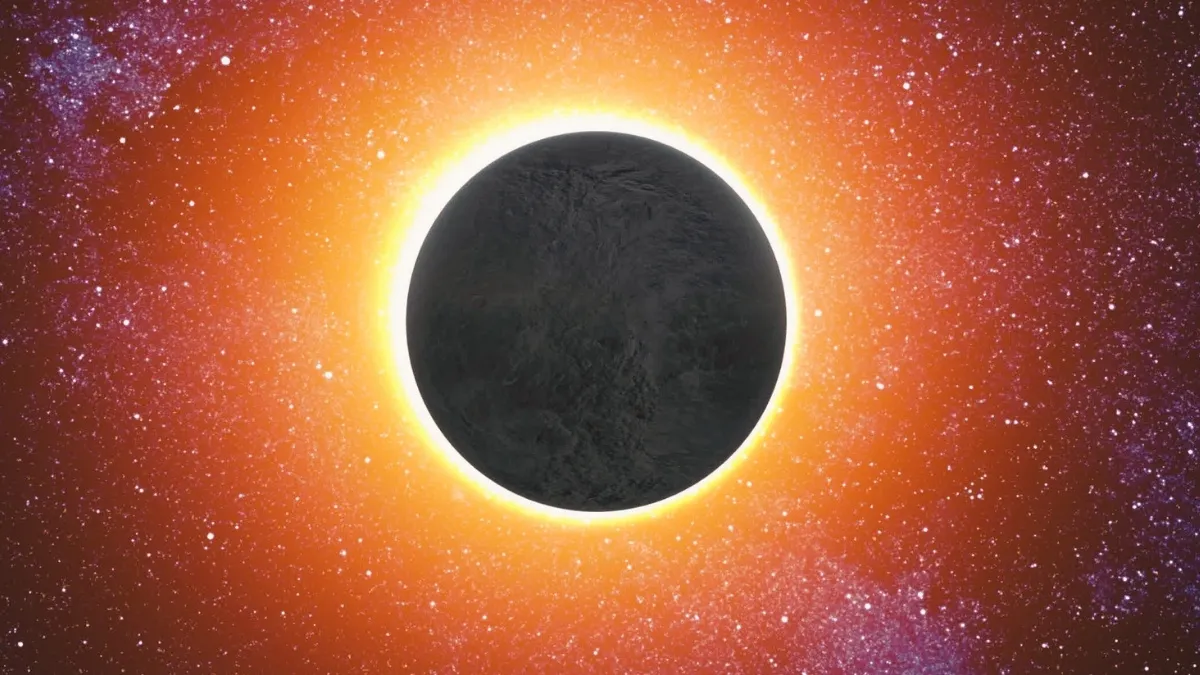
The annular solar eclipse is famously known as the "Ring of Fire." This occurrence happens when the moon passes the Sun. The small size of the moon doesn’t completely cover the sun, thereby leaving a ring of brilliant, fiery sunlight shining brightly around the Moon's dark silhouette. Such an awkward vision makes for a glowing noontime spectacle that looks quite unlike anything else.
The Annular Solar Eclipse 2026 is drawing in millions for its cosmic blend of science and awe, especially as we reach out towards the rare path over remote oceans in 2026. According to NASA, there are about 66 annular eclipses visible from some part of Earth each century, making them a recurring cosmic treat.
Read on to learn about the Annual Solar Eclipse, its science, 2026 timings from NASA, visibility map by countries and safe viewing tips.
Why is the Annular Solar Eclipse Called the "Ring of Fire"?
The "Ring of Fire" name captures the stunning bright ring of Sunlight encircling the Moon during peak eclipse.
This occurs because the Moon's orbit is elliptical; at apogee (farthest from Earth), it looks smaller than the Sun's disk. The Moon covers the Sun's center, but sunlight streams around the edges, creating an "annulus" – Latin for ring – that glows orange like fire.
Daylight dims to a strange twilight, lasting minutes, without total darkness.
-
The ring phase typically endures 5-12 minutes max in the center path.
-
Baily's beads sparkle briefly at start/end, like fiery jewels.
-
No corona shows, unlike totals, keeping skies brighter.
Check about Comet 3I/ATLAS: Oldest Comet Visitor from Solar System?
When is the Annular Solar Eclipse?
The next Annular Solar Eclipse is a big one which will be visible on February 17, 2026, with annularity over Antarctica and ocean zones. NASA details phases precisely for planners. Timings follow precise NASA predictions based on orbital math.
| Phase (UTC) | Exact Timing (Feb 17, 2026) | Description |
| Partial Begins | 04:51 | Moon's edge touches Sun |
| Annularity Starts | 06:05 | Ring of Fire emerges |
| Maximum | 07:13 | Peak ring width ~150 km |
| Annularity Ends | 08:21 | Ring fades |
| Partial Ends | 09:35 | Eclipse complete |
Eclipse Meteorologist, Jay Anderson stated "It's possible that only a few people will view this eclipse from within the annular zone," on his website, Eclipsophile.com.
Where will the Annular Solar Eclipse be Visible From?
The full "Ring of Fire" traces a narrow antumbra path, about 100-200 km wide. For 2026's event, prime annularity hits remote Antarctica; partials blanket southern continents. Always verify local weather and use apps for real-time paths.
| Country/Region | Partial Viewing Start (Local) | Annularity (if applicable) | Partial End (Local) |
| Antarctica (East) | ~11:00 AM | 12:13-13:21 PM | ~2:35 PM |
| South Africa | 10:30 AM | Partial only | 12:45 PM |
| Australia (South) | 2:00 PM | Partial only | 4:15 PM |
| Chile (South) | 8:00 AM | Partial only | 10:20 AM |
| New Zealand | 4:30 PM | Partial only | 6:45 PM |
(Source: EarthSky)
Tips for Watching Annular Solar Eclipse
The people who will be witnessing the Eclipse of the Sun today on February 17, should know that the sky conditions and elevation affect clarity. The eclipse will be visible in the southern part of the earth.
The safest viewing option is from Open southern horizons. The annular eclipse differs from totals by Moon distance – closer yields blackout, farther yields ring. Partials nibble edges only.
Prep eclipse glasses (ISO 12312-2 certified) – bare eyes risk burns. Apps like NASA track it live.
Read about Types of Solar Eclipses here.
Conclusion
The annular solar eclipse's "Ring of Fire" arises from a distant Moon framing the Sun in radiant light, a safe, thrilling show of orbits at work. It sparks wonder without deep darkness, perfect for 2026 chasers. Grab glasses, pick a spot, and witness nature's fiery ring – pure cosmic joy awaits.



Comments
All Comments (0)
Join the conversation