At the invitation of Prime Minister Narendra Modi, the President of Seychelles, Dr Patrick Herminie, is on a visit to India from 5 to 10 February 2026. During their meeting on 9 February, 2026, the Indian Prime Minister Narendra Modi had a comprehensive and productive discussion on the entire bilateral relations with Seychelles’s President Dr Patrick Herminie.
Within the discussion, both leaders also acknowledged Seychelles-India ties in a people-centric manner and reinforced security and stability in the Western Indian Ocean Region, and India reaffirms the Seychelles ' role in India's Vision MAHASAGAR (Mutual and Holistic Advancement for Security and Growth Across Regions)
To understand the growing partnership, it is important to first explore Seychelles—its location, history, geography, and strategic relevance.
About Seychelles
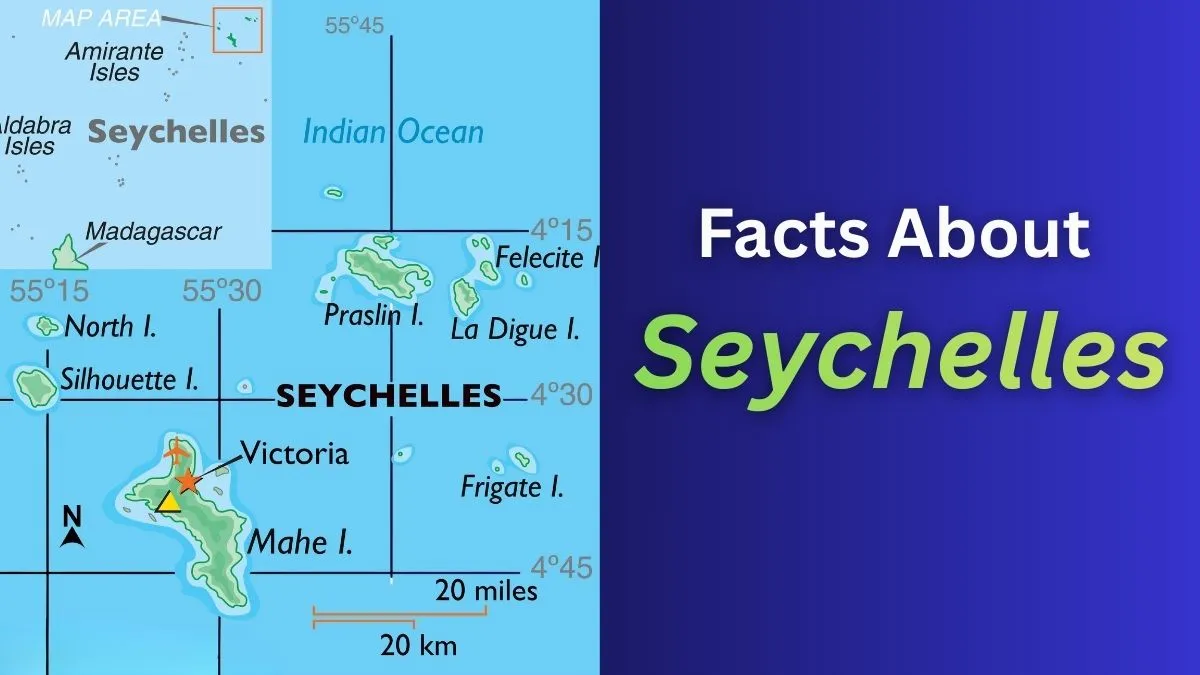
Seychelles, officially the Republic of Seychelles, is an archipelago of 115 islands located in the western Indian Ocean, northeast of Madagascar and about 1,600 km east of Kenya.
-
Capital of Seychelles : Victoria (on Mahé Island)
-
Population: Around 100,000
-
Major Islands: Mahé, Praslin, La Digue
-
Area: Approximately 444 sq. km
-
Climate: Tropical marine
Seychelles is globally recognised for its high human development indicators, rich biodiversity, and strong emphasis on marine conservation.
Tourism, fisheries, and financial services form the backbone of its economy. Its vibrant Creole culture reflects African, European, and Asian influences.
What is the historical Significance of this beautiful island?
The islands were uninhabited for centuries despite appearing on Portuguese maps in the early 16th century. Arab traders may have known of them earlier.
In 1742, French expeditions reached the islands, and in 1756, France formally claimed them, naming them after Jean Moreau de Séchelles, a French finance minister. French settlement gradually developed plantations and introduced enslaved labour.
During the Napoleonic Wars, Britain took control of the islands. Under the Treaty of Paris (1814), Seychelles was formally ceded to Britain.
Initially administered as a dependency of Mauritius, Seychelles became a separate British Crown Colony in 1903.
Political reforms began in the 20th century, leading to constitutional discussions in 1970. After negotiations with Britain, Seychelles became an independent republic on 29 June 1976.
At independence, islands such as Aldabra, Farquhar, and Des Roches were restored to Seychelles. Today, Seychelles is a stable democratic republic and an active participant in regional and global forums.
What are the Geographical Features of Seychelles?
Seychelles is located in the Indian Ocean about 1,600 kilometres (1,000 miles) east of Kenya. This nation comprises 115 beautiful archipelago islands, including tropical islands with two distinct collections of islands.
1. Granitic Islands (about 40 islands)
-
Includes Mahé and Praslin
-
Characterised by rocky terrain, narrow coastal plains, and central hills
-
Highest elevation: around 914 metres
2. Coral Atolls
-
Flat and low-lying
-
Many lack fresh water
-
Some are uninhabited
| Category | Detail |
| Area | 444 sq. km; approximately 2.5 times the size of Washington D.C. |
| Major Islands | Mahe and Praslin. |
| Capital City | Victoria. |
| Terrain | About half of the islands are granitic in origin, with narrow coastal strips and central ranges of hills rising to 914 m. The other half are coral atolls, many uninhabitable. |
| Climate | Tropical marine. |
The climate remains warm and humid throughout the year, with temperatures generally ranging between 24°C and 30°C.
The southeast trade winds (May to November) bring relatively cooler and pleasant weather. Seychelles lies outside the main cyclone belt, making extreme storms relatively rare.
Its Exclusive Economic Zone (EEZ) is vast compared to its land area, making marine resources and maritime security crucial for the country.
What are the relations between India and Seychelles?
India and Seychelles share a relationship that extends far beyond diplomatic engagement. The waves of the Indian Ocean have connected people for centuries. Along its shores, trade between our nations has grown, cultures have converged, and traditions of trust have continued to strengthen.
India and Seychelles share long-standing and friendly relations built on historical trade links, diaspora connections, and maritime cooperation.
| Area of Cooperation | Key Details |
| Strategic & Maritime Cooperation |
|
| Development Partnership |
|
| Digital & Economic Cooperation |
|
| Health & Climate Cooperation |
|
| People-to-People Ties |
|
Data : PIB
Conclusion
Recently, after a meeting was held between Indian Prime Minister Narendra Modi and the Seychelles President Dr Patrick Herminie, from 5 to 10 February 2026, there has been discussion on various issues, and also highlighted the MAHASAGAR vision.
But, with all these things, Seychelles is also an important island nation with rich rich history, unique geographical features, and having strong commitment toward the sustainable development.
In future, the partnership with India & Seychelles will be beneficial for both nations across security, development, and technology.



Comments
All Comments (0)
Join the conversation