Show Key Points
Exercise Kalari Leap: The Southern Air Command (SAC) of the Indian Air Force recently conducted a high-intensity joint maritime exercise, "Kalari Leap," in the strategically vital Lakshadweep and Minicoy archipelago. The exercise underscored India’s commitment to securing its island territories and enhancing interoperability between different wings of its security forces.
As regional maritime dynamics evolve, the Indian Air Force’s Southern Air Command (SAC) has intensified its focus on the "island domains" of Lakshadweep and Minicoy. The Kalari Leap exercise serves as a powerful demonstration of India’s "jointmanship"the ability of different military branches to operate as a single, cohesive unit.
Named after the "leaps" of Kalaripayattu (the ancient martial art of Kerala), the exercise mirrors the agility and precision required for modern island warfare.
Key Highlights of Operational & Participating Assets
The exercise was a "high-tempo" event, meaning it involved rapid, back-to-back operations to simulate a real-world conflict scenario.
1. Multi-Domain Air Operations
The IAF deployed a versatile fleet to cover everything from combat to logistics:
-
Su-30MKI: Provided air superiority and maritime strike capabilities.
-
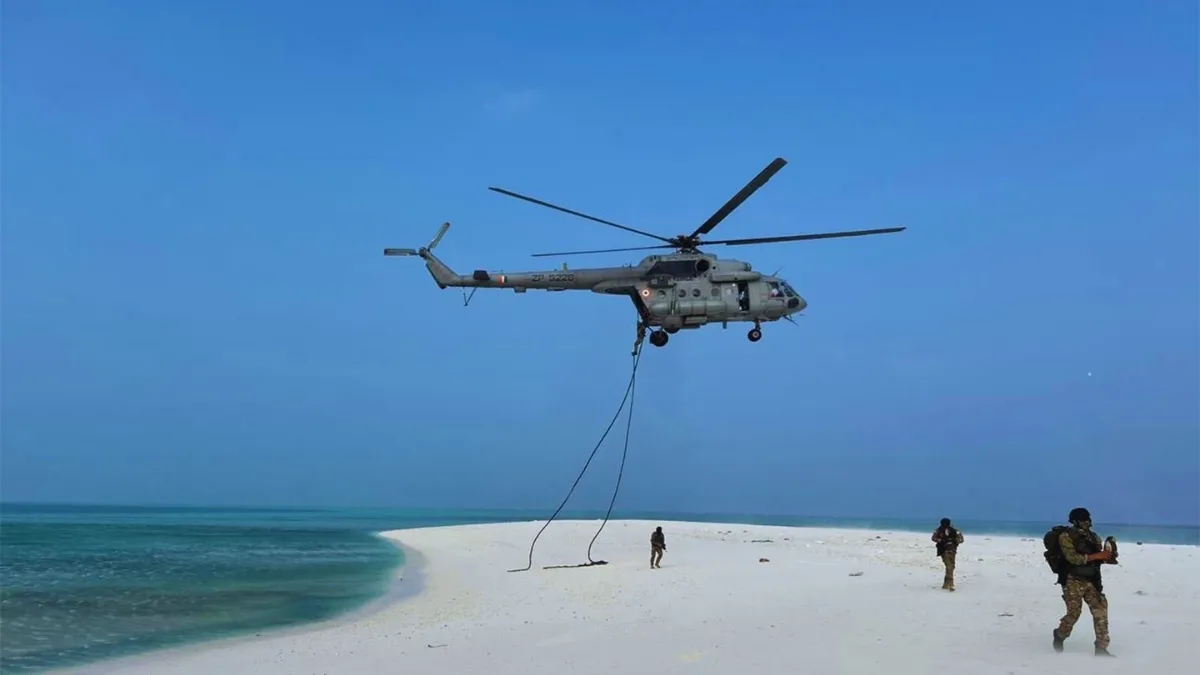
AN-32 & Mi-17V5: Handled airborne and air-landed insertions, ensuring troops and equipment reached remote islands quickly.
-
Dornier 228 (ICG): Acted as the "eyes in the sky" for search and rescue (SAR) and shepherding fighter jets during maritime strikes.
2. Special Operations & Amphibious Assault
The Armed Forces Special Operations Division (AFSOD) played a critical role by executing:
-
Combat Free Fall (CFF): High-altitude parachute jumps to insert elite teams behind simulated enemy lines.
-
Special Heliborne Missions: Using helicopters for rapid deployment in rugged terrain.
-
Amphibious Assaults: Coordinated beach landings in conjunction with Coast Guard Gemini boats.
3. Maritime Security & SAR
The Indian Coast Guard (ICG) provided the naval backbone, deploying ships and specialized Gemini boats to practice anti-ship strikes and maritime search and rescue operations.
Strategic Significance: Why Lakshadweep?
The Lakshadweep and Minicoy islands are situated near major international shipping lanes. The Kalari Leap exercise validates HQ SAC's ability to:
-
Protect Sovereignty: Ensuring a permanent and ready response to any threat in the Arabian Sea.
-
Rapid Force Projection: Proving that India can move significant military power to its furthest outposts in hours, not days.
-
Jointness: Refining the communication and tactical protocols between the IAF and the Coast Guard.
The Bigger Picture: A Season of Drills
Kalari Leap was part of a broader surge in Indian military activity in early 2026, which included:
-
Exercise Vayushakti-26: A massive firepower demonstration at the Pokhran Range.
-
Exercise Agni Varsha: An Indian Army drill in the desert sector focusing on long-range precision fires.
-
Exercise Vajra Prahar: A joint Special Forces drill with the U.S. in Himachal Pradesh.



-1772103995469_t.webp)
Comments
All Comments (0)
Join the conversation