Why Do Most Of The Coconut Trees Grow Along The Seashores?
Do you know why coconut trees grow along the seashores? Their buoyant, waterproof husks allow them to float across oceans to reproduce, while their unique roots easily filter out harsh saltwater. Let's discover the fascinating science behind these coastal survivors.

Coconuts are one of nature's coolest creations. You spot them everywhere: lining postcard beaches, stacked in your local market, even starring in your shampoo. These amazing plants are obsessed with heat and humidity, thriving when temperatures range between 27 and 35 degrees Celsius. But here's something you might not have thought about: why do coconut trees always seem to be hanging out right by the sea? Let's dig into the real reason these trees hug the coastline. Spoiler: it's not just for the scenic views. Nature actually cooked up a genius survival plan, and coconuts are in on the secret.
Why Do Most Of The Coconut Trees Grow Along The Seashore?
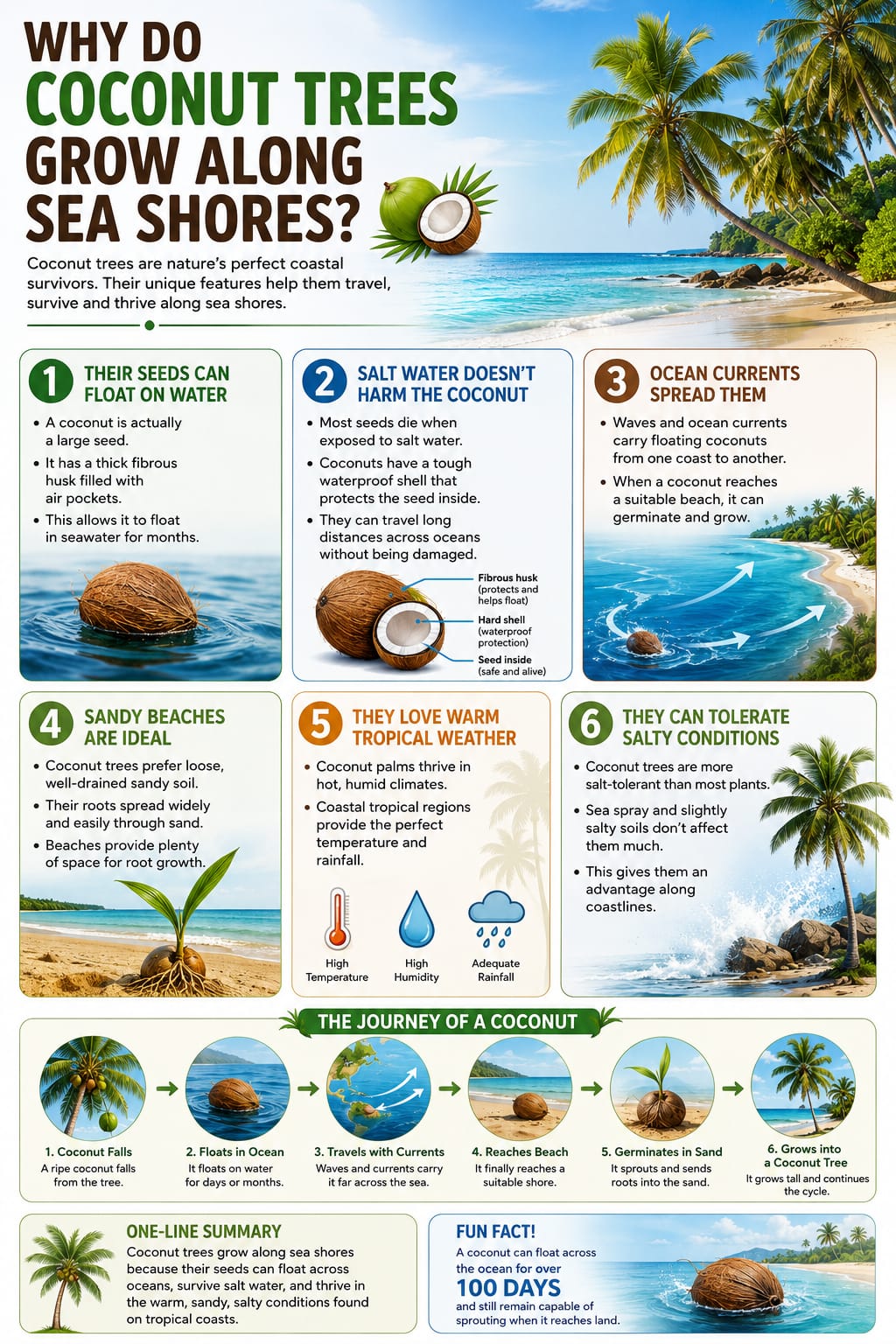
If you walk down a sandy beach, you will almost always see coconut palms leaning gracefully toward the water. It looks like they are posing for a postcard, but there are highly practical reasons for this layout.
First, let us talk about how they reproduce. The coconut itself is actually a giant seed. If a seed falls on regular soil, it stays right there. But a coconut tree uses a clever trick called water dispersal. Coconuts have a thick, fibrous outer layer called a husk, which is filled with air pockets.
This makes the coconut super buoyant, allowing it to float perfectly on saltwater. When a coconut drops off a tree into the ocean, it can float across thousands of miles of water for up to 100 days without spoiling.
Once it washes up on a distant sandy beach, it starts growing roots. This is why they line the coastlines; the ocean is their personal delivery system.
Another big reason is the soil and water structure. Coconut trees love sandy soil because it is highly porous. It allows water to drain away very quickly. If the roots sit in heavy, waterlogged mud, they will rot. Sandy beaches provide the perfect drainage.
Furthermore, these trees are uniquely equipped to handle saltwater. Most plants would wither and die if you gave them salty water because of a process called osmosis, which sucks moisture out of normal roots.
However, coconut palms have a very tough, specialised root system that can filter out excess salt, allowing them to absorb moisture where other trees would die of thirst. They also have a high tolerance for sodium and chlorine, which are found abundantly in coastal areas.
Finally, they love sunlight and open spaces. The seashore offers zero shade from taller jungle trees, meaning the palms get unfiltered, direct sunlight for the entire day. The humid breeze also helps keep the temperature stable, preventing the leaves from drying out too fast.
Coconut Trees Are Mostly Found In Which Places?

While coconut palms can be grown indoors or slightly inland with proper care, they naturally thrive in specific regions around the globe. They are mostly found in the tropical belt, which lies between the Tropic of Cancer and the Tropic of Capricorn. This region provides the constant warmth and high humidity that the trees need to survive.
According to global agricultural reports, over 80% of the world's coconut supply comes from the Asia-Pacific region. The geographical setup of this area, which is full of islands, long coastlines, and peninsulas, makes it an absolute paradise for coastal palms.
Apart from the big Asian producers, you will also find large numbers of coconut trees in coastal areas of Latin America, such as Brazil and Mexico. They also grow extensively across East and West Africa, particularly in countries like Ghana and Tanzania. Essentially, if a country has a hot tropical climate and a sandy coastline, you can expect to see coconut trees growing there.
Which Country Is The Largest Producer Of Coconuts?
The global rankings for coconut production have seen an interesting shift recently. For a long time, Indonesia and the Philippines swapped the top spot. However, official government data from 2026 shows that India has officially taken the lead as the world’s largest producer of coconuts.
According to a report from the Press Information Bureau (PIB) issued in March 2026, India contributes about 30.37% of the total global coconut output. To give you an idea of the sheer scale, the world has about 12,390 thousand hectares of coconut-growing area, and India alone accounts for 2,165.20 thousand hectares of that space.
India produces an astonishing 21,373.62 million nuts every single year. The average productivity in the country is around 9,871 nuts per hectare. Within India, the bulk of this production is concentrated in southern and coastal states.
The top-performing states include Karnataka, Tamil Nadu, Kerala, and Andhra Pradesh. Nearly 30 million people in India depend on this crop for their livelihood, showing just how massive this industry has become.
Which Country Is The Largest Exporter Of Coconuts?
While India leads in raw production, the export market operates a little differently. When it comes to exporting fresh coconuts and value-added products like desiccated coconut, coconut oil, and coir pith, Southeast Asian nations dominate the trade charts.
The Philippines and Indonesia are traditionally the largest exporters of coconut products globally. The Philippines, for example, processes a massive portion of its harvest into coconut oil, generating over $1 billion annually from exports alone. They ship these products to major global markets, including the United States and Europe.
India is also growing fast as an exporter, with its trade volumes increasing at a compound annual growth rate (CAGR) of around 13% over recent years. India exports fresh coconuts and processed goods to more than 140 countries, with major destinations being Vietnam, the United Arab Emirates (UAE), Bangladesh, and the USA.
Which Country Is The Largest Consumer Of Coconut?
When it comes to consumption, the countries that grow the most coconuts also tend to eat and use the most. This is because coconuts are a core ingredient in daily cooking, traditional medicines, and local industries across tropical regions.
Indonesia and India are the largest consumers of coconuts in the world. In India, a massive percentage of the 21 billion nuts produced annually never leaves the country. Instead, they are consumed locally. Fresh coconut water is a highly popular drink across Indian cities, and grated coconut is used daily in coastal cuisines.
Furthermore, a significant portion of the harvest is turned into copra (dried coconut meat) to extract coconut oil, which is used nationwide for cooking and hair care.
Western nations like the United States and various European countries are also rising as major consumers, but they rely heavily on imports to satisfy their growing demand for coconut water and vegan milk alternatives.
Conclusion

To wrap it all up, coconut trees grow along the seashore because it is their natural home. Their floating seeds use the ocean waves to travel, and their roots are specially built to love sandy soil and salty water. Recent data from 2026 confirms that India is now the world's top producer, making up over 30% of global output, while nations like the Philippines lead the export charts. It is amazing how a simple fruit can travel the world's oceans, support millions of farmers, and look so beautiful lining our tropical beaches all at the same time.

Kriti Barua is a skilled digital journalist and communications professional with 4+ years of experience, currently writing for the General Knowledge section at Jagran New Media. She has established herself as a subject matter expert in History, Geography, Trending National and International News, Sports, Science, and Defence, producing clear, reliable, and search-optimised content that connects with readers worldwide.
Kriti holds a BA degree from Delhi University and a one-year diploma in TV Production and Journalism, an academic background that adds research depth and strong storytelling instincts to her writing. Her experience spans brand writing, content marketing, and digital media, giving her a sharp understanding of what makes content both helpful to readers and visible in search.
At Jagran New Media, she applies this expertise to national and international news coverage, query-based articles, and in-depth pieces across her specialist subject areas. Her content is defined by easy language, factual accuracy, strong keyword strategy, and reader-friendly storytelling.


