Difference Between Prime Minister and President of India: Powers, Roles and Key Facts
Difference between the Prime Minister and the President of India is explained with powers, duties, election processes, constitutional provisions, and key facts for UPSC, SSC, and competitive exams.

Difference Between Prime Minister and President of India: Powers, Roles and Key Facts
Key Takeaways
-
The President is the head of the state and a symbol of the whole nation, but most of the real power on paper is used only on the advice of the Prime Minister.
-
The Prime Minister is the head of the government and the one who actually runs the country, makes policies, and leads the Council of Ministers.
-
The President is elected for a fixed term of 5 years, while the Prime Minister stays in office only as long as he or she has the support of the majority in the Lok Sabha.
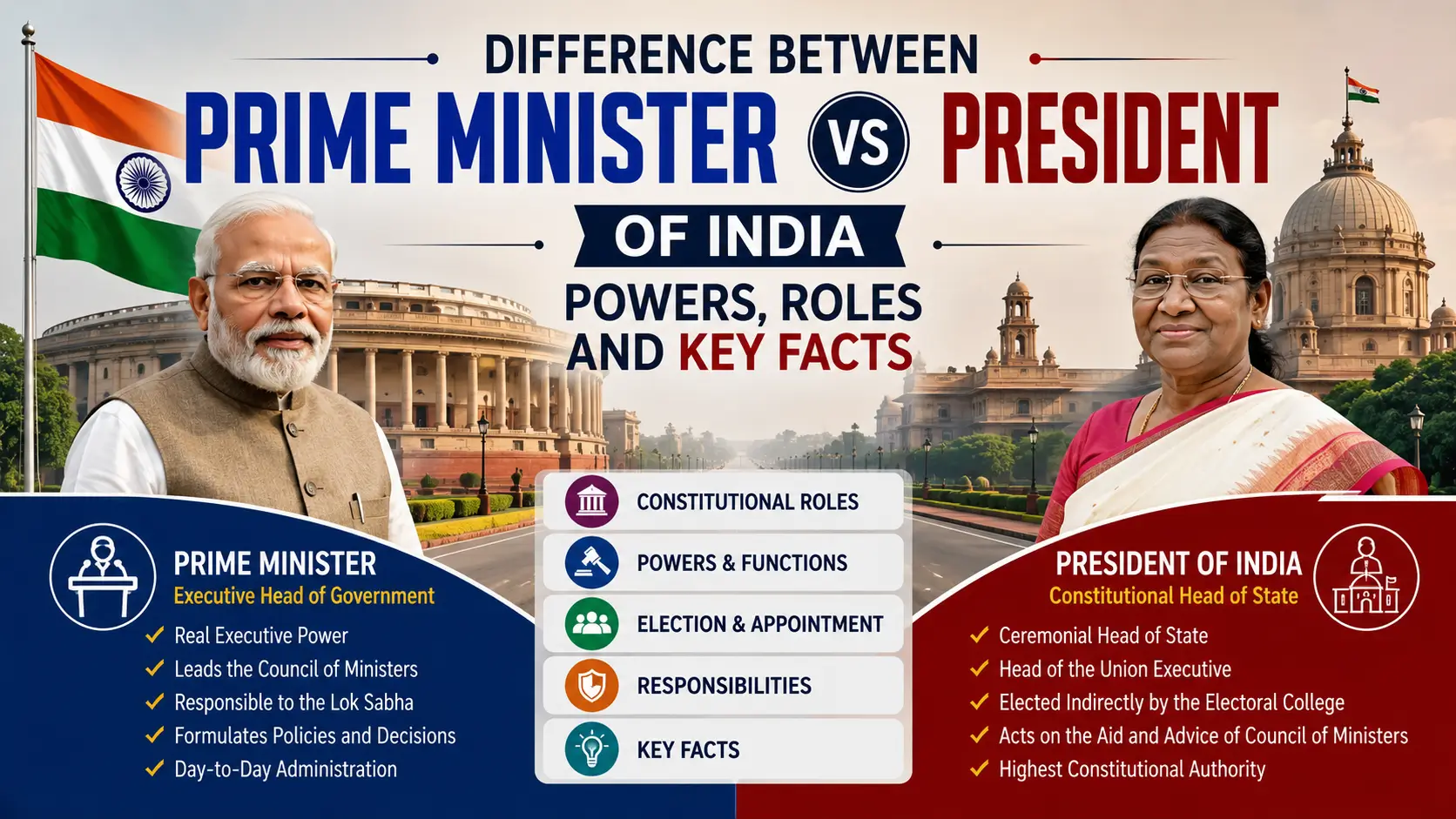
The President of India is the head of the state, whereas the Prime Minister of India is the head of the government. The President is the first citizen of the country and holds this position as honourable in India, while the Prime Minister runs the daily administration and takes the real decisions of the Government of India.
So, the President is the symbolic head of India, and the Prime Minister is the working head.
As of 2026, Smt. Droupadi Murmu is the current President of India, and she was sworn in as the 15th President of India on 25 July, 2022.
As of 2026, Shri Narendra Modi was sworn in as India’s Prime Minister on 30th May 2019, marking the start of his second term in office from 9th June 2024 and serving as the current Prime Minister of India.
So, explore this article, and know who they are, what powers they have, and how they are different from each other.
Who is the President of India?
The President of India is the head of the state. The post of President was created under Article 52 of the Constitution of India, which states that there shall be a President of India. The executive power of the country is officially vested in the President under Article 53, but this power is used by the Prime Minister and the Council of Ministers in real life.
Droupadi Murmu is the current and 15th President of India. She took oath on 25 July 2022 and is the first tribal woman to become President of India. The official residence of the President is Rashtrapati Bhavan in New Delhi.
Quick facts about the President of India
-
The President of India is elected for a term of 5 years.
-
The minimum age to become President of India is 35 years, as per the Article 58.
-
The President is elected indirectly by an Electoral College made up of elected Members of Parliament and elected Members of State Legislative Assemblies, as per Article 54 and Article 55.
-
The President is the Supreme Commander of the Indian Armed Forces.
-
The current monthly salary of the President is ₹5,00,000, fixed under the President's Emoluments and Pension Act, 1951 (last revised in 2018).
Who is the Prime Minister of India?
The Prime Minister of India is the head of the government. The office of the Prime Minister is created under Article 74 and Article 75 of the Constitution. Article 74 says there shall be a Council of Ministers to help and advise the President, with the Prime Minister at its head. Article 75 talks about how the Prime Minister is appointed.
Narendra Modi is the current Prime Minister of India. He took oath for a third term on 9 June 2024, after the 2024 Lok Sabha elections. He first became Prime Minister in May 2014.
Quick facts about the Prime Minister of India
-
The Prime Minister is appointed by the President, but only the leader who can prove majority support in the Lok Sabha is appointed.
-
The Prime Minister does not have a fixed term. He or she stays in office as long as the Lok Sabha has trust in the government, and the normal term of the Lok Sabha is 5 years.
-
The Prime Minister must be a Member of Parliament, either from the Lok Sabha or the Rajya Sabha.
-
The Prime Minister heads the Council of Ministers and runs the central government on a daily basis.
-
The Prime Minister also receives a monthly salary as a Member of Parliament, along with extra allowances given to the Prime Minister, under the Salaries, Allowances and Pension of Members of Parliament Act.
Difference Between Prime Minister and President of India
| Aspects | President of India | Prime Minister of India |
| Position | Head of the State | Head of the Government |
| Current holder (2026) | Droupadi Murmu | Narendra Modi |
| Constitutional Article | Article 52 and Article 53 | Article 74 and Article 75 |
| Type of power | Nominal head, real power lies with the Council of Ministers | Real executive head who runs the government |
| How chosen | Elected indirectly by Members of Parliament and Members of State Assemblies | Appointed by the President after winning the trust of the Lok Sabha |
| Term of office | Fixed term of 5 years | No fixed term, depends on majority support in the Lok Sabha |
| Eligibility | Must be 35 years or older and a citizen of India | Must be a Member of Parliament |
| Role in lawmaking | Gives final assent to bills passed by Parliament | Leads the government and decides government policy |
| Armed Forces | Supreme Commander of the Armed Forces (on paper) | Controls defence decisions through the Council of Ministers |
| Official residence | Rashtrapati Bhavan | Official residence given to the sitting Prime Minister |
| Removal process | Can be removed only through impeachment by Parliament | Loses office if he or she loses majority support in the Lok Sabha |
What is the Powers of the President of India?
The President has many powers on paper, but most of these are used only on the advice of the Prime Minister and the Council of Ministers. The main powers are:
-
Executive powers: All government work is carried out in the name of the President, as per Article 53.
-
Legislative powers: The President calls and ends sessions of Parliament and gives final assent to bills before they become law.
-
Judicial powers: The President can grant pardon, reprieve, or reduce the punishment of a person under Article 72.
-
Military powers: The President is the Supreme Commander of the Indian Armed Forces.
-
Emergency powers: The President can declare a National Emergency, President's Rule in a state, or a Financial Emergency, as given in the Constitution.
-
Appointment powers: The President appoints the Prime Minister, the Governors of states, the Chief Justice of India, and other top officials, mostly on the advice of the Council of Ministers.
What is the Powers of the Prime Minister of India
The Prime Minister is the real head of the executive and holds most of the working power of the government. The main powers are:
-
Head of the Council of Ministers: The Prime Minister chooses ministers and assigns them their departments.
-
Link between President and Cabinet: The Prime Minister communicates all decisions of the Council of Ministers to the President, as mentioned in Article 78.
-
Policy making: The Prime Minister is responsible and leads in the planning and direction of major government policies and schemes making.
-
Leader of the Lok Sabha: The Prime Minister is the leader of the Lok Sabha and the major decision-maker of the majority party, guiding in the Lok Sabha.
-
Chairperson of NITI Aayog: The Prime Minister is also plays an important role like he is also heads Chairperson of the NTI Aayog.
-
Representing India: The Prime Minister represents India in major international meetings and summits.
Why Does India Have Both a President and a Prime Minister?
India follows a parliamentary system of government, which is borrowed from the United Kingdom. As per this, the President is the head of state, which gives stability and represents the unity of the nation.
The Prime Minister acts as the head of the government, who is responsible to the elected Parliament and can be changed if the government loses majority support.
This system keeps the country's top symbolic position separate from day-to-day politics.
Quick Revision Table for Exams
| Term | Meaning |
| Head of State | A position that represents the whole nation. In India, this is the President. |
| Head of Government | A position that runs the actual administration of the country. In India, this is the Prime Minister. |
| Nominal Executive | An authority that has power on paper but does not use it directly. This describes the President. |
| Real Executive | An authority that actually uses executive power. This describes the Prime Minister and the Council of Ministers. |
This topic is commonly asked under GS Paper II (Indian Polity and Governance) in the UPSC Civil Services Examination, and also appears in State PCS exams. Students preparing for these exams should remember the related constitutional articles, which are Article 52, 53, 54, 58 for the President, and Article 74, 75, 78 for the Prime Minister.
Prabhat Mishra is a Subject Matter Expert and digital journalist with an extensive background in the competitive exam landscape and over 4 years of experience in education, national and international news, and current affairs. Over his tenure with top knowledge platforms like Mentorship India, IAS BABA, IAS SARTHI, and now Jagran Josh, he has a deep understanding of government exams like UPSC and State PCS, including UP and Bihar, as he has already qualified for the UPPCS 2022 Mains and Bihar 68th Mains. With his core expertise in history, polity, geography & current affairs, he specialises in creating well-researched, aspirant-centric content and simplifying complex topics for competitive examinations.


