Why are Some Plants Not Green?
Why are Some Plants Not Green? In this article, learn why some plants are not green, how they survive without chlorophyll, examples of non-green plants and why they are important.
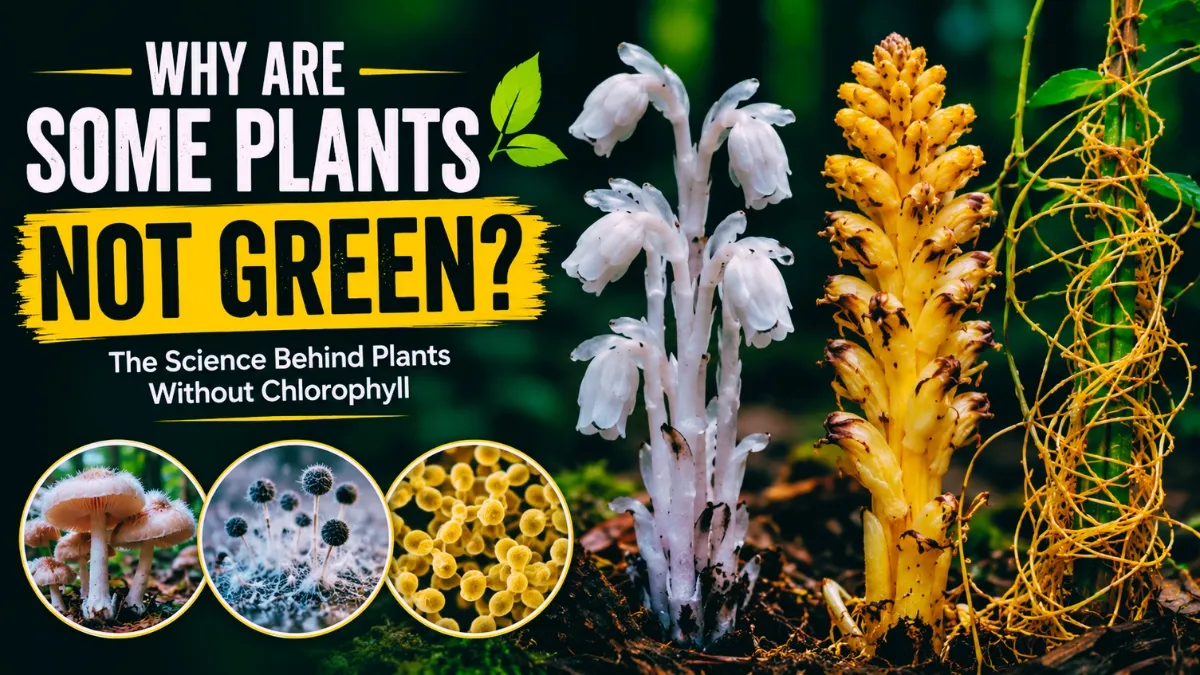
Most plants are green due to the presence of chlorophyll, which assists them in producing their food via the process of photosynthesis.
As per Royal Botanic Gardens, Kew, there exist over 390,000 vascular plant species around the world, out of which many have adapted to peculiar life styles that do not involve photosynthesis.
Some plants are not green because of the absence of chlorophyll in them or due to very low levels of this pigment in them.
Therefore, such plants resort to other methods for nutrition. This proves that nature possesses diverse survival strategies.
Why are Some Plants Not Green?
Some plants do not have any green color in them since they lack chlorophyll, which is a green pigment necessary for the process of photosynthesis.
Instead of synthesizing their own food through photosynthesis using sunlight, they rely on fungi, dead organic materials, or other plants for nutrients.
The lack of chlorophyll in some plants is an evolutionary process whereby these plants have adapted to specific environments.
Some of these plants live in dense forests with little or no light at all, whereas others have developed certain symbiotic and parasitic relations that make them thrive without having to synthesize food.
List of Non Green Plants
Plants that are not green have various ways in which they get energy. Some of them consume dead organic material, others take nutrients from other plants, and others get nourishment from fungi present in the soil.
Though fungi are not categorized under the plant kingdom anymore, they are commonly studied together with non-green plants in botany classes.
| Type | Example | How They Obtain Food |
| Fungi and Fungi-like Organisms | Mushrooms | Feed on dead and decaying organic matter |
| Fungi and Fungi-like Organisms | Molds and Yeasts | Decompose organic material and absorb nutrients |
| Parasitic Plant | Indian Pipe (Monotropa uniflora) | Receives nutrients indirectly through fungi connected to tree roots |
| Parasitic Plant | Dodder (Cuscuta) | Wraps around host plants and absorbs water and nutrients |
| Mycoheterotroph | Various forest species | Depend completely on mycorrhizal fungi for carbon and minerals |
The fungi group that includes mushrooms, molds, and yeasts lack chlorophyll and hence cannot carry out photosynthesis.
Some parasitic plants like the Indian Pipe and Dodder species have evolved to lose all their chlorophyll content.
Mycoheterotrophs are the most unique plants on earth as they depend upon the symbiotic association with underground fungi for survival.
How Do Non-Green Plants Survive Without Photosynthesis?
Non-Green plants depend on getting nutrition from outside sources since they cannot produce their own.
Some feed on decomposing substances, while others are parasites whose survival depends on feeding directly on the water and food from other live plants.
However, there are some plants which form associations with fungi, and the fungi link to trees nearby.
These fungi transfer carbon compounds and nutrients to these plants; thus, these plants can exist in thick forests where light does not favor photosynthesis.
Why Are Non-Green Plants Important?
Non-green plants are rare in nature, but they have significant importance for healthy ecosystems since they provide an opportunity for scientists to study plant evolution, nutrient cycles, and the complex interactions between plants and fungi.
Besides, these plants increase biodiversity and serve as examples of adaptation to environmental conditions by various organisms.
Learning about these plants increases knowledge about ecology and gives students an understanding that plants may differ in their survival mechanisms.
Conclusion
Plants may not be green because they do not contain chlorophyll and are unable to carry out photosynthesis. Thus, these plants live using the energy obtained from fungi, dead organic matter, and other plants.

Alisha Louis is a US content specialist with over 3 years of experience in journalism and storytelling. A graduate with a Bachelor’s degree in Journalism and Mass Communication (BJMC), Alisha has focused her career on covering trending news and major educational developments across the United States. Her sharp eye for detail, combined with a strong journalistic point of view, helps her break down complex American educational topics into accessible, engaging narratives for a global audience. Dedicated to delivering timely and trustworthy reporting, she brings a fresh and insightful perspective to the evolving US academic landscape.


