With the US-Iran-Israel war intensifying as of late April 2026, the crisis has entered its ninth week. The closure of the Strait of Hormuz has triggered a huge energy supply crisis. With a naval blockade of the Strait of Hormuz, the situation remains critical for the world energy market.
During the peaceful times, the Strait handled 20 per cent of the world's oil and gas, including 20 million barrels of oil per day. To tackle the shortage of fuel and energy due to the Strait blockade, countries in the Middle East are exploring alternative routes to shipping oil.
Meanwhile, 8 OPEC members, including major producers like Saudi Arabia, the UAE, and Iraq, agreed to increase oil production once the Strait of Hormuz becomes accessible. OPEC in April 2026 said it will raise oil production quotas by 206,000 barrels per day.
International Relations MCQs on OPEC Members, Trade Corridors, and Oil Pipelines
Q1. Consider the following statements:
1. The Druzhba pipeline is one of the largest pipelines in the world.
2. The Druzhba Pipeline is also known as the Friendship Pipeline.
3. It was built in the 1960s to supply oil from the USSR to countries in Europe.
Which of the following statements is/are correct?
i. Statement 1 only
ii. Statement 2 only
iii Statement 3 only
iv. All of the three statements
Answer: iv. All of the three statements
Explanation: The Druzhba pipeline is world's largest and most critical pipelines in the world. "Druzhba" is the Russian word for "friendship". The construction of the Druzhba pipeline began in the early 1960s. It was specifically designed to transport crude oil from the USSR (now Russia) to countries in Central and Eastern Europe, including Poland, Hungary, Slovakia, the Czech Republic, and Germany.
Q2. Which of the following statements is/are correct?
1. The Sumed pipeline is a strategic route for Persian Gulf oil and natural gas shipments to Europe.
Statement-II: Sumed pipeline connects the Red Sea with the Mediterranean Sea.
Which one of the following is correct in respect of the above statements?
i. Both Statement-I and Statement-II are correct, and Statement-II explains Statement-I
ii. Both Statemnt-I and Statement-II are correct, and Statement-II does not explain Statement-I
iii. Statement-I is correct, but Statement-II is incorrect
iv. Statement-I is incorrect, but Statement-II is correct
Answer: i. Both Statement-I and Statement-II are correct, and Statement-II explains Statement-I
Explanation: The SUMED pipeline (Suez-Mediterranean pipeline) is a critical oil pipeline in Egypt connecting the Red Sea to the Mediterranean Sea, with a capacity of over 2.5 million barrels per day.
Q3. Consider the following pipelines:
a. Saudi East-West Pipeline
b. UAE Abu Dhabi Crude Oil Pipeline
c. SUMED Pipeline
d. None of the these
Which of the following pipelines bypass the Strait of Hormuz?
i. Only a
ii. a and b
iii. Only c
iv. Only d
Answer: ii. a and b
Explanation: The Saudi East-West Pipeline (Petroline) extends from Saudi Arabia’s eastern oil fields to the Red Sea port of Yanbu. It is a critical lifeline capable of transporting approximately 7 million barrels of oil per day (bpd). UAE Abu Dhabi Crude Oil Pipeline (ADCOP) connects the Habshan oil field to the port of Fujairah on the Gulf of Oman, allowing exports to bypass the Hormuz chokepoint completely. It has a capacity of 1.5–1.8 million bpd.
Q4. Launched at the 2023 G20 Summit, this is a direct strategic alternative to China's BRI.
a. International North-South Transport Corridor
b. India-Middle East-Europe Economic Corridor (IMEC)
c. Bangladesh-China-India-Myanmar Economic Corridor
d. Chennai–Vladivostok Maritime Corridor
Answer: b. India-Middle East-Europe Economic Corridor (IMEC)
Explanation: The India-Middle East-Europe Economic Corridor (IMEC) was launched at the G20 Leaders’ Summit in New Delhi on 9 September 2023. It aims to connect India to Europe via ship-to-rail links across the Middle East (via UAE, Saudi Arabia, Jordan, and Israel). Its key signatories include India, the United States, Saudi Arabia, the United Arab Emirates (UAE), France, Germany, Italy, and the European Union.
Q5. With reference to India's projects on connectivity, consider the following Statements:
1. The East-West Corridor under Golden Quadrilateral Project connects Dibrugarh and Surat.
2. The Trilateral Highway connects Moreh in Manipur and Chiang Mai in Thailand via Myanmar.
3. The Bangladesh-China-India-Myanmar Economic Corridor connects Varanasi in Uttar Pradesh with Kunmig in China.
How many of the above statements are correct?
i. Only one
ii. Only two
iii. All three
iv. None
Answer: iv. None
Explanation: The East-West Corridor under Golden Quadrilateral Project connects Silchar in Assam to Porbandar in Gujarat, not Dibrugarh and Surat. The Trilateral Highway connects Moreh in Manipur, India, with Mae Sot in Thailand, via Myanmar, not Chiang Mai. The Bangladesh-China-India-Myanmar Economic Corridor connects Kolkata, West Bengal, with with Kunmig in China, not Varanasi in Uttar Pradesh with Kunmig in China.
Q6. Which corridor enhances India's access to Central Asia through Chabahar port?
a. International North-South Transport Corridor
b. East-West Corridor
c. Bangladesh-China-India-Myanmar Economic Corridor
d. India-Middle East-Europe Economic Corridor (IMEC)
Answer: a. International North-South Transport Corridor
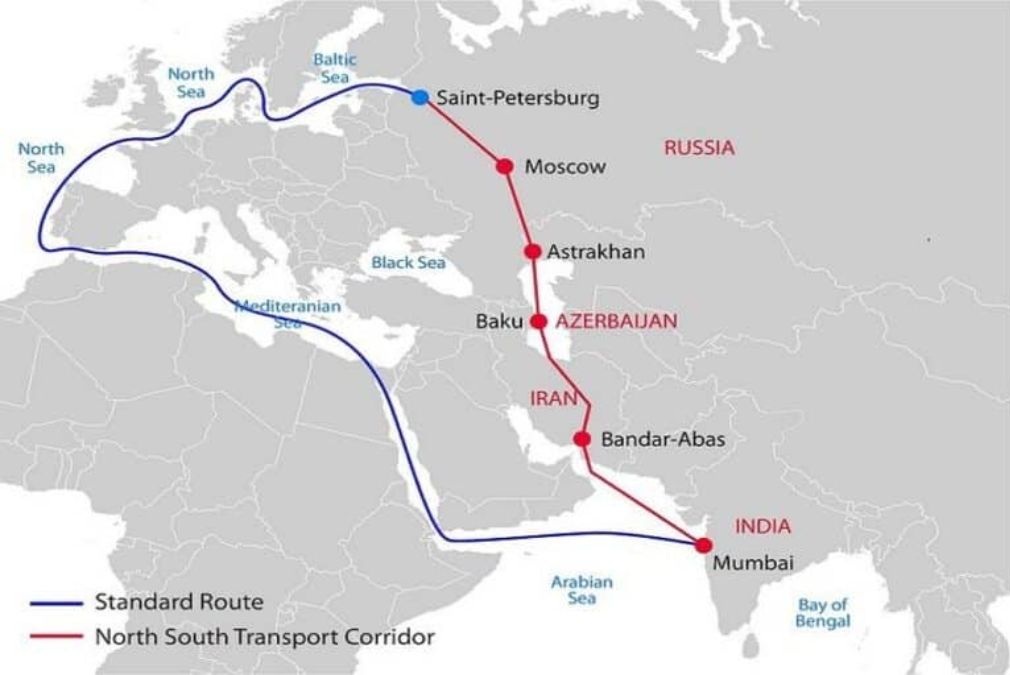
Explanation: The International North-South Transport Corridor (INSTC) is the key project that enhances India's access to Central Asia to Europe through the Chabahar Port in Iran. This multi-modal network connects India to Russia, Iran, and Central Asia via sea, rail, and road.
Q7. With reference to the International North-South Transport Corridor, consider the following statements:
1. The International North-South Transport Corridor is a multi-modal route, including sea and road routes.
2. It connects India to Russia via Iran.
3. The INSTC reduces time and cost by up to 30 to 40 per cent.
Which of the following statements is/are correct?
i. Only 1
ii. Only 2 and 3
iii. All of the above.
Answer: ii. Only 2 and 3
Explanation: Statement I is incorrect, because the International North-South Transport Corridor is a multi-modal route, including sea, road, and also rail routes.
Q8. How many countries are members of the OPEC as of April 2026?
a. 10
b. 18
c. 12
d. 20
Answer: c. 12
Explanation: As of April 2026, the Organization of the Petroleum Exporting Countries (OPEC) has 12 member countries. Iran, Iraq, Kuwait, Saudi Arabia, and Venezuela are known as the Founder Members. Current 12 OPEC members are: Algeria, Congo, Equatorial Guinea, Gabon, Iran, Iraq, Kuwait, Libya, Nigeria, Saudi Arabia, United Arab Emirates (UAE), and Venezuela.
Q9. With reference to the Organisation of the Petroleum Exporting Countries Plus (OPEC+), consider the following statements:
1. OPEC+ is led by the United States.
2. OPEC+ includes non-OPEC oil-producing countries.
3. When OPEC+ decides to cut oil production, oil prices tend to decrease.
Which of the statements is/are correct?
a. Only 1
b. Only 2
c. Both 1 and 3
d. None
Answer: b. Only 2
Explanation: OPEC+ (OPEC Plus) is an alliance formed in late 2016 between the 13 core members of OPEC and 10–11 non-OPEC oil-producing countries. Hence, Statement 1 and 3 are incorrect. OPEC+ is not led by the United States. It is led by Saudi Arabia (representing OPEC) and Russia (representing the non-OPEC allies. When OPEC+ decides to cut oil production, global oil prices tend to increase, not decrease.
Q10. Which of the following country is NOT an OPEC member?
a. Iran
b. Libya
c. Qatar
d. Venezuela
Answer: c. Qatar
Explanation: Qatar withdrew from OPEC in 2019 to focus on natural gas production.