-1777116813191.webp)
River deltas have been the cradles of civilization for millennia to provide fertile soil and vital waterways. Among these geographical marvels, one stands supreme in scale and ecological importance but which river forms the largest delta in the world? The largest delta is formed when combined forces of the Ganges and Brahmaputra rivers create a sprawling network of waterways that meet the sea in a spectacular display of nature's power.
Which River Forms the Largest Delta in the World?
The largest delta in the world is the Ganges-Brahmaputra Delta often called the Ganges Delta or the Sundarbans Delta. This "Green Delta" is the result of three major river systems converging:
-
The Ganges (Ganga): Flowing from the Himalayas through India.
-
The Brahmaputra: Originating in Tibet and flowing through India and Bangladesh.
-
The Meghna: Joining the combined flow before emptying into the ocean.
The Ganga, Brahmaputra and Meghana together discharge a massive volume of water and sediment, second only to the Amazon River system.
-1777118476834.jpg)
Where Is the Ganges-Brahmaputra Delta Located?
The delta is situated in the Bengal region, spanning the country of Bangladesh and the Indian state of West Bengal.
-
Total Area: Approximately 105,000 km2 (41,000sq miles).
-
Distribution: About 67% of the delta lies within Bangladesh, while the remaining 33% is in India, stretching from the Hooghly River in the west to the Meghna River in the east.
Which Countries Share the Largest Delta?
The Ganges-Brahmaputra Delta is a transboundary geographical feature and famously known as the Sundarbans Delta which is very famous for its rich biodiversity and the world's largest mangrove forest and a UNESCO World Heritage site. The delta is primaryly shared by
- India: Specifically the state of West Bengal near Hugly river and Bay of Bengal Region.
- Bangladesh: Comprising nearly 80% of the nation's total landmass over the largest delta in the world.
Rivers from Bhutan, Tibet, and Nepal also drain into this system from the north, making it a vital ecological zone for the entire South Asian region.
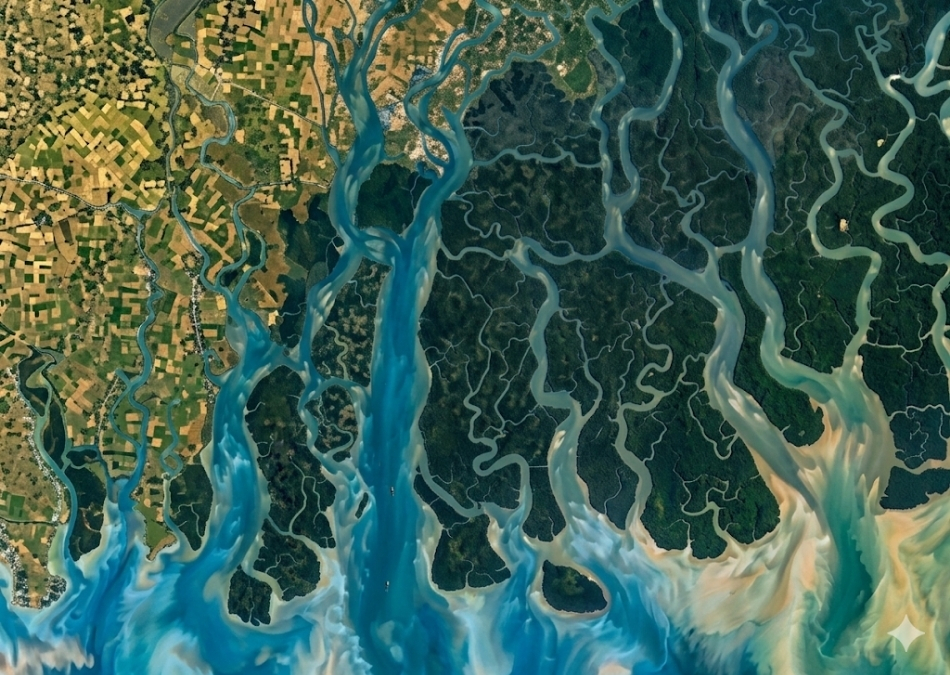
Acute Delta formed by Ganga River
Top 10 Largest Deltas in the World
While the Ganges-Brahmaputra formed the largest delta in the worlod followed by Amazon river here is how it ranks against other global giants by approximate area:
| Rank | Delta Name | Primary River(s) | Area (Approx. km2) |
| 1 | Ganges-Brahmaputra | Ganges, Brahmaputra | 105,000 |
| 2 | Amazon | Amazon | 67,000 |
| 3 | Mekong | Mekong | 40,000 |
| 4 | Lena | Lena | 30,000 |
| 5 | Mississippi | Mississippi | 28,500 |
| 6 | Irrawaddy | Irrawaddy | 20,500 |
| 7 | Volga | Volga | 19,000 |
| 8 | Niger | Niger | 12,000 |
| 9 | Orinoco | Orinoco | 11,000 |
| 10 | Nile | Nile | 10,000 |
How Does it Compare to the Nile or Mississippi Deltas?
The Nile Delta is historically famous and highly fertile, but at roughly $10,000 km2 , it is ten times smaller than the Ganges Delta. The Mississippi Delta is famous for its "bird’s foot" shape although economically vital to the US, it is significantly smaller and currently faces rapid land loss, unlike the Ganges Delta, which continues to receive massive sediment loads despite sea-level rise threats.
Also Read: Which is the Largest Source of Greenhouse Gases in the World ?