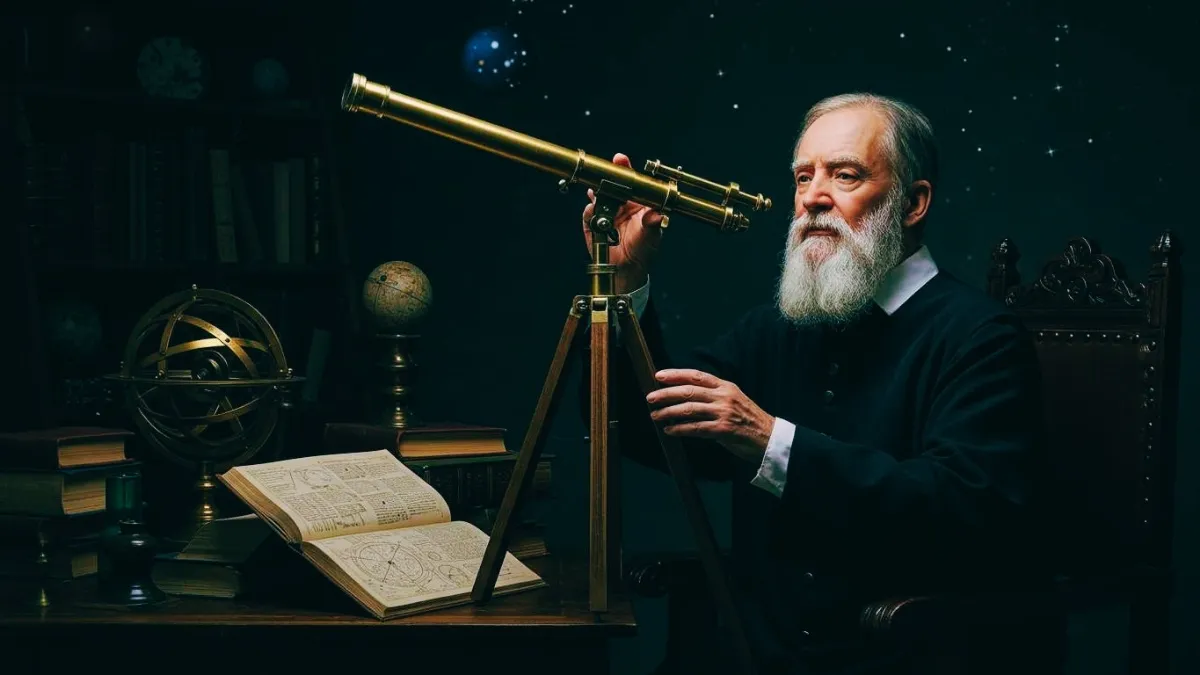
Who is known as the Father of Modern Science? Galileo Galilei holds this prestigious title for revolutionizing how we understand the universe through experiments and observations.
His work laid the foundation for today's science, influencing everything from space missions to smartphone tech.
According to NASA, Galileo's 1610 telescope observations of Jupiter's moons provided the first clear evidence supporting the heliocentric model, shifting humanity's view of our place in the cosmos. This breakthrough ignited the scientific revolution.
Who is Known as the Father of Modern Science?
Galileo Galilei is widely recognized as the Father of Modern Science. Born in 1564 in Pisa, Italy, he transformed scientific thinking by emphasizing observation, math, and experiments over ancient theories.
Galileo earned this honor through pioneering methods that prioritize evidence. Historians from the Royal Society credit him with bridging medieval ideas and modern inquiry, making science empirical and testable for everyone.
Galileo started as a medical student but switched to math and physics. By age 25, he was a professor, inventing tools like the military compass. His big shift came with the telescope in 1609.
Why is Galilei Galileo Known as the Father of Modern Science?
Galileo Galilei is called the Father of Modern Science because he pioneered the scientific method—observing, hypothesizing, experimenting, and verifying with math. He ditched blind faith in old texts like Aristotle's, proving ideas through evidence.
He championed "book of nature" reading via experiments, not just books. The American Physical Society highlights his 1632 "Dialogue" as a game-changer, blending physics and astronomy to support Copernicus' sun-centered solar system. This evidence-driven approach defines modern science today.
Key reasons include:
-
Telescope innovations: Improved Dutch designs 20x, spotting Milky Way stars and lunar craters.
-
Jupiter's moons: Discovered four in 1610, proving not everything orbits Earth.
-
Physics laws: Dropped objects from Pisa's tower (legend says) to show gravity accelerates all equally, ignoring weight.
These challenged Church views, leading to his 1633 trial.
Yet, he whispered, "Eppur si muove"—"And yet it moves"—defending Earth’s motion.
Galileo Galilei's Key Discoveries and Contributions
Galileo’s inventions and findings reshaped science forever. From pendulums to planets, his work sparked the scientific revolution.
Using simple tools, he provided data-backed proofs in astronomy and physics. UNESCO recognizes his pendulum clock idea as foundational for precise timekeeping in navigation and medicine, impacting daily life even now.
Breakdown of major contributions:
-
Astronomy breakthroughs: Mapped sunspots, Venus phases (heliocentrism proof), and Saturn's rings (early glimpses).
-
Motion studies: Defined inertia in "Two New Sciences" (1638)—objects keep moving unless stopped, precursor to Newton's laws.
-
Hydrostatic balance: Weighed objects in water, advancing engineering.
| Discovery | Year | Impact |
| Jupiter's moons | 1610 | Supported solar system model |
| Pendulum motion | 1581 | Basis for clocks and heart rate studies |
| Falling bodies | 1600s | Gravity laws without air resistance |
His books, like "Sidereus Nuncius" (Starry Messenger), spread ideas via prints.
Despite house arrest, his methods inspired Newton, Kepler, and beyond.
Galileo died in 1642, but his spirit fueled the Enlightenment.
Conclusion
Galileo Galilei is known as the Father of Modern Science for inventing the evidence-based approach we use today—from telescopes revealing cosmic truths to experiments proving physics laws. His bold push against dogma made science accessible and revolutionary. Explore his story to appreciate how one man's curiosity powers our world.