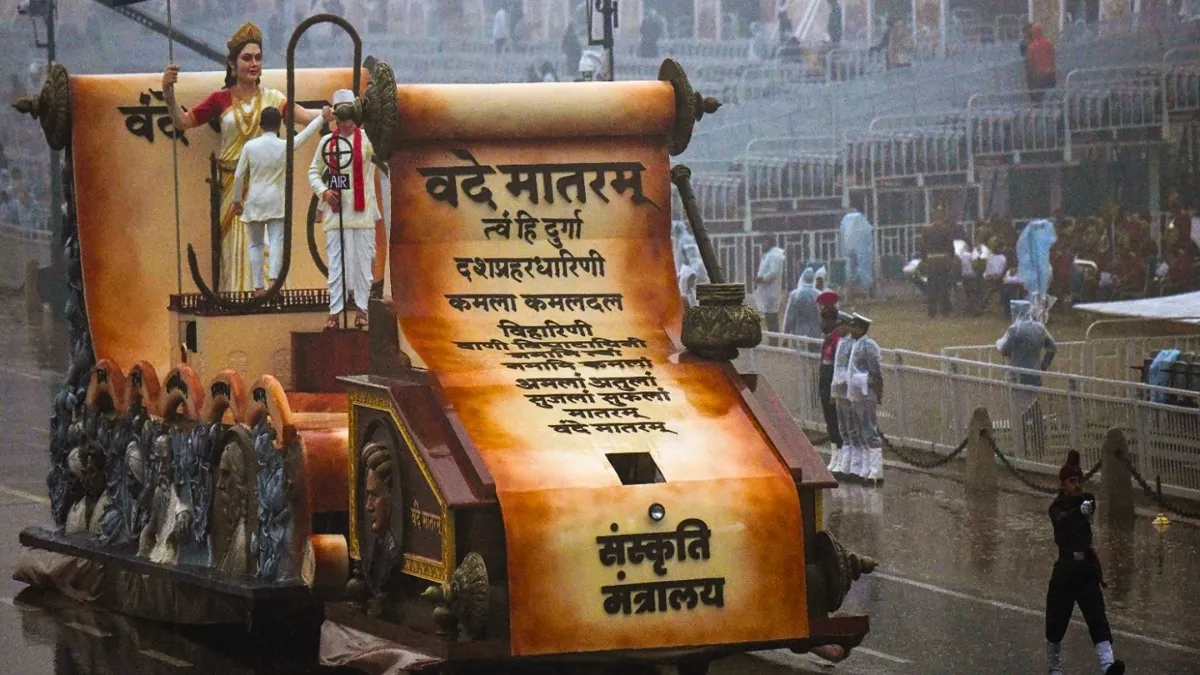
Union Ministry of Home Affairs issued the new guidelines that all six stanzas of the National Song Vande Matatam written by Bankim Chandra Chattopadhyay shall be sung first when the national Song and National Anthem Jan Gana Man are scheduled to be played/sung together and requires all persons to stand up when ‘Vande Mataram’ is played.
Key Highlights of the New MHA Guidelines
According to the The Ministry of Home Affairs periodically reviews the protocols surrounding national honors to ensure the dignity of the nation. The key highlights includes:
Mandatory Sequence: In any formal ceremony where both the National Song and the National Anthem are featured Vande Mataram (3 minute 10 Seconds) must be performed first followed by Jana Gana Mana.
Full Rendition: the new guidelines mandate the singing of all six stanzas of the poem unlike previous practices where often only the first two stanzas were sung.
Standardized Protocol: The guidelines aim to bring uniformity across all government departments, educational institutions, and public sector undertakings during state functions and national holidays.
Preservation of Spirit National Song: The guidelines emphasize that the performance must maintain the "utmost dignity and solemnity" befitting the symbols of Indian independence, and requires all persons to stand up when ‘Vande Mataram’ is played.
Historical Significance of Vande Mataram
Vande Mataram (meaning "I bow to thee, Mother") was composed by Bankim Chandra Chattopadhyay in the 1870s. It was later included in his 1882 novel, Anandamath. Vande Mataram was sung at the 1896 Calcutta session of the Congress by Rabindranath Tagore.
-
'Vande Mataram' was first used as a political slogan on August 7, 1905, during the Anti-Partition and the Swadeshi movements in Bengal.
-
In 1905, at the Varanasi Session of the Indian National Congress, the song 'Vande Mataram' was adopted for all-India occasions.
-
Vande Mataram was also sung by Bande Mataram Sampradaya in the Prabhat Pheris during the partition of Bengal to promote the concept of the Motherland as a mission.
-
On 20 May 1906, in Barisal (now in Bangladesh), over ten thousand participants, both Hindus and Muslims, marched through the main streets carrying Vande Mataram flags to spread the message of self-reliance, unity, and political consciousness.
-
In August 1906, an English daily titled Bande Mataram was launched under the editorship of Bipin Chandra Pal, with Sri Aurobindo later joining as joint editor.
-
On 27 February 1908, Coral Mills in Tuticorin (Tamil Nadu) went on strike. They marched through the streets chanting 'Vande Mataram' as a mark of protest and patriotism.
-
In June 1908, thousands gathered outside the Bombay police court during Lokmanya Tilak’s trial, singing Vande Mataram in a powerful display of solidarity.
What were the Important Stanzas of Vande Mataram Dropped?
The original poem was written by Bankim Chandra Chatterjee, from which the national song was adopted by the Constitutional Assembly on January 24, 1950, which included six stanzas, with the later verses referencing Hindu goddesses such as Lakshmi and Durga. In the 1937 Faizabad session of the Indian National Congress, only the first two stanzas of the poem were adopted for public use.
The Union Home Ministry has issued new guidelines for the National Song, Vande Mataram. It mandates singing all six stanzas, and crucially, Vande Mataram must precede Jana Gana Mana if both are performed. The directives aim for uniformity across institutions, emphasizing dignity and requiring standing during its rendition. This updates previous practices where often only two stanzas were sung, reinforcing the song's historical significance.



-1769068084167.jpg)

Comments
All Comments (0)
Join the conversation