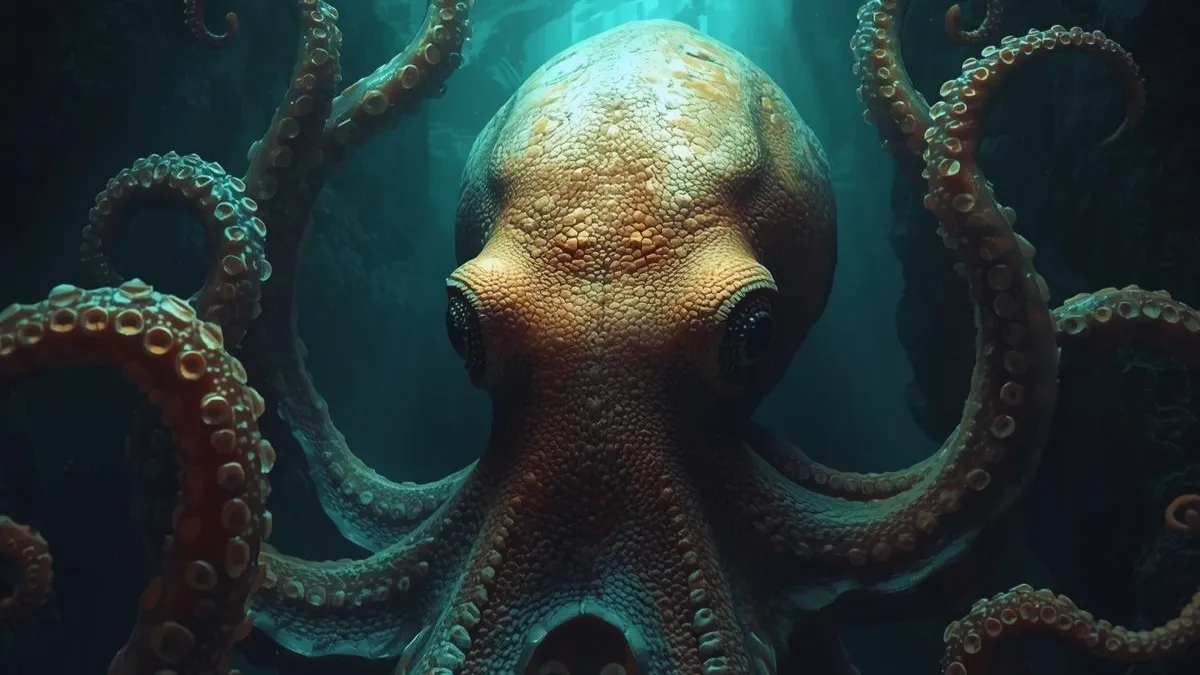
World’s Oldest Octopus: Octopuses are among the most intelligent and mysterious creatures in the ocean. Known for their ability to camouflage, solve puzzles, and escape tight spaces, these soft-bodied animals have fascinated scientists for decades. Scientists have found the fossils of the oldest octopus, dating back nearly 330 million years.
However, a recent scientific study has brought octopuses back into the spotlight revealing that their evolutionary history may be far older than previously believed.
The discovery of a fossil once mistaken for another marine creature has now been identified as the oldest known octopus ancestor, pushing their origins back hundreds of millions of years. This finding not only reshapes marine biology but also raises an interesting question—which is the oldest octopus in the world?
Which is the Oldest Octopus in the World?
The oldest octopus in the world is not a living individual but a fossil ancestor known as Pohlsepia Mazonensis belongs to the Syllipsimopodus bideni family recognised a oldest octopus species in the Guinness world records, scientists, dating back around 330 million years to the Carboniferous period.
The fossil was initially misidentified as a type of ancient nautilus shell. However, recent research has revealed that it actually belongs to an early octopus-like cephalopod, making it the earliest known octopus relative ever discovered.
Previously known octopus fossils were about 296 million years old. The new discovery pushes the timeline back by over 30 million years which means octopuses evolved much earlier than scientists had assumed.
What is the oldest octopus fossil ever discovered?
The recent 2022 study on Syllipsimopodus bideni the 330-million-year-old fossil changed the history books by pushing back to history and proved that octopuses are 82 million years older than previously thought, meaning they predated dinosaurs. and the new ancestor named as Pohlsepia Mazonensis which belongs to the Syllipsimopodus bideni family.
The 10-Arm Origin, this ancestor had 10 arms unlike modern 8-armed octopuses which confirms they evolved from the same lineage as squid but eventually lost two arms to become more specialized.
The discovery of the new Octopus Syllipsimopodus bideni focuses on internal evolution which showed a gladius a thin internal shell. This proves that octopuses moved their shells from the outside to the inside much earlier than expected to become faster, more flexible hunters.
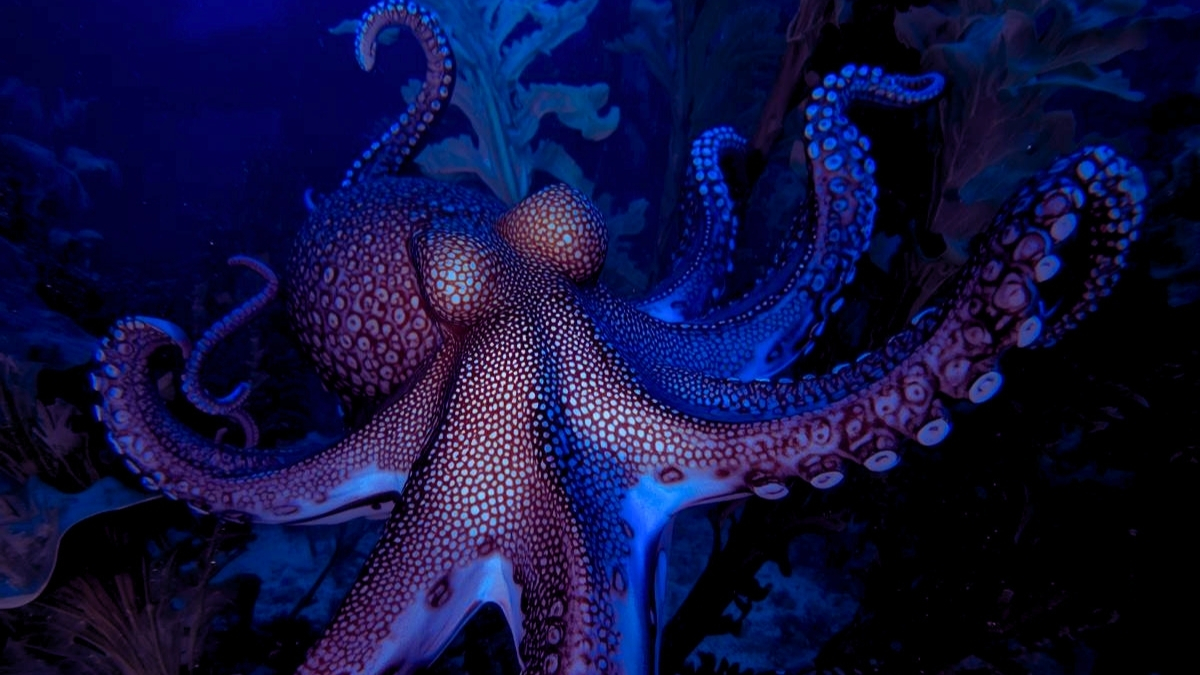
What is the Lifespan of the Oldest Octopus in the World?
While the fossil represents the oldest known octopus lineage, modern octopuses are surprisingly short-lived creatures.
Average Lifespan of Octopus:
-
Most octopus species: 1–2 years
-
Some larger species: 3–5 years
Why is their lifespan so short?
-
They are semelparous and die after reproduction.
-
Rapid growth but no long-term survival strategy
-
High metabolic rate
Which Octopus Species Lives the Longest in the World?
No octopus species is known to live beyond a few years, making their ancient evolutionary history even more fascinating. Among living species, the longest-living octopus is believed to be:
- Giant Pacific Octopus (Enteroctopus dofleini): The famous Giant Pacific Octopus, one of the largest species, lives only around 3–5 years, making them far from long-lived compared to other marine animals. It is a habitat to North Pacific Ocean known for intelligence and size
- Deep-Sea Octopus Species: Some deep-sea species may live slightly longer due to cold environments slowing metabolism However, research is still ongoing.
Amazing Facts About the Oldest Octopus in the World
Octopuses are essentially the closest thing we have to "alien" intelligence on Earth. Their biology is so radically different from ours that scientists often use them as a model for how extraterrestrial life might function. Here is the following amazing facts about the Octopus includes:
- Nine Brains: Octopus have a central brain, but two-thirds of their neurons are actually located in their arms.
- Independent Thinking: Each arm can "think" for itself tasting, touching, and moving to grab food without waiting for instructions from the head.
- Chromatophores: These are tiny, muscular pigment sacs. By contracting or relaxing these muscles, they can change patterns in milliseconds.
- Papillae: They can also change their skin texture to mimic jagged rocks or smooth sand by manipulating tiny bumps on their skin.
- Blue Blood: Their blood is copper-based (hemocyanin), which is more efficient at transporting oxygen in cold, low-oxygen water.
- Triple Threat: They have three hearts. Two pump blood to the gills, while the third pumps it to the rest of the body. Interestingly, the main heart stops beating when the octopus swims, which is why they prefer crawling, swimming literally exhausts them.
- The Veined Octopus: This species is known to collect discarded coconut shells or seashells, carry them around, and assemble them into a mobile fortress when they feel threatened.
- Regeneration: Unlike many animals that grow back a scar-tissue version of a limb, an octopus can perfectly regenerate a lost arm, including all the complex nerves and suckers, with no loss of function.



-1775913062772_t.webp)

Comments
All Comments (0)
Join the conversation