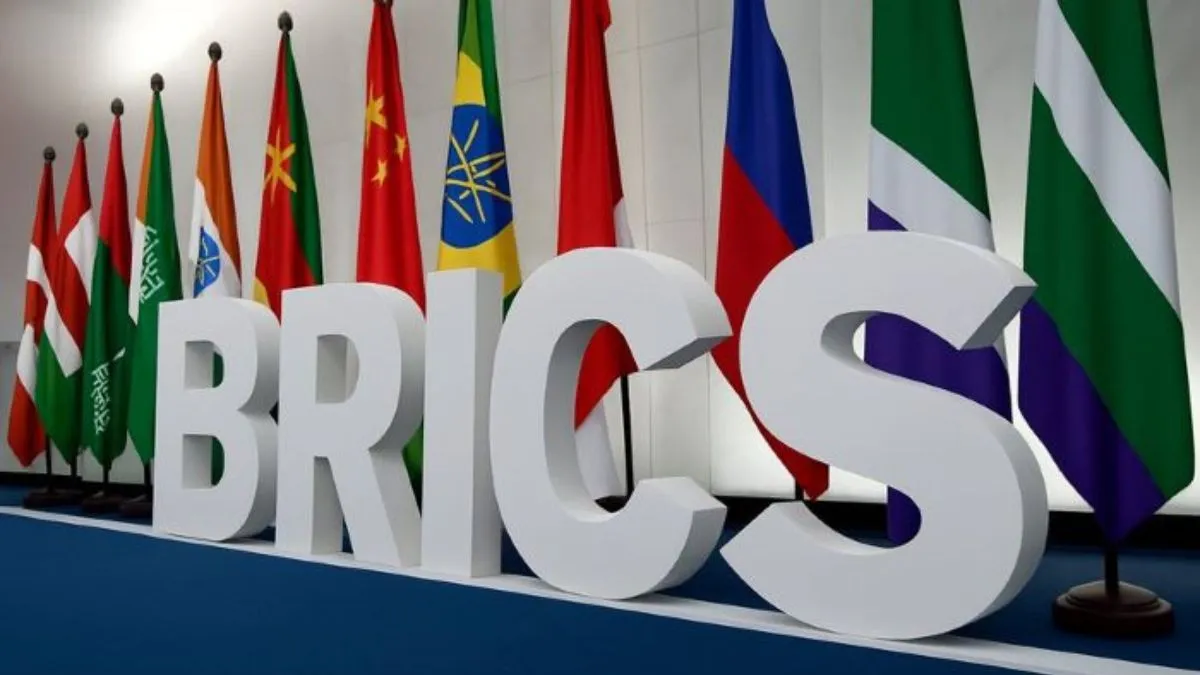
International organisations such as the G7, SCO, UNGA, G20, BRICS, and many others are often in the news where the global leaders gather to negotiate geopolitical, economic, and security issues. No nation can solve global issues alone. These international groupings are tasked with providing solutions to climate change, energy transition, regional security and stability, public health, humanitarian aid, tech governance, and a lot more.
As students of international relations, law, and economics, as well as professionals in policymaking, it is crucial to understand and learn about these international groupings and organisations for analysing how nations conduct global affairs. In this article, we have 10 international relations multiple-choice questions (MCQs) covering G20, QUAD, BRICS, and SCO.
International Relations MCQs on G20, QUAD, BRICS, and SCO
1. Consider the following statements about G20:
- The G-20 group was originally established as a platform for the finance ministers and central bank governors to discuss international economic and financial issues.
- Digital public infrastructure is one of India’s G-20 priorities.
Which of the statements given above is/are correct?
(a) i only
(b) ii only
(c) Both i and ii
(d) Neither i nor ii
Answer: (c) Both i and ii
Explanation:
Statement i is correct. The G20 wad founded after the Asian financial crisis as a forum for the finance ministers and central bank governors to discuss global economic and financial issues.
Statement ii is correct. Under India's G20 Presidency (2022-2023), Digital Public Infrastructure (DPI) was a core priority. India showcased its own digital systems like UPI, Aadhaar, and DigiLocker at G20.
2. Consider the following countries:
i. Ethiopia
ii. Nigeria
iii. Egypt
iv. UAE
How many of the above are full-time members of BRICS?
(a) One
(b) Two
(c) Three
(d) All four
Answer: (c) Three
Explanation: Ethiopia, Egypt, and the UAE are full-time members of BRICS, while Nigeria is not. Following a major expansion of BRICS in 2024, Ethiopia, Egypt, and the UAE became full-time members from 1 January 2024.
3. When was the first QUAD Summit held?
(a) 2012
(b) 2017
(c) 2020
(d) 2021
Answer: (d) 2021
Explanation: The first QUAD Leaders Summit was hosted virtually by the US due to the COVID-19 pandemic. QUAD is a four-nation alliance of India, Australia, USA, and Japan which was established in 2007 and revived in 2017.
4. In which one of the following groups are all the four countries members of G20?
(a) Argentina, Mexico, South Africa and Turkey
(b) Australia, Canada, Malaysia and New Zealand
(c) Brazil, Iran, Saudi Arabia and Vietnam
(d) Indonesia, Japan, Singapore and South Korea
Answer: (a) Argentina, Mexico, South Africa, and Turkey
Explanation: The G20 is an international forum for global economic cooperation that originally consisted of 19 individual countries and the European Union; as of 2023, the African Union is also a permanent member.
5. In September 2021, which country became a full member of Shanghai Cooperation Organisation (SCO)?
(a) Iran
(b) Russia
(c) Syria
(d) Pakistan
Answer: (a) Iran
Explanation: Iran became a permanent member of Shanghai Cooperation Organisation (SCO) in September 2021. The country obtained observer status in the SCO in June 2005, and in 2008, applied for full membership. Iran's permanent membership was approved during the 21st meeting of the Council of Heads of State of SCO held in Dushanbe, Tajikistan.
6. Consider the following statements regarding "QUAD grouping":
- United States, Australia, India, and Japan are members of QUAD.
- QUAD stands for the Quadrilateral Security Dialogue.
- QUAD focuses on the Indo-Pacific region.
Which of the statements given above is/are correct?
(a) i only
(b) ii only
(c) iii only
(d) i, ii, and iii
Answer: (d) i, ii, and iii
Explanation:
Statement i is correct. The United States, Australia, India, and Japan are the members of QUAD.
Statement ii is correct. QUAD stands for the Quadrilateral Security Dialogue.
Statement iii is correct. The QUAD focused on promoting a free, open and inclusive Indo-Pacific region, primarily focusing on issues like maritime security, climate change, technology, and balancing China's growing influence in the region.
7. The ‘Fortaleza Declaration’ is related to the affairs of:
(a) ASEAN
(b) BRICS
(c) OECD
(d) WTO
Answer:
Explanation:
8. With reference to the Shanghai Cooperation Organisation (SCO), consider the following statements:
- It is an intergovernment regional organisation focusing on security, political stability, economic cooperation, and culture exchange.
- The official language of the SCO Secretariat is Russian and Chinese.
- The headquarters of the SCO is located in Moscow, Russia.
- The Regional Anti-Terrorist Structure (RATS), the second permanent body of SCO, is headquarted in Tashkent, Uzbekistan.
Which of the following statements is/are correct?
(a) i only
(b) i and iv only
(c) iii only
(d) i, ii, and iv only
Answer: (d) i, ii, and iv only
Explanation:
Statement i is correct. The SCO is an Eurasian intergovernment alliance aimed at strengthenging political, economic, and security. Founded in 2001 in Shanghai by the leaders of China, Kazakhstan, Kyrgyzstan, Russia, Tajikstan, and Uzbekistan.
Statement ii is correct. The official languages of the SCO are Russian and Chinese.
Statement iii is incorrect. The headquarters of the SCO is located in Beijing, China, not Moscow.
Statement iv is correct. The Regional Anti-Terrorist Structure (RATS), the second permanent body of SCO, is headquarted in Tashkent, Uzbekistan.
9. The 16th BRICS Summit was held under the chairmanship of ____.
(a) Russia
(b) India
(c) South Africa
(d) Brazil
Answer: (a) Russia
Explanation: The 16th BRICS Summit took place in Kazan, Russia, from 22 to 24 October, 2024, under the Russian chairmanship. It was the first summit after the group's major expansion (BRICS+) in early 2024.
10. In which year was the G20 founded?
(a) 1960
(b) 2000
(c) 1990
(d) 1999
Answer: (d) 1999
Explanation: G20 was established in 1999. In the wake of the late-1990s Asian financial crisis, G20 was formed as a forum for Finance Ministers and Central Bank Governors. In 2008, it was elevated to a leaders' summit to address and financial crisis and promote international financial stability. The G20 does not have a permanent headquarters or secretariat. Instead, it operates through a rotating presidency.



-1775913062772_t.webp)
Comments
All Comments (0)
Join the conversation