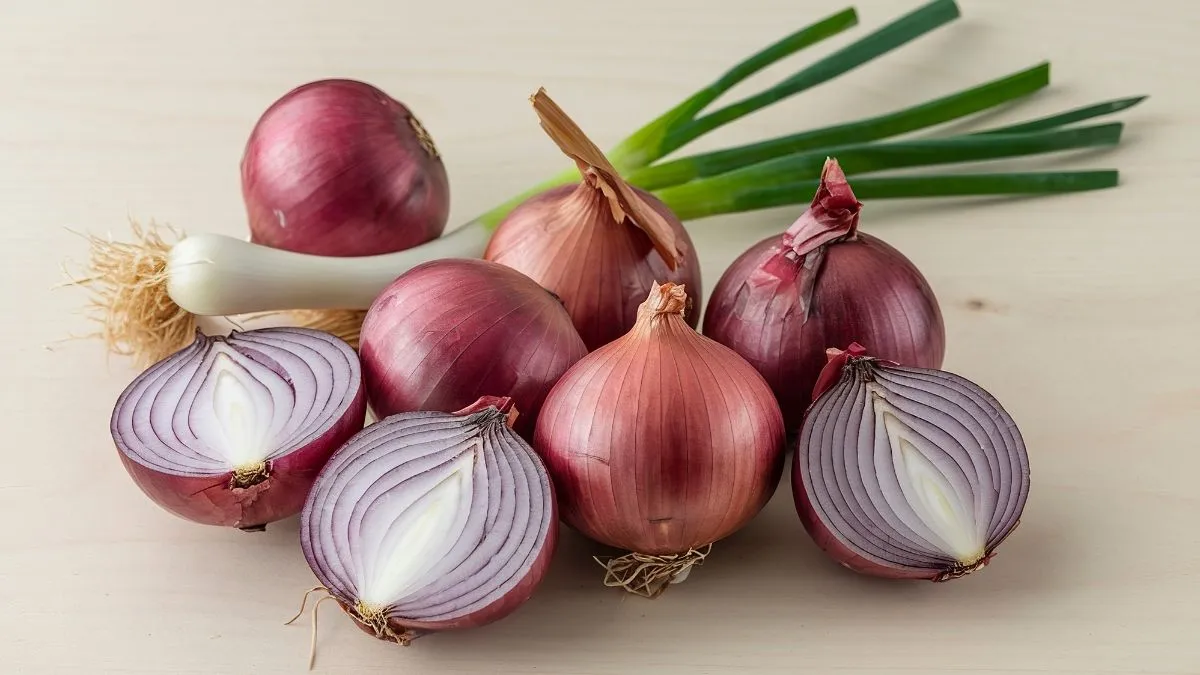
The onion is probably the most useful vegetable in the world, but it also has a complicated biological identity. The Food and Agriculture Organization (FAO) says that the world grows more than 100 million tons of onions every year. This shows that onions are an important crop for food security.
Students who want to take competitive exams need to know the scientific name of onion for biology and agriculture papers. The scientific name for the onion puts it in a group of plants that also includes garlic and leeks.
The strong smell and layered structure are what make it so. This article clearly and expertly explains how onions and their family are classified in the taxonomic system.
What is the Scientific Name of Onion?
The scientific name of an onion is Allium cepa. In botanical nomenclature, the first part, Allium, represents the genus, while cepa refers to the specific species. It belongs to the Amaryllidaceae family.
This naming convention helps scientists and horticulturists worldwide identify the common bulb onion regardless of regional language barriers, ensuring precision in agricultural research and trade.
Classification of Onion and Its Family
The taxonomic classification of onion is rooted in the monocotyledonous group of flowering plants. It is part of the subfamily Allioideae. While Allium cepa is the most common variety, the genus contains several other species used for medicinal and culinary purposes across the globe.
Taxonomic Hierarchy of Onion
| Rank | Name |
| Kingdom | Plantae |
| Division | Magnoliophyta |
| Class | Liliopsida |
| Order | Asparagales |
| Family | Amaryllidaceae |
| Genus | Allium |
| Species | A. cepa |
Family of Onions and Their Scientific Names
| Common Name | Scientific Name | Primary Region | Conservation Status |
| Common Onion | Allium cepa | Global | Cultivated |
| Garlic | Allium sativum | Central Asia/Global | Cultivated |
| Chives | Allium schoenoprasum | Europe, Asia, N. America | Least Concern |
| Leek | Allium ampeloprasum | Mediterranean | Cultivated |
Also Read - What is the Scientific Name of Wheat?
5 Facts about Origin and History of Onions
Tracing the roots of the onion takes us back thousands of years. While wild ancestors are nearly extinct, their legacy remains documented in ancient history:
-
Central Asian Roots: Most botanists agree that onions originated in Central Asia, specifically in regions spanning modern-day Iran and West Pakistan.
-
Ancient Egyptian Reverence: In Ancient Egypt, onions were worshipped as symbols of eternal life due to their anatomy of circles within circles, and were often buried with Pharaohs.
-
Medicinal Staple: During the Middle Ages, onions were so highly valued that they were used to pay rent and were prescribed by early doctors to treat headaches and snakebites.
-
Global Travel: Onions were one of the first crops to be transported to the Americas by Christopher Columbus, eventually becoming a staple in Native American diets.
-
Wild Relatives: While Allium cepa is known only in cultivation, its closest wild relatives are still found in the mountain ranges of Central Asia, according to the USDA.
Check Out - What is the Scientific Name of Coriander?
Understanding the scientific name of onion provides a gateway into the massive world of plant taxonomy. From its origins in the heart of Asia to its current status as a global dietary essential, Allium cepa continues to be a subject of intense agricultural study. Recent genomic sequencing of the onion has even paved the way for developing more disease-resistant varieties to ensure future food stability.



-1775923716537_t.webp)
Comments
All Comments (0)
Join the conversation