Key Points
- Dust storms from W. India transport bacteria to Himalayas, posing health risks.
- Pre-monsoon winds carry dust, depositing microbes onto Himalayan ecosystems.
- Dust contains pathogens causing respiratory, skin, and gastrointestinal issues.
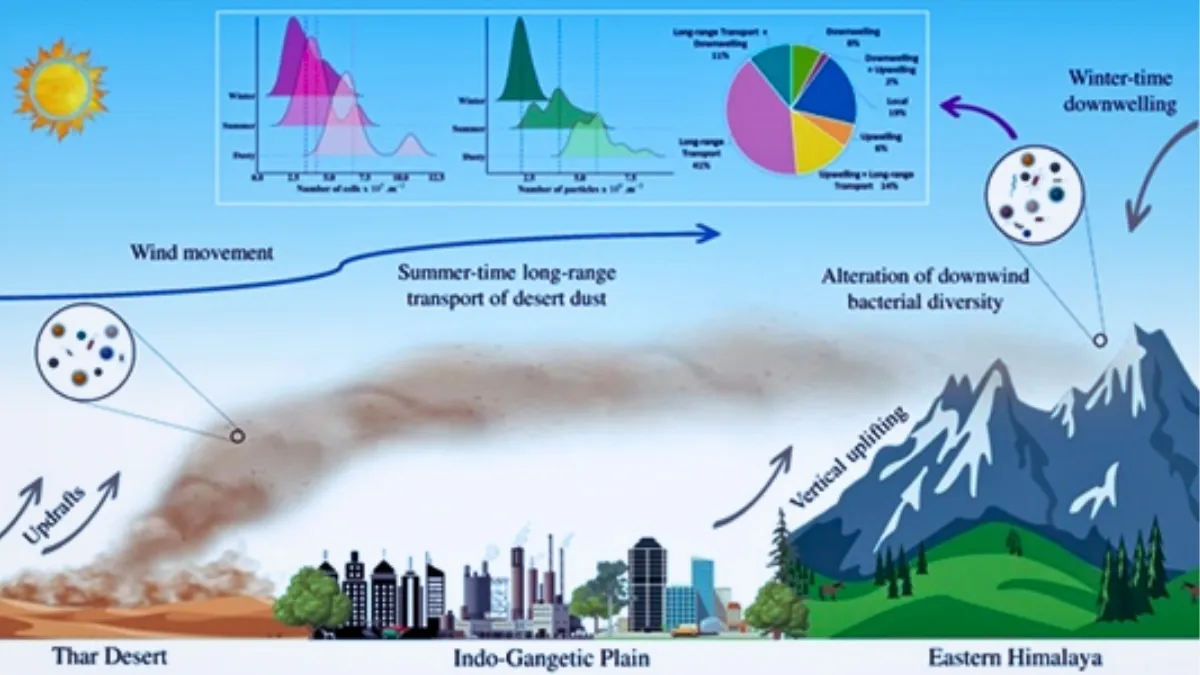
Scientists from the Bose institute under the Department of Science and technology, have uncovered dust storms or Transboundary Dust Transport that originated from arid or semi arid regions of Western India travel across the Indo-Gangetic Plains before setting over Himalayan Hilltops carrying bacteria including disease causing pathogens.
What is Desert Bacteria?
Desert bacteria refer to a diverse group of microorganisms which include bacteria, fungi, and viruses that have evolved to survive in extreme situations in arid environments of the Thar Desert in Western India. These microbes are resilient can survive in the intense UV radiation, extreme temperature and lack of water in the desert, they often form spores or protective coatings when heavy winds sweep across the desert floor, these microorganisms become airborne, attaching themselves to fine dust particles (aerosols) that can remain suspended in the atmosphere for days and allowing the microbes to survive long-distance travel through the upper atmosphere.
Why is it Travelling Toward the Himalayas?
- During pre-monsoon and summer months The Indo-Gangetic Conveyor Belt found powerful dust storms (often called Andhi) originating in Western India and the Middle East which helped the particle move toward the Himalayan region.
- Dust particles are picked up by prevailing westerly winds. As they travel across the Indo-Gangetic Plains, they gather additional pollutants and moisture.
- During the summer air warm masses hit the high-altitude wall of the Himalayas, the air cools and the dust settles (dry deposition) or falls with rain and snow (wet deposition). This effectively "dumps" the desert microbes onto the Himalayan ecosystem.
Also Read: What is ''Mother of All Deals’’? India-EU Free Trade Agreement
How is it Posing Health Risks?
The study highlighted by Bose Institute, these dust plumes act as a "bio-aerosol" transport system for pathogens while many desert microbes are harmless which poses significant risks to the local populations in high-altitude regions who are not naturally adapted to these foreign microbes.
1. Respiratory Illnesses: The dust particles like PM2.5 and PM10 are small enough to be inhaled deep into the lungs when these particles are "loaded" with bacteria, they can trigger asthma, bronchitis, and chronic obstructive pulmonary disease (COPD), especially in vulnerable communities with limited healthcare access.
2. Skin Infections: As the dust settles on clothing and skin, certain fungal and bacterial strains can cause dermatological issues, ranging from simple rashes to more persistent fungal infections.
3. Gastrointestinal Issues: The Himalayas are the "water towers" of Asia when dust settles on glaciers and into water streams, the embedded pathogens can contaminate the primary water sources for local communities which can cause stomach and intestinal infections among residents who mostly rely on untreated spring or stream water.
4. Antibiotic Resistance: the presence of Antibiotic-Resistant Genes (ARGs) in these airborne bacteria that have the ability to survive in harsh environments. These bacteria often carry genes that resist common medicines. If these genes transfer to local microbial populations, it could make common infections much harder to treat in the future.
5. Environmental Vulnerability: Himalayan populations already live in conditions of Hypoxia (low oxygen) and extreme cold. These factors naturally stress the respiratory system, making it more susceptible to infections carried by the dust.
Also Read: What is PANCHAM Chatbot?
What are the Safety precautions
The safety precautions for residents or tourists visiting the Himalayas during the dust storm Pre-Monsoon season (typically March to June)
-
Use an N95 or N99 respirator Mask which is designed to filter out the PM2.5 and PM 10 particles that these bacteria use as transport.
-
Monitor Air Quality before heading out, check satellite-based air quality indices. If "Aerosol Optical Depth" (AOD) is high or visibility is hazy, stay indoors.
-
Cover Up, wear long sleeves, trousers, and hats to minimize the surface area of skin exposed to settling dust.
-
Fine dust can cause severe irritation and bacterial conjunctivitis. Use wraparound sunglasses or airtight goggles rather than standard spectacles.
-
After being outdoors during a dusty day, shower and change clothes immediately to remove any "hitchhiking" microbes from your skin and hair.
-
Dust settling on glaciers and in open streams can contaminate "pure" mountain water. Always boil or UV-treat water before drinking.
-
Ensure that local water tanks and traditional dhara (spring) collection points are covered to prevent dry deposition of dust.
-
If you have a respiratory condition, keep your inhalers and prescribed medications ready during the pre-monsoon months.
-
Children and Elderly are at higher risk for the specific "pathogen cocktails" identified in the study. Limit their outdoor playtime during visible dust events.
Types of Pathogens & Symptoms Table
| Pathogen Type | Specific Strain/Genus | Common Symptoms & Risks | Primary Source |
| Respiratory | Klebsiella pneumoniae | High fever, chills, cough with yellow/bloody mucus (pneumonia), shortness of breath. | Foothill upwelling & dust plumes |
| Respiratory | Aspergillus fumigatus (Fungi) | Wheezing, chest pain, and "fungus balls" in lungs of vulnerable people. | Desert dust transport |
| Skin | Staphylococcus aureus | Red, swollen, and painful skin bumps, impetigo, and abscesses. | Desert dust (Long-range) |
| Skin / General | Corynebacterium | Skin lesions or ulcers; can also cause upper respiratory tract inflammation. | Desert dust (Long-range) |
| Gastrointestinal | Acinetobacter | Diarrhea, vomiting, and stomach pain (if water source is contaminated). | Dust settling in water |
| Multi-Infection | Pseudomonas | Ear infections, skin rashes ("hot tub folliculitis"), and respiratory issues. | Local/Regional mixing |
Source: dst
Also Read: EPFO 3.0: New UPI Withdrawal, Easy PF Acess & Other Details
-1764828864392.jpg)


Comments
All Comments (0)
Join the conversation