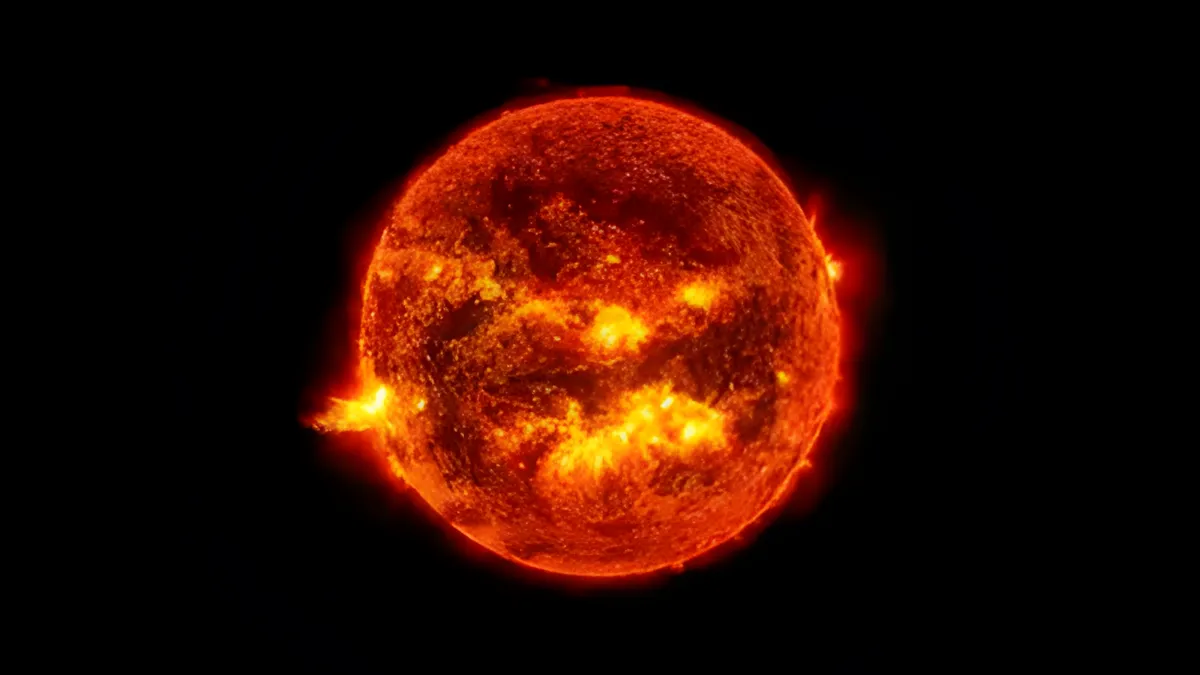
The strongest solar eruption of the year was an X8.3-class solar flare released by the Sun on February 1, 2026, by the active sunspot region 4366.
This experience is one of the events in a 20-plus M-class, multiple X-class flare barrage in 24 hours which highlights the heightening activity of Solar Cycle 25.
What Are Solar Flares?
Solar flares are bursts of energy that occur on the surface of the sun when the strands of magnetic fields in the sunspots break and rejoin.
They shoot radiation, primarily X-rays and ultraviolet light, at almost the speed of light, and it takes 8 minutes to reach the earth and ionize the upper atmosphere.
Coronal mass ejections (CMEs) are often accompanied by flares, which are billion-ton clouds of plasma that may also cause additional disruption to space weather.
Solar Flare Classification
The classification of the flares by peaking X-ray intensity (1-8 Angstrom wavelength) measured by GOES satellites is done in a logarithmic scale: A<B<C<M<X, where each letter is 10 times stronger and numbers 1.0-9.9+.
| Class | Peak Flux (W/m²) | Strength Example |
| A | 10⁻⁷ | Minor |
| B | 10⁻⁶ | 10x A |
| C | 10⁻⁵ | 10x B |
| M | 10⁻⁴ | Moderate |
| X1 | 10⁻³ | Major; X8.3 = 8.3x X1 |
X-class flares like X8.3 are rare and potent, exceeding many historical events.
What is the X8.3 Flare Event?
The birth of region 4366 (beta-gamma-delta magnetic class, 1100 millionths solar hemisphere) was very rapid and created the X8.3 flare with its maximum at 23:57 UTC (6.57 p.m. ET) on February 1.
It was the most prolific place of Cycle 25, in the 18+ M-flares and 3-4 X-flares (including X1.0, X2.8, X1.6). It is still facing Earth till February 4 and it is unstable.
Effects and Impacts
The radio blackouts caused by the flare were R3 (strong) in the South Pacific, the eastern region of Australia and New Zealand because of ionizing the ionosphere and scrambling the HF signals.
CMEs related to them would probably watch the sun February 5, predict G1 aurora, satellite hazards, and mid-latitude auroras, no large grid threats anticipated.
Surveillance and Authoritative Resources
Warnings messages issued using GOES/SDO data by NOAA SWPC and images gathered by NASA Solar Dynamics Observatory.
Flares, CMEs and forecasts flare updates Track flares, CMEs, forecasts Track updates at swpc.noaa.gov.
The X8.3 flare points to the volatility of Solar Cycle 25, with a maximum in 2026, and reminds of the importance of space weather awareness of tech infrastructure. The monitors that have been verified will give timely warnings as the activity continues.




Comments
All Comments (0)
Join the conversation