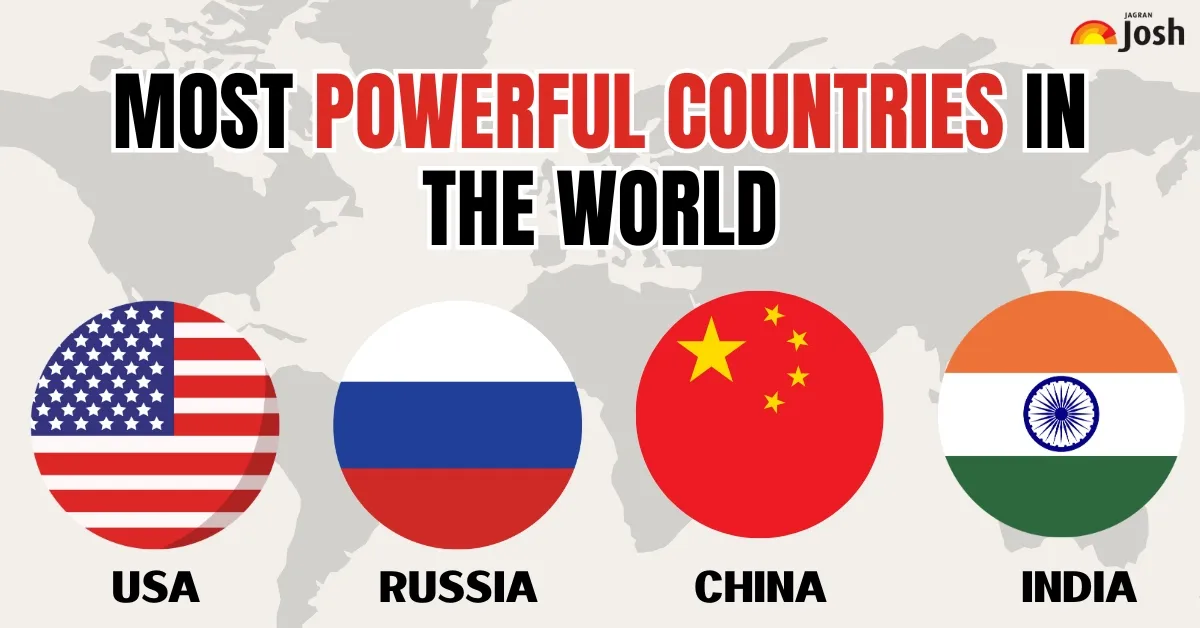
Did you know that the most powerful country in the world isn't only defined by military strength? Power comes from a combination of military strength, economic influence, and the ability to shape global events.
As of 2026, the United States is seen as the most powerful nation in the world by military strength. This view comes from more than just its large military forces.
The U.S. has the world’s largest economy, innovative technologies, and a global network of strategic partnerships that give it significant influence on the world stage.
However, which country ranks 2nd or 3rd? Want to find out? In this article, we will take a closer look at the most powerful countries in the world today.
ALSO READ| Which is the Most Powerful Military Alliance In The World?
Global Firepower 2026: Most Powerful Countries in the World
Here's the list of the most powerful countries in the world in 2026, which includes major players such as the United States, China, and Russia. The table has been compiled from the data provided by the Global Fire Index and USA News.
The index is calculated using over 60 factors, such as manpower, equipment, natural resources, finances, and geography. These countries possess significant military, economic, and political influence on a global scale. The list includes:
| Rank | Country | PwrIndx Score | GDP (USD) | GDP per Capita (PPP) | Population |
| 1 | United States | 0.0741 | $27.4 trillion | $81,695 | 335 million |
| 2 | Russia | 0.0791 | $2.02 trillion | $44,104 | 144 million |
| 3 | China | 0.0919 | $17.8 trillion | $24,558 | 1.41 billion |
| 4 | India | 0.1346 | $3.55 trillion | $10,176 | 1.43 billion |
| 5 | South Korea | 0.1642 | $1.71 trillion | $54,033 | 51.7 million |
| 6 | France | 0.1798 | $3.03 trillion | $61,157 | 68.2 million |
| 7 | Japan | 0.1876 | $4.21 trillion | $50,207 | 125 million |
| 8 | United Kingdom | 0.1881 | $3.34 trillion | $58,906 | 68.4 million |
| 9 | Türkiye | 0.1975 | $1.11 trillion | $44,151 | 85.3 million |
| 10 | Italy | 0.2211 | $2.25 trillion | $58,755 | 58.8 million |
1. United States of America

- Capital: Washington, D.C.
- Region: North America
- Population: 334,914,895
- Area: 9,833,517 sq. km
The United States remains the world's most powerful military in 2026. It keeps its top spot with a Power Index (PwrIndx) score of 0.0741.
This dominance comes from a defence budget of $831.5 billion and a total force of 2.13 million personnel, which includes 1.33 million active-duty members.
The U.S. leads the world in airpower with 13,032 aircraft, featuring advanced stealth fighters like the F-22 and F-35.
On the ground, it has 4,666 tanks and over 409,000 armoured vehicles. Its naval strength includes a fleet of 11 nuclear-powered aircraft carriers, which support a level of global force projection that no other nation currently matches.
U.S. Military Force Breakdown (2026)
| Category | Total Assets/Personnel | Global Rank |
| Total Military Personnel | 2,132,530 | 1st |
| Total Aircraft | 13,032 | 1st |
| Main Battle Tanks | 4,666 | 4th |
| Aircraft Carriers | 11 | 1st |
| Defense Budget | $831.5 Billion | 1st |
2. Russia

- Capital: Moscow
- Region: Asia
- Population: 143,826,130
- Area: 17,098,242 sq. km
Russia remains the world's second most powerful military in 2026, holding a Power Index (PwrIndx) score of 0.0791.
Its main strength comes from its massive land power, which includes the largest tank fleet globally, with 5,630 units. Russia also leads the world in artillery systems.
To support its operations, the country maintains a large force of 3.57 million personnel, including 1.32 million soldiers on active duty.
Financially, Russia has significantly raised its defence budget to $212.6 billion, which amounts to about 7.1% of its GDP. Russia continues to modernise its military. It focuses on improving nuclear readiness, submarine warfare, and electronic systems.
Russian Military Force Breakdown (2026)
| Category | Total Assets/Personnel | Global Rank |
| Total Military Personnel | 3,570,000 | 4th |
| Tanks | 5,630 | 2nd |
| Self-Propelled Artillery | 3,603 | 1st |
| Submarines | 66 | 1st |
| Aircraft Carriers | 4,237 | 2nd |
| Defense Budget | $212.6 Billion | 3rd |
China

- Capital: Beijing
- Region: Asia
- Population: 1,410,710,000
- Area: 9,596,960 sq. km
China is the world's third most powerful military in 2026, with a Power Index (PwrIndx) score of 0.0919. Its main strength is its large number of personnel, 3.17 million in total, including over 2 million active soldiers.
China has the largest navy in the world, with 841 total ships, including 3 aircraft carriers and 61 submarines. In the air, it operates 3,529 aircraft, focusing heavily on modernising its fleet with 5th-generation stealth fighters like the J-20.
On land, China has a strong force of 5,870 tanks and 152,040 armoured vehicles. With a defence budget of $303 billion, the country is actively pursuing smart warfare using AI and hypersonic technology.
China Military Force Breakdown (2026)
| Category | Total Assets/Personnel | Global Rank |
| Total Military Personnel | 3,170,000 | 1st |
| Aircraft Total | 3,529 | 3rd |
| Main Battle Tanks | 5,870 | 1st |
| Total Naval Assets | 841 | 1st |
| Defense Budget | $303 Billion | 2nd |
IN CASE YOU MISSED| Most Powerful Intelligence Agencies in the World
4. India

- Capital: New Delhi
- Region: Asia
- Population: 1,428,627,663
- Area: 3,287,263 sq. km
India remains the world's fourth most powerful military in 2026, with a Power Index (PwrIndx) score of 0.1346.
Its strength comes from a large manpower pool, which includes 1.43 million active-duty personnel and a total force of more than 5.1 million.
For the 2026-27 fiscal year, India has announced a record defence budget of $86 billion (₹7.85 lakh crore), marking a 15% increase to speed up modernisation and encourage self-reliance.
The Indian Air Force operates a strong fleet of 2,183 aircraft, while the Army has almost 4,000 tanks to protect its borders.
The Indian Navy is also growing as a blue-water force, with 343 total naval assets, including 2 aircraft carriers and 18 submarines.
India Military Force Breakdown (2026)
| Category | Total Assets/Personnel | Global Rank |
| Active Military Personnel | 1,431,000 | 2nd |
| Total Aircraft | 2,183 | 4th |
| Main Battle Tanks | 3,913 | 6th |
| Total Naval Assets | 343 | 4th |
| Defense Budget | $86 Billion | 5th |
5. South Korea

- Capital: Seoul
- Region: Asia
- Population: 51,712,619
- Area: 99,720 sq. km
South Korea remains the fifth most powerful military in the world in 2026. It has a Power Index (PwrIndx) score of 0.1642.
As the only non-nuclear country in the top five, its high rank showcases its significant conventional strength, especially its world-class artillery and reserve forces.
For 2026, the government approved a defence budget of $44.8 billion, which is about 65.8 trillion won. This is the largest increase in five years and will support the "Three Axis System" to address regional threats.
The military has 3.8 million personnel and is backed by a strong domestic industry that is currently producing the KF-21 Boramae stealth fighter, set to enter service this year.
South Korea Military Force Breakdown (2026)
| Category | Total Assets/Personnel | Global Rank |
| Total Military Personnel | 3,800,000 | Top 5 |
| Active Personnel | 600,000 | 9th |
| Self-Propelled Artillery | Leading Asset | 1st/Top Tier |
| Naval Hulls | ~200 Active Hulls | Top 10 |
| Defense Budget | $44.8 Billion | Top 10 |
What Makes a Country Powerful? The 7 Pillars of Global Power Explained
Source: History
The power of a nation on the global stage is determined by various key factors that extend beyond military might. These drivers collectively shape its influence, economic dominance, and geopolitical strength. Here are the seven crucial drivers.
1. Economic Strength
Economic power is a fundamental pillar of global influence. It determines a nation’s ability to invest in infrastructure, technology, education, and defence.
- A robust economy allows countries to exert influence in global markets, shape international trade policies, and provide aid to other nations, thereby securing alliances.
- Economically dominant countries like the United States and China are home to leading multinational corporations, dominate financial markets, and set global economic trends.
- For example, China's Belt and Road Initiative showcases how economic strength can expand a nation's influence by creating dependence through infrastructure investments worldwide.
2. Military Capabilities
- A powerful military provides both defence and deterrence. Nations with strong military capabilities can protect their borders, project power abroad, and influence international conflicts or peacekeeping efforts.
- The U.S. maintains over 750 military bases globally, ensuring its presence in key regions. Modern military power also includes cyber defence, space capabilities, and advanced weaponry.
- Countries like Russia and China invest heavily in these areas, challenging the traditional dominance of Western nations.
- Military alliances, such as NATO, further amplify a country's strength by pooling resources and ensuring collective security.
3. Technological Innovation
Technology is a driving force behind modern global power. Nations leading in areas such as artificial intelligence, quantum computing, biotechnology, and renewable energy gain strategic and economic advantages.
- For instance, the U.S. dominates global tech innovation with companies like Google and Microsoft, influencing global communication and security.
- Technological prowess also enhances military capabilities, as seen in advancements in drones, satellites, and cybersecurity.
- China's rapid technological advancements, such as its strides in 5G and AI, have positioned it as a key competitor on the global stage.
4. Geopolitical Influence
Geopolitical influence is shaped by a country’s strategic location, natural resources, and ability to navigate international relations.
- For example, Saudi Arabia’s control over vast oil reserves makes it a critical player in global energy markets.
- Similarly, nations like Turkey and Singapore leverage their geographic locations to influence trade routes and regional politics.
- Control over chokepoints such as the Strait of Hormuz or the South China Sea enhances a nation’s strategic importance.
Countries with geopolitical influence can mediate conflicts, negotiate favourable trade terms, and lead in multilateral organisations.
5. Diplomatic Network
Diplomacy amplifies a country's ability to influence international affairs without direct conflict. Through alliances, treaties, and participation in global institutions, nations can foster cooperation and resolve disputes.
- The United Nations, NATO, and G20 are platforms where diplomatic prowess is showcased. Soft power, including cultural exports and ideological appeal, also plays a crucial role.
- For instance, France’s cultural diplomacy and India’s focus on yoga and Bollywood enhance their global reputations.
A strong diplomatic network allows countries to shape global narratives and establish leadership in global governance.
6. Human Capital
The quality and education of a population directly affect a country's productivity and innovation. Nations with skilled workforces attract global investments and maintain competitive economies.
- Germany's focus on vocational training and Japan's emphasis on technological education are examples of leveraging human capital for sustained growth.
- Human capital also influences technological innovation and adaptability in a rapidly changing world.
- Countries with robust healthcare and education systems ensure a healthier, more capable workforce, further bolstering their economic and global standing.
7. Cultural and Ideological Influence
Cultural dominance enables nations to shape global perceptions and values. The U.S., through Hollywood, fast food, and social media, has entrenched itself in the cultural psyche of the world.
- Similarly, countries like South Korea leverage pop culture (e.g., K-pop) to expand their global influence.
- Ideological appeals, such as promoting democracy, human rights, or sustainability, can also attract allies and shape international norms.
- Countries with strong cultural influence often enjoy goodwill, making their policies and products more acceptable globally.
How do these factors declare a Country Most Powerful?
- Interdependence: Each factor strengthens the others. Economic power funds military and technological advancements. Cultural influence attracts allies, enhancing diplomatic networks.
- Global Impact: Countries like the U.S. and China demonstrate how combined factors ensure dominance in international organisations, trade, and geopolitical conflicts.
- Sustainability: Long-term influence relies on maintaining a balance across all factors, ensuring resilience in global competition.




Comments
All Comments (0)
Join the conversation