List of 10 Rivers With the Most Crocodiles In The World
Tropical rivers are home to thousands of crocodiles, amazing creatures that are direct descendants of dinosaurs. Of Earth's 27 crocodilian species, none are entirely extinct today, though seven are critically endangered. It's truly fascinating that these ancient animals can sometimes stay submerged underwater for more than two hours.

According to the IFAW (International Fund for Animal Welfare), the saltwater crocodile has the strongest bite force in the world of any living animal at 3,700 PSI (pounds per square inch). This estimated number is scientifically measured by the paleobiologists. Crocodiles, or true crocodiles, are amphibians, which means they can live both on land and in water. They belong to the family Crocodylidae and live for 50-70 years. These semi-aquatic reptiles weigh up to 200-750 kgs and swim at a speed of 35km/h.
Do you know the ultimate trick they use to hunt their prey? Death roll. This apex predator is famous for this move, where it grabs its prey and spins its whole body like a drill to drown the victim or tear off bite-sized chunks of meat. And youknow what makes these living fossils more unique? These giant reptiles are divided by water type, which means if you ever spot a crocodile, it will be either a saltwater crocodile or a freshwater crocodile.
So, you can find them in rivers, swamps, lakes, mangroves, estuaries, deltas, and more. Can you guess which water body, mainly rivers, where crocodiles are commonly found, hosts the highest number of crocodiles in the world? In this article, we will look at the Crocodile River. Let's decode its name.
Crocodiles: A Quick Glance At This Apex Predator
Crocodiles are basically living dinosaurs that have survived on Earth for millions of years. These heavily armoured reptiles love tropical water and are absolute masters of the waiting game.
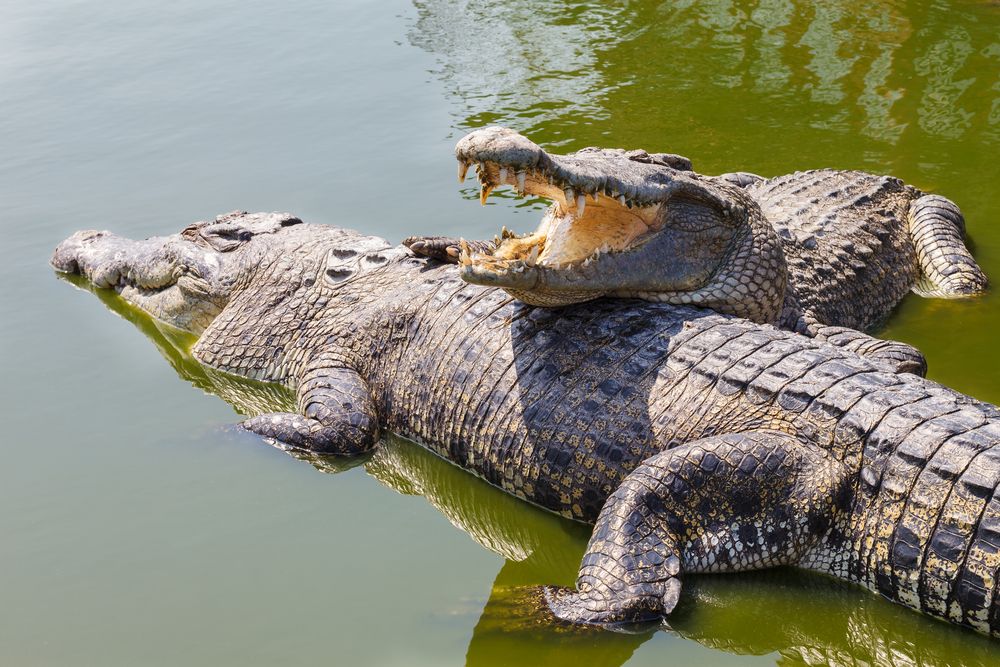
By floating completely out of sight, they use the element of surprise and an incredibly powerful bite to catch their prey, making them one of nature's most successful survivors.
| Feature | Key Facts |
| Family | Crocodylidae (True Crocodiles) |
| Average Length | 7 to 15 feet (some species, like Saltwater crocodiles, can exceed 20 feet) |
| Average Weight (Mass) | 400 to 1,000 lbs (up to 2,200 lbs for massive individuals) |
| Lifespan | 60 to 70 years in the wild (some live past 100 years) |
| Geographic Distribution | Tropical regions of Africa, Asia, the Americas, and Australia |
| Specific Habitats | Rivers, estuaries, swamps, marshes, lakes, billabongs, and coastal mangroves |
| Mating Season | Generally, during the wet/rainy season (varies globally by region) |
| How They Communicate | Deep bellows, loud splashes, sub-audible vibrations (water dancing), and juvenile chirps |
| Hunting Process | Ambush predation: Floating invisibly, stalking slowly, lunging rapidly, and utilising the "death roll" |
| Diet | Fish, birds, crustaceans, frogs, and mammals (deer, wild pigs, water buffalo) |
| Natural Predators (Apart from Humans) | Jaguars, large anacondas, tigers, lions, leopards, and hippos (mostly target young or smaller crocs) |
| Speed | Land: 15–22 mph (short bursts/galloping) | Water: Up to 20 mph swimming |
| Collective Noun | A bask (on land) or a float (in the water) |
5 Lesser-Known Crocodile Facts
- Since crocodiles can't sweat, they have a pretty strange way of beating the heat. You will often see them sleeping with their mouths wide open (gaping) just to let the heat escape and cool their bodies down.
- If you shine a flashlight at a crocodile at night, its eyes glow a creepy, bright red. They have a natural, mirror-like layer inside their eyes (tapetum lucidum) that catches even the tiniest bit of moonlight, giving them perfect vision in the pitch black.
- Crocodiles actually eat large stones on purpose. These rocks sit in their stomachs to help grind up tough bones and meat, but they also act like a diver's weight belt, helping the crocodile stay steady and heavy underwater.
- Crocodile eggs don't have chromosomes that determine if a baby is a boy or a girl. Instead, it all comes down to how warm the nest is. Cooler nests under 86°F produce baby girls, while hotter nests over 93°F turn into baby boys.
- The old saying about "crocodile tears" is based on real biology. Crocodiles actually do cry while they eat, but it isn't because they feel guilty. Air gets pushed into their sinuses while they chew, which accidentally forces tears out of their eyes.
Where Does The Term 'Crocodile' Originate From?
So, where does the word 'crocodile' actually come from? The word "crocodile" has a really long and interesting history, and it changed a lot before becoming the word we use today.
Turns out, it goes all the way back to the Greeks, who called these creatures 'krokódilos', which literally means 'stone worm'.
The name stuck, travelled through Middle English, and eventually landed in our dictionaries as 'crocodile'. The Greeks probably called it that because crocodiles like to lie on warm, rocky riverbanks.
Later on, the Romans took the word into their language, Latin, and spelt it crocodilus. But during the Middle Ages, people were not very good at spelling, so the word got pretty messy. In old French books from the 1200s, they spelt it 'cocodrille' and described the animal as being yellow.
The very first time the word showed up in English was in a magical poetry story from the early 1300s. Back then, they spelt it cokedrill. The story tells of a king who found a scary two-headed monster: one head looked like a crocodile, and the other like a unicorn.
Over the next few hundred years, smart people started translating old science books, and famous writers like William Shakespeare started using the word. By the mid-1500s, people finally fixed the spelling to "crocodile" to match the old Latin books, which is exactly how we write it today.
How Many Crocodile Species Are There In The World?
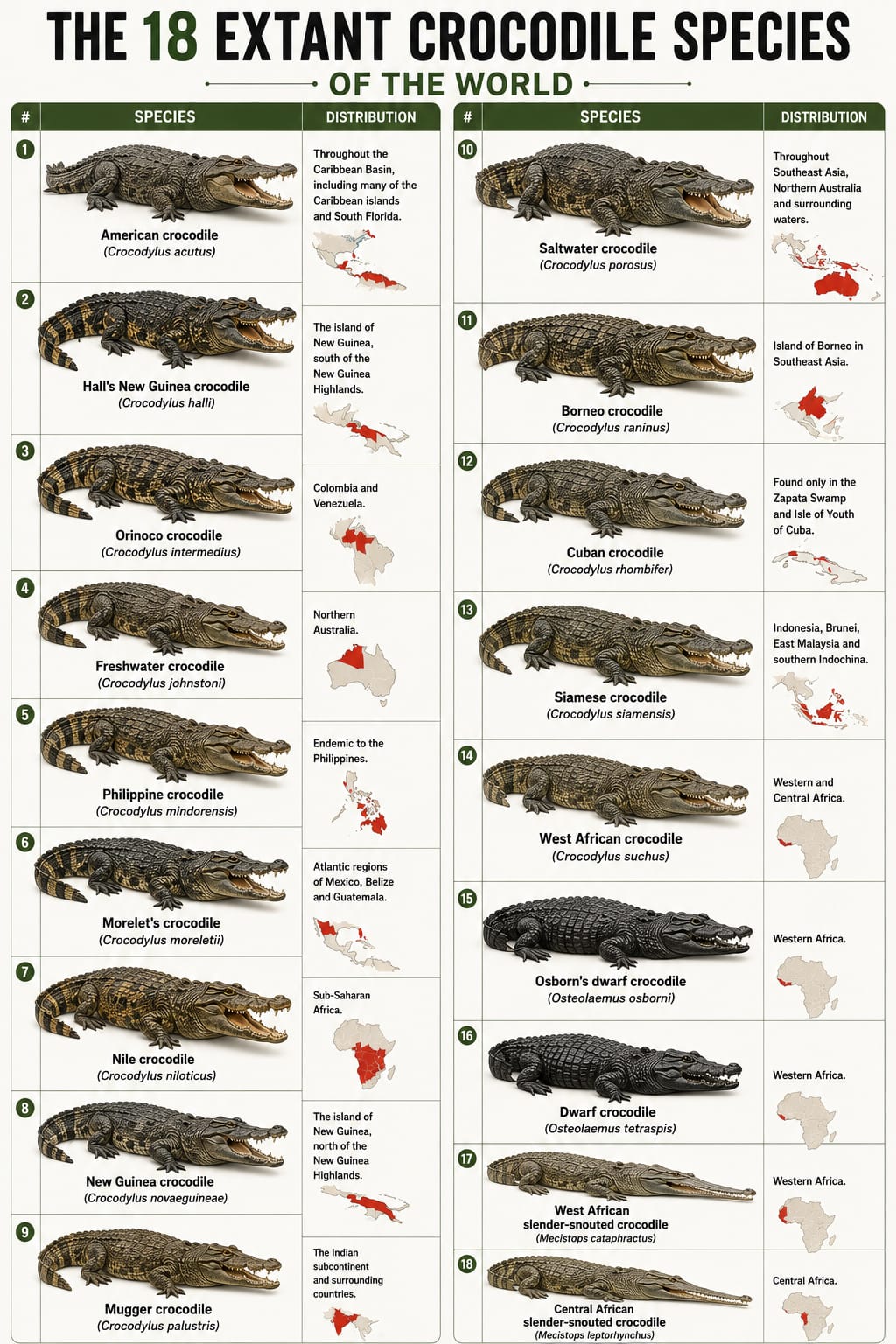
Scientists say there are 18 main types of crocodiles living today. Here is the list of all of them, explained very simply:
| Species Name | Distribution (Where they live) | Description (What they are like) |
| American crocodile | South Florida, the Caribbean islands, and Central America. | They are big and grey, with a V-shaped snout. They love salty water and can even swim out into the deep ocean. They eat fish and small animals. |
| Hall's New Guinea crocodile | South part of the New Guinea island. | A smaller crocodile that lives near the mountains. They look a lot like the regular New Guinea croc, but their heads can be a bit shorter or wider. |
| Orinoco crocodile | Colombia and Venezuela. | These are big crocs with long noses and tan skin with brown spots. They live in the Orinoco River basin. They are in big trouble and are almost extinct. |
| Freshwater crocodile | Northern Australia. | A small crocodile with a very skinny, long nose. They stay deep inland in rivers to avoid fighting the giant saltwater crocodiles. |
| Philippine crocodile | Only in the Philippines. | This one is small with a wide nose and golden-brown skin. They love freshwater. Sadly, this is the most endangered crocodile in the world today. |
| Morelet's crocodile | Mexico, Belize, and Guatemala. | A small to medium croc that is dark grey-brown. They live in fresh water and eat birds and mammals. Their population is doing totally fine. |
| Nile crocodile | All over Africa (below the Sahara). | These are massive and super aggressive! They have a bronze colour that turns black as they age. They eat huge animals like zebras and buffalo. |
| New Guinea crocodile | North part of the New Guinea island. | A small, grey-brown crocodile that prefers freshwater lakes. The babies have a V-shaped nose that gets wider as they grow up. |
| Mugger crocodile | India and nearby countries. | This is a medium-sized croc that looks a lot like an alligator because it has a super-wide nose. They are heavily armoured and live in slow rivers. |
| Saltwater crocodile | Southeast Asia and Northern Australia. | The biggest reptile on Earth! They are extremely dangerous and aggressive. They love the ocean and can swim very long distances in saltwater. |
| Borneo crocodile | Borneo Island in Asia. | A freshwater croc that looks so much like a saltwater crocodile that scientists used to think they were the exact same animal. |
| Cuban crocodile | Only in two small swamps in Cuba. | Small but crazy aggressive! They have bright colours and can actually run and hunt on land. They sometimes even hunt in packs like wolves. |
| Siamese crocodile | Indonesia and Southeast Asia. | A pretty small, dark green crocodile. They are almost completely gone from the wild, and scientists don't know how many are left. |
| West African crocodile | West and Central Africa. | People used to think this was a Nile crocodile, but it is actually a totally different species. They are much smaller and have narrower noses. |
| Osborn's dwarf crocodile | West Africa rainforests. | A very small, pure black crocodile. They spend a lot of time on land inside forests, especially at night when they hunt for bugs and small frogs. |
| Dwarf crocodile | West Africa. | Just like the Osborn croc, these are small, black, and heavily armoured. They love walking on the forest floor at night to find food. |
| West African slender-snouted crocodile | West Africa. | A medium croc with a very long, skinny nose that is perfect for catching fish in the jungle rivers. They are highly endangered. |
| Central African slender-snouted crocodile | Central Africa. | They look just like the West African slender-snout and live deep in the rainforest rivers. They eat mostly fish and are doing a little bit better. |
List of 10 Rivers With the Most Crocodiles In The World
The table below highlights some of the world's major rivers that are home to the highest densities and largest populations of crocodiles. It shares interesting details about who lives there and how these fascinating creatures thrive.
| River | Crocodile Species | Distribution | Description |
| Tárcoles River | American Crocodile | Costa Rica (Central Pacific coast) | Features the highest density of crocodiles in the world, with around 75 crocs per square mile. |
| Nile River | Nile Crocodile | Sub-Saharan Africa (Egypt to South Africa) | Home to hundreds of thousands of massive, aggressive crocodiles throughout the basin. |
| Chambal River | Gharial & Mugger Crocodile | Northern India (Madhya Pradesh, Rajasthan, UP) | The absolute safest and largest stronghold for the unique, needle-snouted gharial. |
| Brahmani River | Saltwater Crocodile | Odisha, India (Bhitarkanika region) | Famous for housing giant saltwater crocodiles that regularly cross over 16 to 20 feet in length. |
| Alligator Rivers | Saltwater & Freshwater Crocodile | Northern Territory, Australia | Despite the name, these rivers are packed to the brim with giant Australian saltwater crocs. |
1. All About the Tárcoles River
The Tarcoles River is a very important waterway in Costa Rica. It flows through the Puntarenas province and the Central Valley and then goes into the Gulf of Nicoya on the Pacific side. The river covers over 1,242 miles in its watershed. It is about 66 feet deep and 98 feet wide on average.
Unfortunately, the Tarcoles River is one of the most polluted rivers in Costa Rica. Even though it is polluted, many animals still live there because of its location. The river is also very important for farmers and for generating electricity in Costa Rica.
The Famous Crocodile Bridge
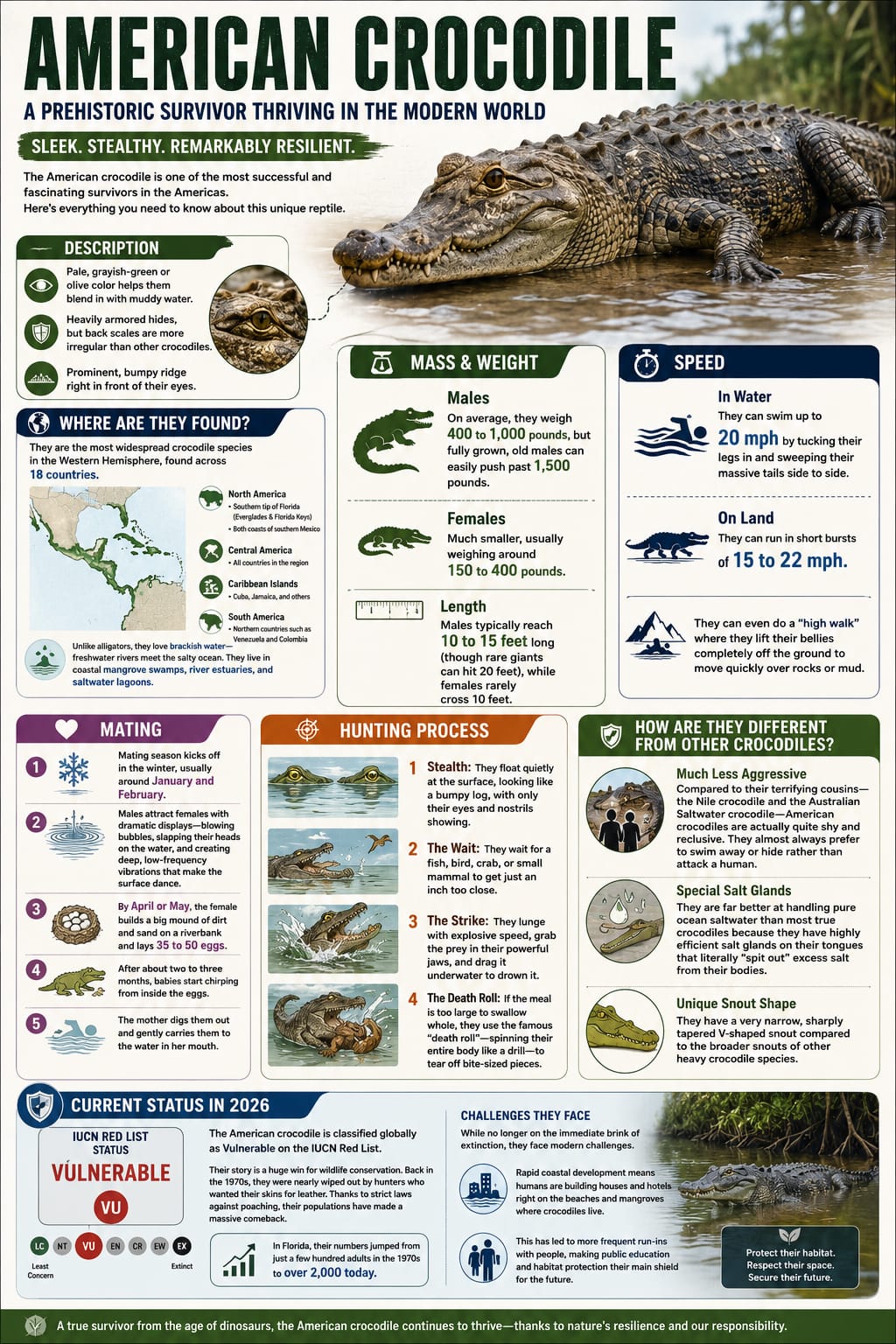
The Carara National Park, located in Costa Rica, is a biological reserve that protects the Tarcoles River and is also famous for "Crocodile Bridge", officially known as the Tarcoles Bridge. This bridge is located on Route 34, about 1 hour and 20 minutes west of San José, and the Tarcoles River flows beneath it, which is home to the infamous American crocodiles.
At every square mile, you can spot an average of 75 crocodiles lazily sunbathing right under the famous "Crocodile Bridge", completely used to the crowds of tourists looking down at them. In 2026, the population of these American crocodiles remains incredibly dense, with over 2,000 individuals living along this single stretch of water.
Local conservation laws have protected them from hunting for decades, allowing them to grow to a massive size. Even though the river suffers from heavy upstream pollution, these tough reptiles are thriving thanks to the abundant fish and birds.
All About the Nile River
The Nile is the most famous river in Africa and the longest river in the world. It actually starts from two different places: Lake Victoria and Lake Tana. From there, the water flows all the way up through eleven countries, like Uganda, Sudan, and Egypt. Finally, the river ends when it dumps into the Mediterranean Sea.
This river is super important because millions of people live in dry deserts, and they need the Nile for drinking water and growing food. Without this river, they cannot survive.
Also, the Nile is the ultimate home for the Nile crocodile. There is a huge number of them living here, around 250,000 to 500,000 crocodiles! These big reptiles love the river because the water moves slowly, and they can lie on the warm sand to rest and hunt for food easily.
The Nile Crocodile along the Nile Basin
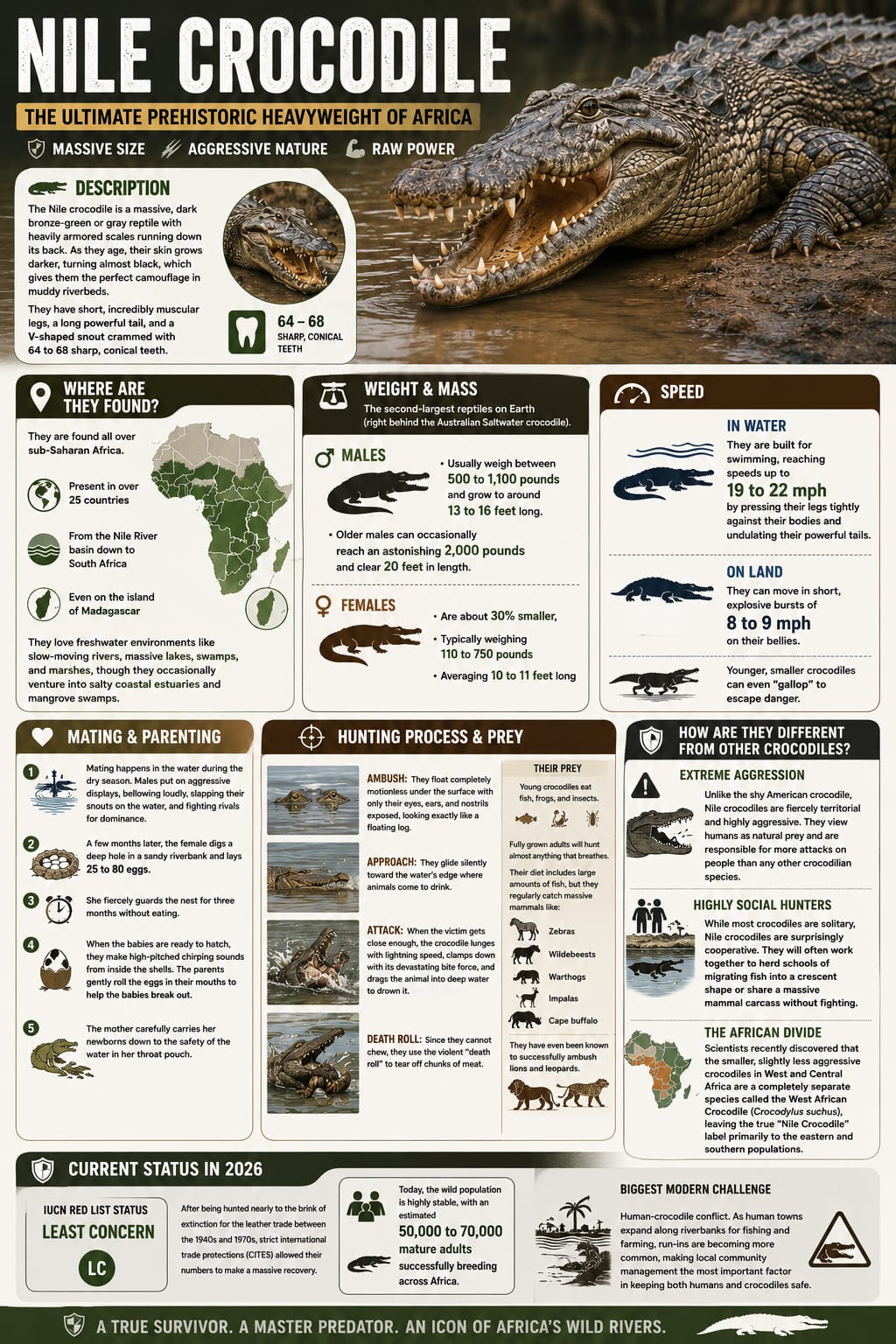
The legendary Nile crocodile continues to reign supreme as Africa's ultimate freshwater predator. Across the entire continent, their numbers are safely estimated between 250,000 and 500,000 individuals. They are classified as a species of "Least Concern," meaning they are far from extinction.
They live a highly traditional, wild life, dominating riverbanks and waiting for annual mammal migrations to hunt.
However, living alongside humans brings friction. As towns grow closer to the water, these large and highly aggressive crocodiles frequently clash with local villagers who use the river for laundry, fishing, and bathing.
Conclusion
If you want to find the world's biggest crocodiles, just follow the river. Crocodiles don't just hang out by the water; they depend on it for everything. Picture the muddy banks in Costa Rica, packed with sunbathing giants, or the Nile, where the current is strong, and the crocs are even stronger. Some, like the Nile crocodile, are thriving. If we want these ancient beasts to stick around, we have to keep their rivers clean and safe. Otherwise, we're looking at a future with a lot fewer crocodiles, and that would be a real loss.
[Note: Sometimes, people use the word "crocodile" for all the members of the order Crocodilia which includes alligators, caimans, and gharials too. However, according to scientists, it is incorrect. Alligators and caimans belong to a completely different family, and gharials have their own family too. So, just to be clear, this article is only talking about "true crocodiles". We are only looking at the animals that belong to the official crocodile family, whether they are living today or went extinct a long time ago.]
Kriti Barua is a skilled content writer with 4+ years of experience in creating clear, engaging, and informative content. She began her writing journey as a Creative Writer Intern at Wordloom Ventures. She holds a BA degree from Delhi University and has completed a one-year diploma in TV Production and Journalism, which adds depth to her research and reporting style.
Kriti has worked across brand writing, marketing content, and digital media, building strong expertise in articles that connect with readers and perform well online. At Jagran New Media, she writes for the GK section, covering national news, international stories, and query-based articles that answer what people actively search for. Her work focuses on easy language, reliable information, strong keywords, and reader-friendly storytelling, making her content both helpful and search-friendly.


-1780920929302_t.webp)