Why Egypt’s Great Pyramid of Giza has Defied Earthquakes for 4,600 Years
A groundbreaking study published in Scientific Reports reveals how the Great Pyramid of Giza has withstood thousands of years of major earthquakes. By measuring ambient frequencies, scientists discovered that the ancient wonder acts as a giant seismic shock absorber, deflecting destructive ground movements.
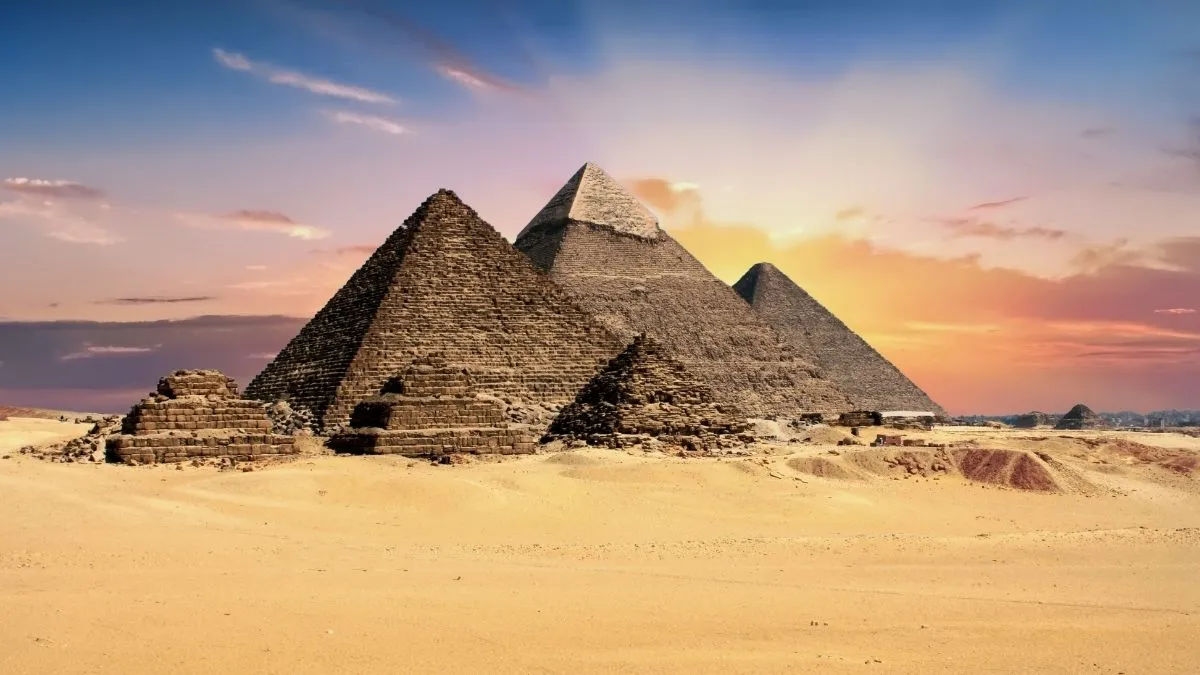
The Great Pyramid of Giza has withstood thousands of years of wars, erosion, and shifting sands, but its ultimate test has always been beneath the earth. A landmark study published May 21, 2026, in Scientific Reports reveals that this sole surviving Ancient Wonder possesses a hidden defence against catastrophic earthquakes.
Researchers from Egypt’s National Research Institute of Astronomy and Geophysics (NRIAG) and Japan deployed 37 sophisticated vibration sensors throughout the 4,600-year-old tomb of Pharaoh Khufu. Their findings show that the structure behaves like an accidental seismic shield, using an advanced system of inner voids and structural mass distribution to neutralise tremors that have levelled surrounding modern cities over millennia.
Why doesn't the Great Pyramid of Giza Collapse During an Earthquake?
The core secret to the monument's survival lies in a phenomenon called seismic resonance mismatch. The building is most vulnerable when an earthquake strikes and the building vibrates at the same frequency as the shaking ground, which magnifies the destruction violently.
By analysing ambient vibrations caused by distant ocean waves and traffic, seismologists discovered a striking discrepancy:
-
The Surrounding Soil: Vibrates at a slow frequency of approximately 0.6 Hertz.
-
The Pyramid Interior: Vibrates uniformly at a much higher frequency of 2.0 to 2.6 Hertz.
Because the ground and the monument move at completely different rates, earthquake energy cannot transfer efficiently into the 6-million-ton limestone structure. This fundamental mismatch serves as a natural buffer, keeping the core blocks locked firmly in place.
Check Out - What are the 7 Wonders of the Ancient World? Check List
How do the Internal Chambers of the Pyramid Act as Shock Absorbers?
Large structures typically act like upside-down pendulums during an earthquake; the base stays anchored while the top sways violently. Sensors showed that seismic vibrations amplified by a factor of four inside the high-altitude King’s Chamber. However, directly above this room sits a series of vertically stacked granite voids known as the relieving chambers.
| Feature | Primary Historic Purpose | Newly Discovered Seismic Effect |
| Limestone Bedrock Base | Anchors the massive weight | Prevents the dangerous swaying common in modern tall buildings |
| Symmetrical Pyramid Shape | Aesthetic and spiritual perfection | Distributes kinetic stress evenly across a 5-hectare footprint |
| Stacked Relieving Chambers | Relieves dead-load weight above the King's Chamber | Drastically drops vibration amplification, acting as a kinetic buffer |
The data indicated that the vibration amplification inside these relieving chambers fell sharply from four to three. This drop demonstrates that the empty spaces redistribute physical stress and interrupt dangerous seismic waves before they can compromise the ceilings of the primary chambers.
Check Out - List of 9 Largest Museums in the World in 2025: Updated
Was the Monument Purposely Built to Withstand Seismic Hazards?
Lead study authors, Mohamed ElGabry and Asem Salama, said it’s a stretch to say that ancient architects knew anything about modern seismic engineering or frequency dynamics. This remarkable stability, rather, results from centuries of trial and error and architectural development.
Prior generations witnessed structural failures, such as the early collapse risks of the Meidum Pyramid or the shifting angles of the Bent Pyramid. By the time construction began on the Giza Plateau around 2500 B.C., Egyptian builders had developed an unparalleled intuitive mastery of mass distribution, load transmission, and site selection, ultimately engineering a monument built for eternity.
Check Out - Which City Hosted the 1998 World Cup final?
The Great Pyramid of Giza didn’t survive for so long by historical luck. The ancient builders had unwittingly created a near-earthquake-proof masterpiece by using structural symmetry, a solid bedrock foundation, and internal chambers to disrupt seismic energy. These new findings provide valuable insights into the timeless preservation of geoheritage for modern engineers.

Harshita Singh specializes in US affairs and general knowledge, simplifying intricate geopolitical and historical subjects into clear, digestible insights for learners. Holding a BA (Hons) in English from the University of Delhi and with over three years of experience in educational writing, she produces authoritative, thoroughly researched content that empowers readers to engage confidently with global current affairs. For inquiries, you can reach out to her at harshita.singh@jagrannewmedia.com.


