Key Points
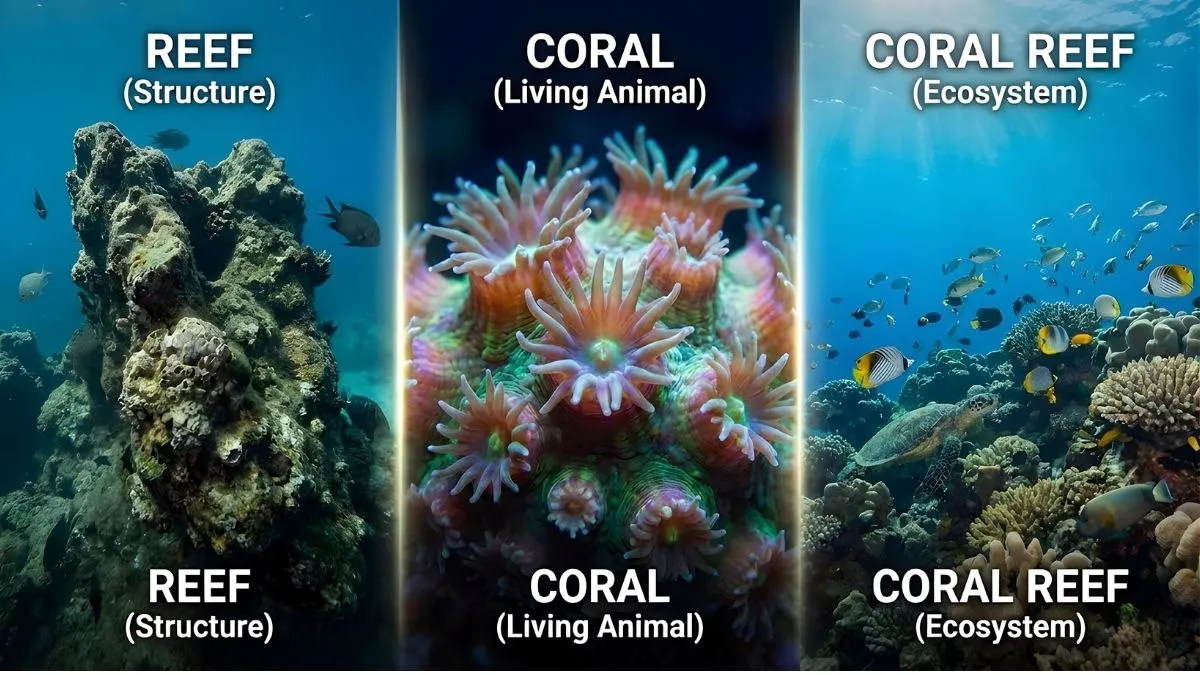
- Reefs are underwater structures, natural or artificial, providing height above the seabed.
- Corals are living marine animals (polyps) that can be hard (reef-building) or soft.
- Coral reefs, built by hard corals over thousands of years, are vital marine ecosystems.
The ocean is home to many natural resources, with natural structures, reefs, and corals are also one of them, which are often misunderstood by many people.
Previously, I also got confused about these natural structures, but after reading NASA’s article, it is now clear that reefs, corals, and coral reefs all possess different natures.
They are very different from each other in marine science. Understanding their differences helps us to know about marine ecosystems and their importance to life on Earth.
In this article, we are going to learn about each term, how they are connected, their differences, and why coral reefs are so important for both nature and human communities.
What is a Reef?
A reef is a raised structure that stands above the ocean floor. It can be either natural or artificial.
By definition, a reef provides some height or structure compared to the surrounding seabed. Reefs can form in different ways:
-
Natural reefs may be made of rock, sand, or biological materials.
-
Artificial reefs are created by humans, sometimes using materials such as concrete blocks or even old tyres, which later become home to marine organisms.
In simple terms, a reef is a physical underwater structure. It does not have to be made of coral.
What Are Corals?
Corals are living marine animals. They belong to the phylum Cnidaria, the same group as jellyfish and sea anemones. Corals are mostly found in warm, shallow tropical waters.
Each coral is made up of tiny animals called polyps. These polyps:
-
Are only a few millimetres wide
-
Have a mouth surrounded by tentacles
-
Use stinging cells to capture plankton and small organisms
Thousands of polyps live together and form a colony, which we recognise as coral.
Types of Corals
There are two main types of corals:
1. Hard Corals (Stony Corals)
-
Scientifically known as Scleractinians
-
Produce a hard skeleton made of calcium carbonate
-
Responsible for building coral reefs
2. Soft Corals
-
Scientifically known as Alcyonacea
-
Flexible and bendable
-
Often look like trees, fans, or bushes
-
Do not form large reef structures
Also Read: What is Coral Bleaching?
Why Are Corals Colourful?
Corals get their bright colours from microscopic algae called zooxanthellae that live inside their tissues. These algae perform photosynthesis using sunlight and provide food to the coral. In fact, about 80–90% of the food produced by photosynthesis is shared with the coral.
This is why most reef-building corals are found in shallow waters where sunlight can reach them.
What is a Coral Reef?
A coral reef is a type of reef that is mainly built by living hard corals.
In other words:
-
Every coral reef is a reef.
-
But not every reef is a coral reef.
Coral reefs form over thousands of years as hard corals grow, die, and leave behind their calcium carbonate skeletons. New corals grow on top of the old skeletons, slowly building massive underwater structures.
The largest coral reef system in the world is the Great Barrier Reef, located off the coast of Australia. It stretches over 1,000 miles and covers approximately 133,000 square miles.
Also Read: List of Top 9 Famous Coral Reefs in the World, Check Here!
What are the differences between Reef, Coral, and Coral Reef?
Between these terms, many people often get confused and have misconceptions about their meanings, nature, formation, and the distinction between living and non-living, as well as their roles.
So, here is a table format with all the necessary details about Reefs, Corals, and Coral Reef
| Feature | Reef | Coral | Coral Reef |
| Nature | Physical underwater structure | Living marine animal | Reef built mainly by hard corals |
| Living or Non-living | Can be living or non-living | Living organism | Built by living corals |
| Formation | Natural rock, sand, or artificial materials | Made of tiny animals called polyps | Formed from accumulated coral skeletons |
| Main Role | Provides structure and habitat | Builds skeleton (in hard corals) | Supports entire marine ecosystems |
| Example | Rock reef, artificial reef | Hard coral, soft coral | Great Barrier Reef |
Why Are Coral Reefs Important?
Coral reefs are among the most valuable ecosystems on Earth.
1. Habitat for Marine Life
Coral reefs are always supported in marine ecosystems for thousands of species, from tiny microorganisms to very large fish, sharks, and sea turtles.
They are often called the “Rainforest of the Sea” because they provide rich biodiversity for marine ecosystems
2. Coastal Protection
These coral reefs also act as a natural barrier during storms, typhoons, and also even in hurricane. Even these coral reefs can reduce the energy wave byt 97%, which helps in protecting coastlines from flood nd erosion.
3. Support for Livelihoods
Millions of people depend on coral reefs for fishing, tourism, and recreation. Many island and coastal communities rely on reef ecosystems for food and income.
4. Medical Research
Scientists are studying chemicals found in coral to develop new medicines, including antibiotics effective against resistant bacteria. These compounds are now reproduced in laboratories to avoid harming natural coral populations.
Conclusion
In nature, everything, whether it is on land or in the ocean, as part of marine ecosystems, is very important, and they all play an important role in safeguarding our environment.
Same as reefs, corals, and coral reefs, all are closely related, but they are ot identical. Among these three, Corals are living organisms, reefs are underwater structures, and coral reefs are built by hard corals.
Understanding their differences will help us understand more about our marine ecosystem and recognise the urgent need to protect coral reefs worldwide.
Also Read: Coral reefs in Western Indian Ocean to be extinct by 2070?



Comments
All Comments (0)
Join the conversation