Competitive programming has been considered as one of the strictest methods of evaluating the problem solving capabilities, logical thinking, and pressure under demanding circumstances of a student. The International Collegiate Programming Contest (ICPC) among numerous other programming contests in the world is one of the most demanding and esteemed platforms among young programmers. The contest is won annually with more than 100 countries participating and has been and continues to be a laboratory project testing ground by the students who have continued to serve in the research, infrastructure and product development teams of the major world technology companies.
The ICPC is a very selective multi-stage process. Preliminary rounds are the starting point of many thousands of teams yet few of them can reach the regional contests. Such regionals do not only require excellent background in algorithms and data structures, but also a combination of teamwork, time management and concentration in a highly-stressful setting. The results at this stage are normally determined by a thin margin and therefore preparation and execution is equally significant.
The Importance of ICPC Regionals
The local competitions constitute one of the most challenging stages of the ICPC cycle. Three-person programmer teams must share a single computer and be able to work on a variety of problems in algorithms given a five-hour time frame. Scoring is based on accuracy and speed, making it strategic decision-making, as well as technical ability.
In addition to rankings, there is greater meaning in performance at regionals. Top-ranking in the teams allow entry into the ICPC World Finals where a well-screened group of international competitors is made. Technology companies and research institutions closely monitor performances at this stage since it is usually indicative of good systems-level thinking and problem-solving skills.
ICPC Regionals 2026: Future Performances
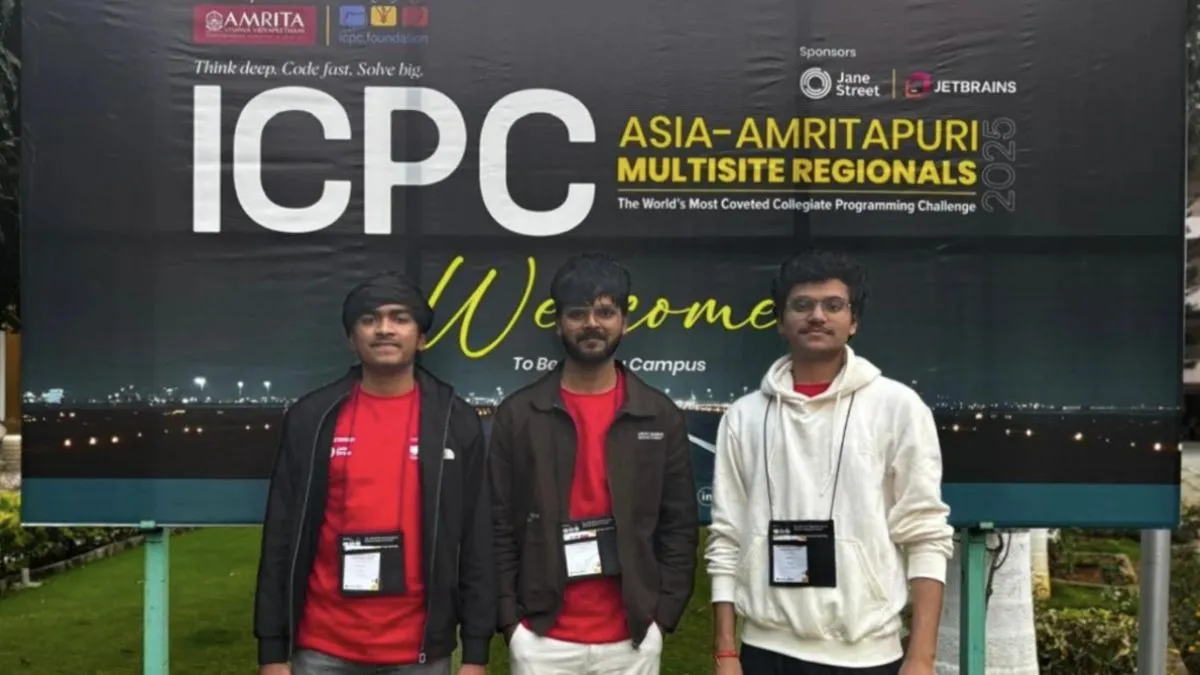
The ICPC Regionals 2026 also managed to bring out the quality of talent that was produced by institutions nationwide. In January, they had participated in the Amritapuri regional contest where teams with varying academic backgrounds had to compete against one another and many of them had years of preparation with them.
These players included two second-year undergraduate teams of Scaler School of Technology. Team CtrlAltDel submitted five correct solutions out of eleven, but this had the team ranked 106 th out of over 370 teams. The team competed mostly with third- and fourth-year students with well established engineering schools and ended up at the top third of the competition. The fact that they were almost finishing another problem was also emphasizing the importance of outcomes at this level being typically influenced by a narrow margin, time management and concentration.
The other group of this institution, Tech Team, showed stable performance in various regional competitions. They were successful in four at the Amritapuri regional, and were ranked 134th overall. Their best performance was previously at the Kanpur regional contest where they got a rank of 68 by solving four out of twelve problems which is one of the best results obtained by a team representing their institution so far.
What These Results Indicate
Such performances are more of a trend within the engineering education and competitive programming, rather than simply individual rankings. The success of ICPC does not come overnight; one has to be exposed to complex problem-solving very early, practice rigorously and can work within strict boundaries. The possibility of competing on a level playing field with senior teams by the second-year students implies that the experience gap can be closed substantially through the organization of preparation and continuous participation.
These are also the consequences of the fact that problem-solving skills need to be developed at the very beginning of an undergraduate career. In its very nature, competitive programming entails not just technical skill development, but also resilience, ability to work in a team, and clarity of thought when one is under pressure.
Acquisition of Competitive Programming in Academic Institutions
Colleges with an undergraduate programming undergraduate program that place increased emphasis on algorithmic thinking and algorithmic problem solving have higher undergraduate participation in competitions such as the ICPC. In the Scaler School of Technology, one of the core components of the undergraduate programs in computer science and artificial intelligence is competitive programming. The students get introduced to complex problems in their early stages and are assisted with peer-mediated practice sessions and mentorship that mimics the level of problems and challenges of the high-tier competitions.
The method has been slowly translated to a greater representation and enhanced performance in competitions on the national level. Being exposed to challenging sets of problems, as well as practicing repeatedly, assists students in developing the depth, speed and discipline necessary to compete with students of the long-established engineering universities.
The methods of competitive programming remain important to influence the future of any engineer, and therefore the performance in such forums as ICPC can give an in-depth idea of how learning and preparation during school-going years impacts on the result in the long term.





Comments
All Comments (0)
Join the conversation