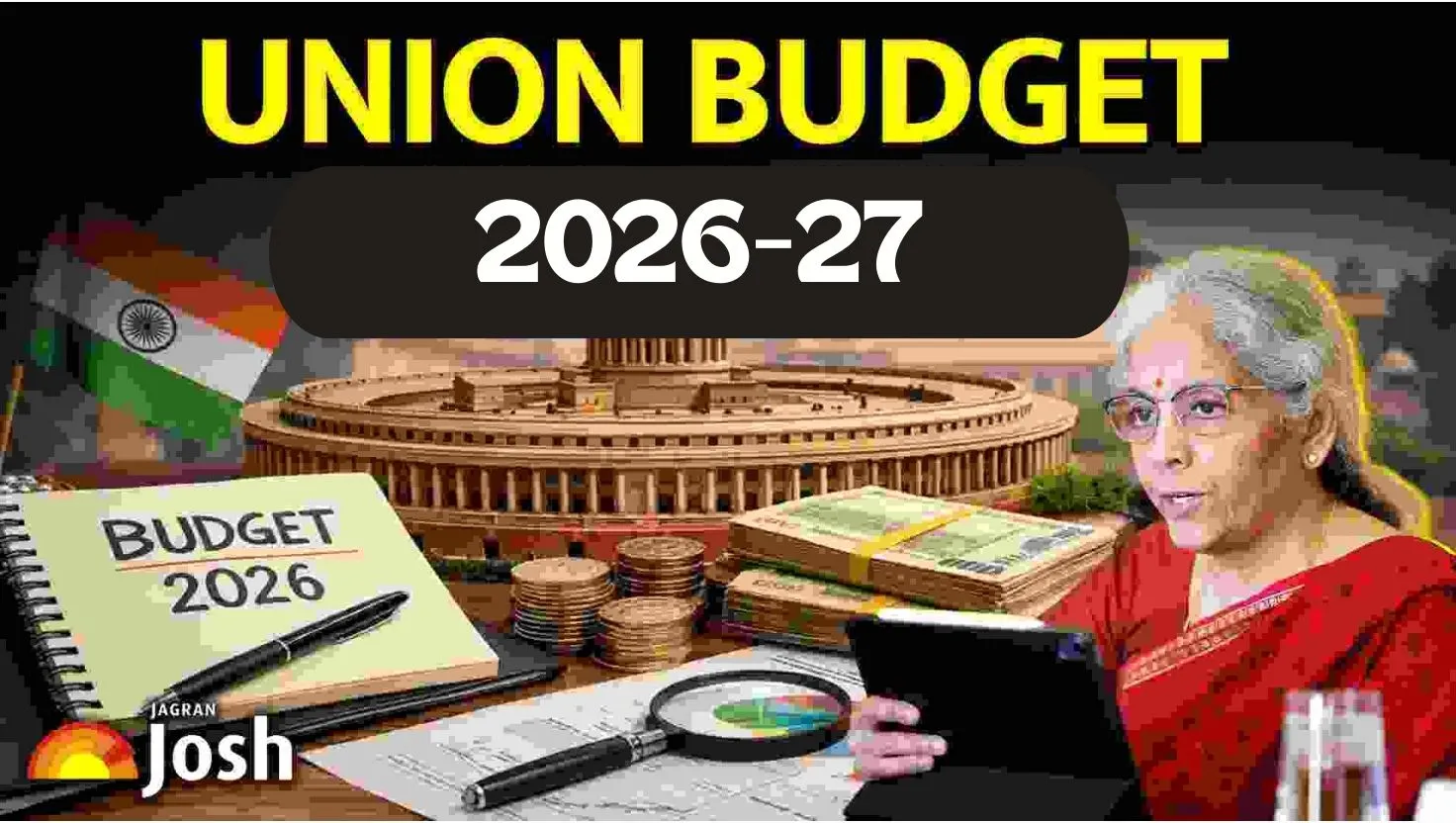
Union Budget 2026: Union Finance Minister Nirmala Sitharaman presented the full-fledged budget for the 9th consecutive time on 01 February 2026. The Budget is the annual financial statement of the government’s income and expenditures for the upcoming financial year. The Union Budget 2026-27 highlights the need for sustaining economic growth, strengthening the foundations of growth, people-centric development, trust based governance, ease of doing business and ease of living, and fiscal matters.
This is the first time in India's budget history that a full Union Budget has been presented on a Sunday.
Union Budget 2026 Major Key Points
The Union Budget 2026-27 mainly emphasised on the manufacturing, MSME, and biopharma. Here we have presented in detail about all the new announcements and schemes related to the budget:
Key announcements related to taxes:
STT on futures increased from 0.02% to 0.05%.
STT on options premium will be increased from 0.10% to 0.15%.
No change in STCG and LTCG taxes.
The new Income Tax Act will come into effect from April 1st; simplified rules and return forms will be released soon.
Customs duty reduced on 17 medicines.
Measures taken to support IT services and attract global investment.
High Speed Rail Corridors:
-
Mumbai-Pune
-
Pune-Hyderabad
-
Hyderabad-Bengaluru
-
Hyderabad-Chennai
-
Chennai-Bengaluru
-
Delhi-Varanasi
-
Varanasi-Siliguri
ALSO READ: Union Budget 2026: Everything You Need to Know About India’s Annual Financial Statement
Union Budget 2026-27 Highlights for Financial Sector
As per the Budget document, Setting up of a High Level Committee on Banking for Viksit Bharat to align with India’s next growth phase.
-
Incentive of ₹100 crore for single issuance of municipal bonds of more than ₹1000 crore. Current Scheme under AMRUT will continue
-
Restructuring Power Finance Corporation (PFC) and Rural Electrification Corporation (REC).
-
Comprehensive Review of the Foreign Exchange Management (FEMA) (Non debt Instruments) Rules.
-
Introduction of Market making framework and total return swaps on corporate bonds.
Tax Proposals for Financial Sector
-
Raising the STT on Futures from 0.02% to 0.05%.
-
STT on options premium and exercise of options to be raised to 0.15% from rate of 0.1% and 0.125%, respectively.
Union Budget 2026 Allocation for Education Sector
-
5 University Townships in the vicinity of major industrial and logistic corridors.
-
A girls’ hostel in Higher Education STEM institutions in every district.
-
Setting up or upgrading of four Telescope Infrastructure facilities.
Watch this Video:
Budget Highlights 2026: Sector-wise Key Announcements
| Sector | Key Announcements |
| Investment & Finance | Non-debt receipts at ₹34 lakh crore; Total expenditure ₹49.6 lakh crore; Capital expenditure ₹11.7 lakh crore; Market borrowing ₹17.2 lakh crore; FY27 fiscal deficit at 4.3% of GDP; Debt-to-GDP ratio at 55.6%. |
| Tax Reforms | APA process to be completed within 2 years; New scheme for small taxpayers; Revised return filing date extended till 31 March; ITR-1/2 last date: 31 July, non-audit cases: 31 August; MAT reduced to 14%; TCS on foreign tour packages at 2%; TCS on education and medical expenses under LRS at 2%; TCS at 2% on several goods; Interest on motor accident compensation made tax-free. |
| Foreign Investment | Tax holiday for foreign companies providing cloud services till 2047; Launch of Foreign Investment Disclosure Scheme. |
| Agriculture & Horticulture | Promotion of coconut, cashew, cocoa, agarwood, sandalwood, almonds, and pine nuts; Strengthening of fisheries value chain. |
| Women Entrepreneurs | Launch of She-Mark Scheme to enhance credit access for women entrepreneurs. |
| Manufacturing | Establishment of Artificial Limbs Manufacturing Corporation of India; Strong focus on R&D and Artificial Intelligence. |
| Sports | Launch of the Khelo India Mission. |
| Tourism | Trekking development in J&K, Uttarakhand, and Araku Valley; Wildlife trails; Turtle trails in Odisha, Kerala, and Karnataka; Bird-watching circuits in Andhra Pradesh–Tamil Nadu; Buddhist circuit in North-East India; Training of 10,000 tourist guides; Development of 15 archaeological sites. |
| Employment | Creation of a Digital Knowledge Grid to promote local research and technology-based jobs. |
| Animal Husbandry | Credit subsidy support; Strengthening dairy and poultry value chains; Promotion of FPOs and entrepreneurship. |
| Education | Establishment of 5 university campuses near industrial corridors; Setting up of the National Institute of Hospitality. |
| Healthcare | Development of 5 regional hubs for medical tourism; Training of 1.5 lakh caregivers; Establishment of NIMHANS 2.0 in North India; Girls’ hostels in every district. |
| Connectivity | Promotion of seaplane manufacturing; Infrastructure financing through municipal bonds. |
| Service Sector | Formation of an end-to-end (E2E) committee; Target of 10% share in the global services market by 2047; Focus on AI-based skill training. |
This budget is expected to maintain the pace of growth, strengthen fiscal discipline, and announce reforms that can safeguard the economy from the effects of global trade tensions and US tariffs.




Comments
All Comments (0)
Join the conversation