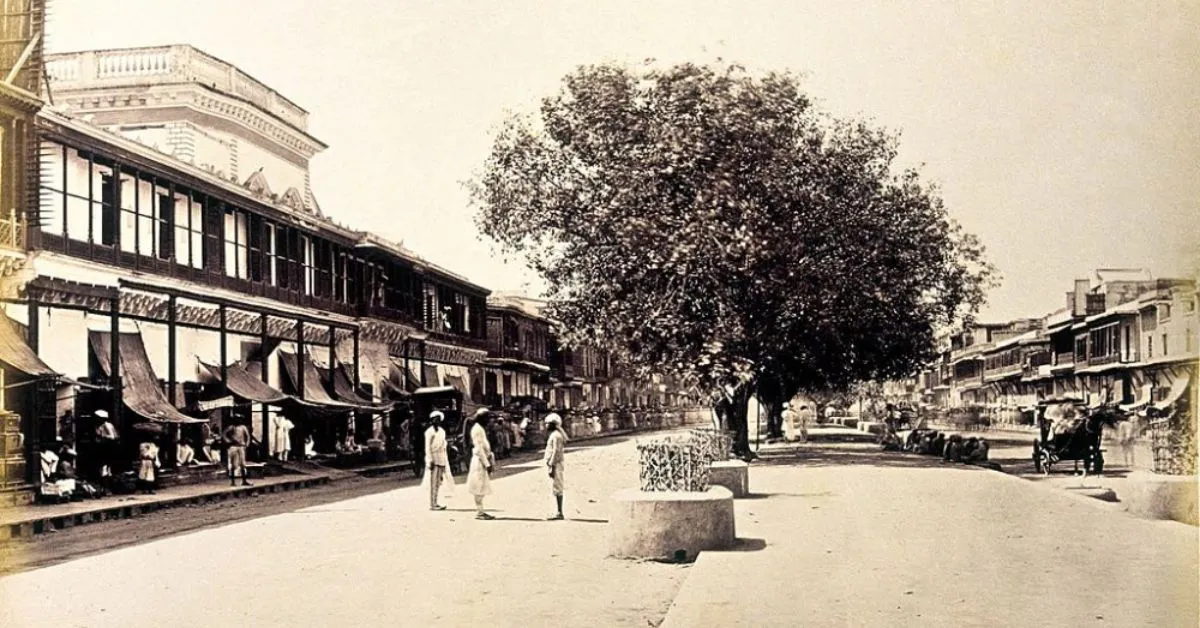
For thousands of years India has been a trading civilisation. Long before the contemporary idea of a shopping district, the bazaar was the heart of every city. It was the place where commerce, culture, religion, and everyday life met in the most interesting way possible. So, when the question of the oldest market in India arises, it opens a door to the whole history of how this country lived, traded and formed its identity.
Which is the Oldest Market in India?
When we measure by reported history, scale, and by continuous operation, then the answer is Chandni Chowk, Old Delhi.
Chandni Chowk was a brainchild of the Mughal Emperor Shah Jahan built in the 17th century. When he moved the capital to Delhi, he had the vision of a large boulevard with grand havelis and important buildings.
The first Chandni Chowk was a square half-moon, which was lined along its edges and in the middle with trees, canals, and pools. It was 40 yards in width and 1,520 yards in length. Chandni Chowk was named after Chandni Chowk, which literally means Moonlight Square, because of the reflection of the moon in a huge pool that used to occupy the place.
The Incredible India mentions: “Chandni Chowk, built in the 17th century, was a brainchild of Mughal Emperor Shah Jahan. As he shifted the capital from Agra to Delhi, he envisioned a grand boulevard flanked by imposing havelis and significant structures.”
It was the year 1650, that saw the opening of one of the oldest markets that have been in operation to date, not only in India, but in Asia as well. It is still open 375 years later.
READ| Which is the Oldest City in the World?
The Story Behind Chandni Chowk Market
The Chandni Chowk history is as amazing as the market itself. Emperor Shah Jahan, the man behind the Taj Mahal had relocated his imperial capital in 1648 to a new city that he referred to as Shahjahanabad. Also every great capital required a great market. And the one he trusted to design this market was not an architect, or an official at court, but his eldest daughter.
The Incredible India website mentions: “The original Chandni Chowk was a half-moon-shaped square, adorned with trees, canals, and pools. It stretched 40 yards wide and 1,520 yards long. The name “Chandni Chowk” translates to “Moonlight Square,” a nod to the moon’s reflection on a large pool that once graced the area. The Mughal royal processions paraded through these streets, adding prestige and grandeur. Princess Jahanara Begum, Shah Jahan’s favourite daughter, designed and established this bustling market in 1650 CE. Silver merchants thrived here, contributing to the moniker “Silver Street.”
It was not merely a market. It was a civilisation in a nutshell - a meeting-place of merchants, soldiers, artists, and commoners, under the same umbrella of business and culture.
What History Did to Chandni Chowk
There is no market that could have existed 375 years without being revamped over and over. Chandni Chowk has witnessed invasions, colonial restructuring and the trauma of 1857.
French traveller François Bernier witnessed the destruction of this market during the unrest of the Indian Rebellion of 1857 and its consequences. The British also added some architectural legacy to the region by building the Delhi Town Hall in 1863. The square pool was occupied by a clock tower - the Ghantaghar - in the 1870s.
The Chandani Chowk Info website mentions: “The 1857 Revolt marked a turning point. The British demolished many Mughal structures and asserted their authority by building the Town Hall and the Ghantaghar (clock tower), which replaced the original moonlit pool. The central canal was closed and later replaced by a tramway, fundamentally altering the street's character.”
In 1947, India won independence. New Delhi took on modern shops and offices, but Chandni Chowk kept its old charm.
The Chandani Chowk Info mentions: “The Partition of India led to a massive influx of refugees from Pakistan who settled in Old Delhi. Many took over abandoned havelis in Chandni Chowk, establishing new businesses and accelerating its transformation from a mixed residential-commercial area to the intensely dense marketplace it is today.”
Chandani Chowk Today
Today, Chandani Chowk is one of the largest wholesale markets in India. It retains its historical nature in the face of modernisation.
This is a crowded market that has a history that is more than 300 years old and was at one time frequently visited by Turkish, Chinese as well as Holland merchants. The Delhi Tourism mentions: “It is the perfect place to shop in. This densely populated market has been around for more than three centuries and was once visited by merchants from Turkey, China and even Holland.”
Chandni Chowk is not an artifact. It is not a museum. It is a market, which opens its doors each morning, filled with noise and colours and closes its doors each evening, having sold hundreds of crores of goods to traders from across the country.
READ| Which Was the First Movie in India?
Check out some more interesting articles from the general knowledge section to boost your knowledge of national and international topics. Stay connected with Jagran Josh for more topics like this.



-of-West-Bengal-1775897003288_t.webp)

Comments
All Comments (0)
Join the conversation