When Is The 2026 Total Solar Eclipse? Is It Visible From India?
On Wednesday, August 12, 2026, a spectacular total solar eclipse will sweep across the Northern Hemisphere, plunging parts of Greenland, Iceland, and Spain into complete daytime darkness. The maximum duration of totality will last for 2 minutes and 18 seconds off the coast of Iceland. Will it be visible from India? Read more to discover whether Indian skywatchers can see this year's last total solar eclipse or not.
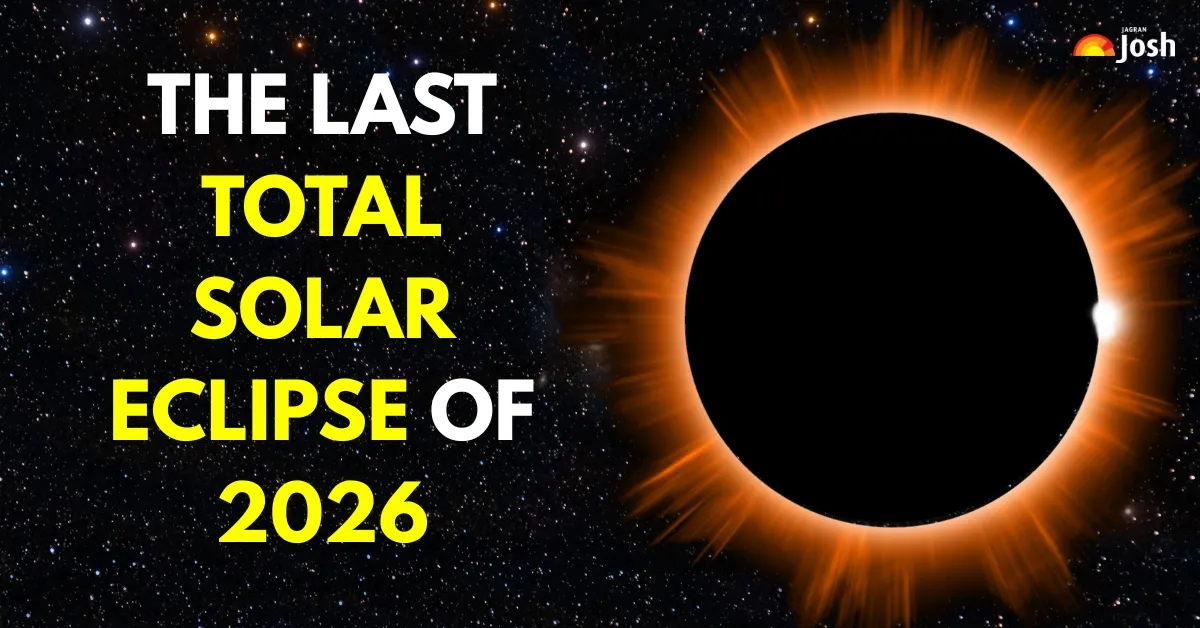
There are plenty of cool things happening in the sky, but a total solar eclipse is in a league of its own. Imagine eating lunch and suddenly, boom, the sun disappears, the temperature drops, and you can spot stars in the middle of the day. That's what's coming up on Wednesday, August 12, 2026, and space nerds everywhere are already marking their calendars. This isn't just a quick flicker, either; whole swathes of the planet will get plunged into darkness, and you can bet millions of sky-watchers and scientists will be out there with their cameras and telescopes. Want to know when it's happening, where you can catch it, and if India's getting a front-row seat? Stick around, because we're about to break down everything you need to know about this once-in-a-while cosmic blockbuster.
What is a Total Solar Eclipse?
A total solar eclipse happens when the Moon passes directly between the Earth and the Sun. Even though the Moon is much smaller than the giant Sun, it is much closer to us. Because of this perfect alignment, the Moon blocks out all the direct sunlight from reaching Earth for a few minutes.
During a total solar eclipse, the Moon throws a deep shadow onto a small strip of land on Earth. This path is called the path of totality. If you are standing inside this narrow path, the Sun completely disappears behind the Moon.
The sky becomes so dark that it looks like deep twilight, and you can see the Sun's mysterious outer atmosphere, called the corona, glowing like a ghostly halo.
What Causes a Total Solar Eclipse?
It all boils down to a wonderful celestial coincidence. The Sun is about 400 times wider than our Moon. However, the Sun also happens to be roughly 400 times farther away from Earth than the Moon is.
Because the size and distance balance out perfectly, both the Sun and the Moon look almost exactly the same size in our daily sky. When the Moon's orbit aligns flawlessly with the Earth and the Sun, it acts like a giant umbrella, temporarily shielding us from the Sun's blinding glare.
When and Where Can You Watch the 2026 Total Solar Eclipse?
The highly anticipated total solar eclipse will take place on August 12, 2026. The path of totality will sweep across the Northern Hemisphere, starting in northwestern Russia, crossing the Arctic Ocean, Greenland, Iceland, and the Atlantic Ocean, and ending in northern Spain and parts of Portugal.
The maximum duration of complete darkness (totality) will last for 2 minutes and 18 seconds, which will happen just off the western coast of Iceland.
| Location | Start of Partial Eclipse (Local Time) | Start of Totality (Local Time) | Duration of Totality |
| Reykjavík, Iceland | 4:47 PM GMT | 5:48 PM GMT | 1 minute 1 second |
| Keflavík, Iceland | 4:47 PM GMT | 5:48 PM GMT | 1 minute 39 seconds |
| Gijón, Spain | 7:31 PM CEST | 8:26 PM CEST | 1 minute 45 seconds |
| Oviedo, Spain | 7:31 PM CEST | 8:27 PM CEST | 1 minute 49 seconds |
| Palma, Spain | 7:38 PM CEST | 8:31 PM CEST | 1 minute 36 seconds |
A much wider region, including eastern North America and most of Europe, will see a partial solar eclipse, in which the Moon looks like it took a bite out of the Sun.
Is It Visible From India?
Here is the heartbreaking news for skywatchers in India: No, the 2026 total solar eclipse will not be visible from India. Since the eclipse is occurring high in the Northern Hemisphere and in the late evening in European time zones, it will already be late at night in India. The eclipse begins at 9:04 PM IST on August 12 and ends at 4:25 AM IST on August 13. Because the Sun will be well below the horizon in India during these hours, the event cannot be seen anywhere in the country.
Will There Be a Sutak Kaal in India?
In Indian tradition, a holy period of cleansing called Sutak Kaal is observed before an eclipse, during which people follow strict rules and avoid eating or cooking. However, since the eclipse is completely invisible in India, Sutak Kaal will not be applicable. Temples will remain open, and daily routines can be followed without any religious restrictions.
How Many Solar Eclipses Are Happening in 2026?
The year 2026 features a total of two solar eclipses, and each one is of a different type. Neither of these will be visible from India.
- February 17, 2026 (Annular Solar Eclipse): This was the first solar eclipse of the year. It was visible over Antarctica, parts of the Indian Ocean, and southern Africa. It created a breathtaking "Ring of Fire" in the sky.
- August 12, 2026 (Total Solar Eclipse): This is the second solar eclipse of the year, bringing complete darkness to parts of Europe and the Arctic.
Understanding the Different Types of Solar Eclipses
The Moon doesn't always block the Sun in the same way. Depending on how the Earth, Moon, and Sun align, there are four main types of solar eclipses:
- Total Solar Eclipse: The Moon completely blocks the Sun, revealing the beautiful solar corona.
- Partial Solar Eclipse: The alignment is not perfectly straight. The Moon covers only a portion of the Sun, making it look like a crescent.
- Annular Solar Eclipse: The Moon is directly centred in front of the Sun, but is too far away from Earth to cover it entirely. The outer edges of the Sun stay visible, creating a brilliant "Ring of Fire".
- Hybrid Solar Eclipse: This is the rarest type. It shifts between an annular and a total eclipse depending on where you are standing on Earth because of our planet's curved surface.
When Was the Last Total Solar Eclipse?
The last time the world witnessed a total solar eclipse was on April 8, 2024. This event was popularly known as the "Great North American Eclipse". Millions of people across Mexico, the United States, and Canada gathered outdoors to watch the Moon completely block the Sun for up to 4 minutes and 28 seconds.
Longest Total Solar Eclipse in History
The length of a total solar eclipse changes depending on how close the Moon is to Earth and how far Earth is from the Sun.
- The longest naturally recorded total solar eclipse in ancient history took place on June 15, 743 BC, lasting for a whopping 7 minutes and 27 seconds. Scientists believe the absolute longest eclipse theoretically possible can only last 7 minutes and 32 seconds.
- In modern times, humans have used technology to beat nature. On June 30, 1973, a group of scientists hopped inside a supersonic Concorde 001 jet plane. They flew at twice the speed of sound, racing right along with the Moon's shadow across Africa. By doing this, they managed to stay inside the shadow and stretched their total solar eclipse experience to an amazing 74 minutes.
India will not be able to see the live show this August, but space agencies like NASA will stream the whole event online. This way, you can still enjoy it from home.

Kriti Barua is a skilled digital journalist and communications professional with 4+ years of experience, currently writing for the General Knowledge section at Jagran New Media. She has established herself as a subject matter expert in History, Geography, Trending National and International News, Sports, Science, and Defence, producing clear, reliable, and search-optimised content that connects with readers worldwide.
Kriti holds a BA degree from Delhi University and a one-year diploma in TV Production and Journalism, an academic background that adds research depth and strong storytelling instincts to her writing. Her experience spans brand writing, content marketing, and digital media, giving her a sharp understanding of what makes content both helpful to readers and visible in search.
At Jagran New Media, she applies this expertise to national and international news coverage, query-based articles, and in-depth pieces across her specialist subject areas. Her content is defined by easy language, factual accuracy, strong keyword strategy, and reader-friendly storytelling.


