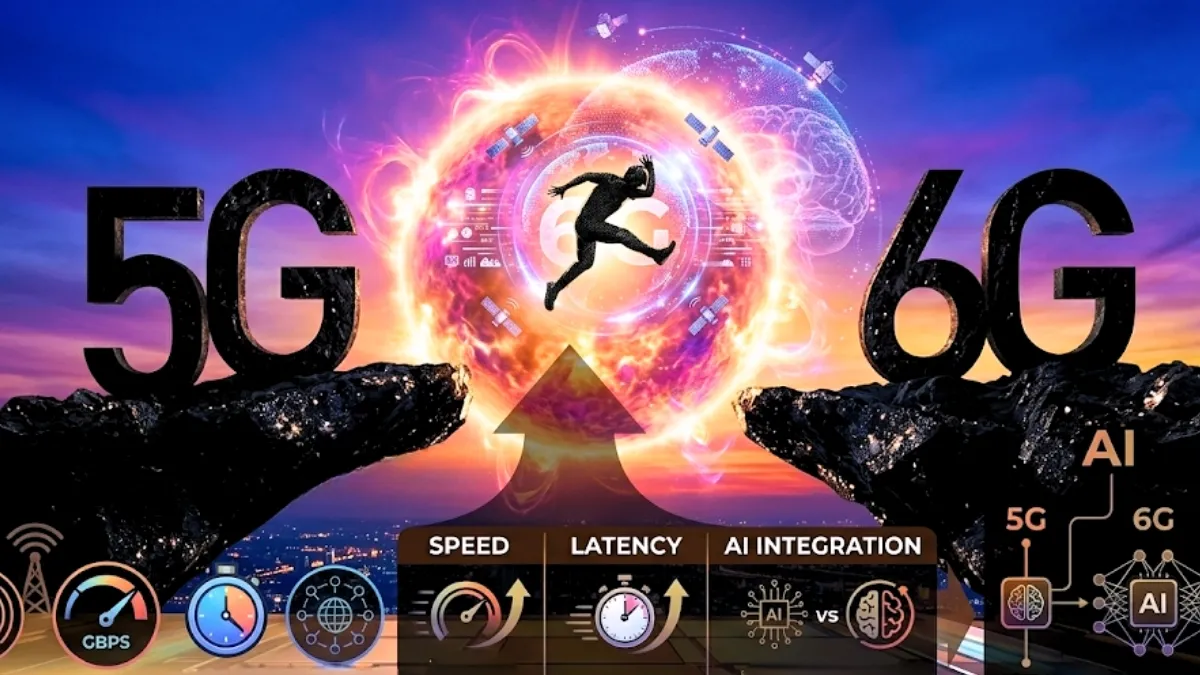
As of 2026, In the modern technological era 5G has become the global standard for high-speed mobile connectivity. The technological world is looking towards the new generation 6G. This is a faster version of 5G which represents a fundamental shift in how we interact with the digital world by merging high-frequency spectrums with AI-natives. 6G is designed to turn the entire network into a distributed brain, supporting a level of connectivity that was once the stuff of science fiction.
What is 5G Technology?
5G (Fifth Generation) was designed to connect not just people but machines, objects and devices. It introduced three major improvements:
-
eMBB (Enhanced Mobile Broadband): Faster data speeds for streaming and downloads.
-
URLLC (Ultra-Reliable Low-Latency Communication): Critical for autonomous vehicles and industrial automation.
-
mMTC (Massive Machine-Type Communications): Allowing up to 1 million devices per square kilometer.
While 5G brought us 4K streaming and the early stages of smart cities, it is reaching its physical limits in terms of bandwidth and processing intelligence.
What is 6G Technology?
6G (Sixth Generation) is the upcoming wireless standard that will utilize the Terahertz (THz) frequency band (95 GHz to 3 THz) while 5G was about connecting everything, 6G is about intelligent connectivity.
It is expected to offer a theoretical peak data rate of 1 Terabit per second (1 Tbps) roughly 50 to 100 times faster than 5G beyond speed, 6G focuses on Integrated Sensing and Communication (ISAC). The 6G technology network does not send the data but also "sees" and "senses" the physical environment, creating a seamless bridge between the physical and digital worlds.
Key Features of 6G:
6G introduces several revolutionary features that set it apart:
-
Terahertz Frequencies: Using sub-millimeter waves to provide massive bandwidth.
-
AI-Native Architecture: AI isn't just an "add-on"; it is built into the core of the network for self-optimization and self-healing.
-
Microsecond Latency: Reducing delay to less than 1 millisecond which targets 10–100 microseconds.
-
Global Coverage: Integration with Low Earth Orbit (LEO) satellites to provide 6G coverage in oceans, mountains and the sky.
-
Energy Harvesting: A focus on zero-energy devices that can power themselves using ambient radio waves or solar energy.
How 6G Redefines Speed, Latency, and AI Integration
The leap from 5G to 6G is characterized by three pillars:
1. Redefining Speed: 5G peaks at 20 Gbps, 6G aims for 1 TBPS to put that in perspective, downloading 142 hours of Netflix movies in one second. This speed is essential for Holographic Communication, where high-resolution 3D images of people can be transmitted in real-time for meetings or telehealth.
2. Redefining Latency: Latency in 5G is around 1–5 milliseconds. 6G targets sub-millisecond latency (under 0.1ms). This is critical for the "Tactile Internet," where a surgeon in London could operate on a patient in New York using a robotic arm with zero perceptible lag, feeling the resistance of the tissue as if they were there.
3. Redefining AI Integration: In 5G, AI is used to analyze data after it’s collected. In 6G, the network is AI-Native.
-
Edge Intelligence: AI processing happens at the device level, reducing the need to send data to central servers.
-
Semantic Communication: Instead of sending every pixel of a video, 6G AI understands the context. It might only send the data of a person's facial movements, and the receiving device’s AI reconstructs the rest, saving massive bandwidth.
-
Digital Twins: 6G will allow for real-time "Digital Twins" of entire cities or factories, where every physical movement is mirrored in a virtual model instantly.
Difference Between 5G and 6G Techanology
| Feature | 5G Performance | 6G Target |
| Peak Data Rate | 20 Gbps | 1 Tbps |
| Latency | 1–5 ms | < 0.1 ms |
| Connection Density | 1 Million devices/km² | 10 Million devices/km² |
| Spectrum | Sub-6 GHz, mmWave | Terahertz (THz) |
| AI Role | Optimization Tool | Core Architecture (Native) |
6G technology is a faster phone connection which is the backbone of a future technology. By 2030 6G is expected to power autonomous drone fleets, immersive metaverses and AI-driven smart grids that could solve global energy challenges by making it more intelligent.
Also Read: Which State is the Largest Producer of Uranium in India?



Comments
All Comments (0)
Join the conversation