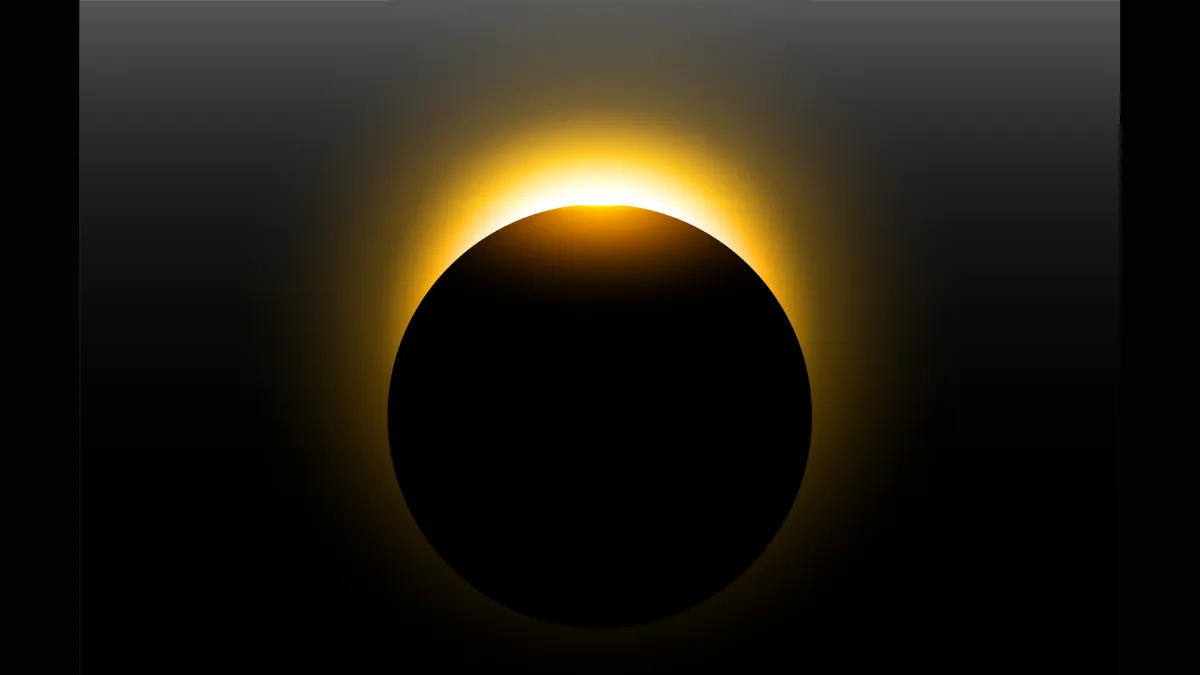
A lunar eclipse is a phenomenon that happens when the earth is in its exact position between both the sun and the moon and it throws a shadow on the surface of the moon. This astronomical phenomenon prevents direct sunlight from reaching the Moon and, as a result, it becomes extremely faint and tends to acquire a rather impressive reddish color, commonly referred to as a Blood Moon.
Among the solar eclipses, lunar eclipses can be seen anywhere in the night on the dark side of the planet, and as such, billions of people can observe it without having to travel to view it.
What are the Roles of Orbits in Lunar Eclipse?
The Earth spins on its axis around the Sun in yearly orbit but the Moon spins on its orbit around the earth in a monthly orbit, however the plane of this orbit is tilted by about 5 degrees in comparison to the orbit of the earth around the Sun called ecliptic.
This angle results in the Moon usually going slightly over or under the shadow of the Earth during the full moons, stopping an eclipse every month.
These eclipses are only visible in two precious seasons every year, separated by a span of approximately six months, when the orbit of the Moon crosses the plane of the ecliptic close to the new or full moon and the three bodies are all in perfect position.
In the case of a lunar eclipse, the Moon has to pass through the conical shadow of the earth, which is made up of the umbra (darker inner) and penumbra (light outer).
Types of Lunar Eclipses
There are three main types of lunar eclipses that get their names depending on the extent in which the Moon gets into the shadow of the earth.
-
Total Lunar Eclipse: The Moon goes directly through the center of the umbra, and she is in the middle of it throughout its entire length, and is, as a result, very richly reddish, the sunlight being refracted.
-
Partial Lunar Eclipse: only a part of the Moon will be covered in the umbra and the rest will be light or in the penumbra producing a characteristic bite out of the edge of the Moon.
-
Penumbral Lunar Eclipse: The Moon is gliding across the penumbra and hence a slight darkening is seen all over, which often cannot be noticed with the naked eye.
What is the Reason Behind the Red Color?
When it is in totality, all direct sunlight energy is blocked, however, the atmosphere of the earth acts as a natural filter, bending and scattering the incoming sunlight energy to the Moon.
The blue wavelengths are shorter and are dispersed like the sunsets on earth, whereas the red wavelengths are longer and are easily passed through giving the Moon a warm and rusty appearance and feeling like many sunsets around the world reflected on its surface.
This red is sometimes intensified by atmospheric conditions like dust, pollution or recent volcano eruptions leading to darker or lighter variations. This is the only characteristic that categorises total lunar eclipses and sets them apart as compared to others.
Frequency and Prediction
Eclipses of the moon happen two or five times a year, but total eclipses are even less frequent averaging two or three eclipses on earth each year because it demands strict alignment.
They repeat in regular patterns during saros cycles, which are periods of eclipses that recur every 18 years, 11 days, and the astronomers can predict the events centuries before it occurs due to models of orbital mechanics.
The calculations made are accurate due to historical data and gravitational simulations of NASA so in the case of the total lunar eclipse on March 3, 2026 the eclipse fits into a saros series. The approximate number of lunar eclipses in a 18 year cycle is 40, of which there are 1/3 total lunar eclipses.
Viewing Safely
Lunar eclipses are not harmful to the eyes and they can be safely observed with naked eyes wherever the Moon is above the horizon at the time of the lunar eclipse. Make the view more detailed with the help of the field glasses or a small telescope to observe the color gradient and the influence of the atmosphere on the Moon surface.
To see the moon, one needs as dark-sky observations as possible free from the effects of urban light pollution; it is always important to check local moonrise/set times and weather predictions with trusted apps such as Timeanddate or NASA eclipse resources.
There is no protection filter and no warning like solar eclipses; consequently, they are attractions throughout the year and family-friendly.
Check Out - List of Solar and Lunar Eclipses in 2026, Check Dates and Times!



Comments
All Comments (0)
Join the conversation