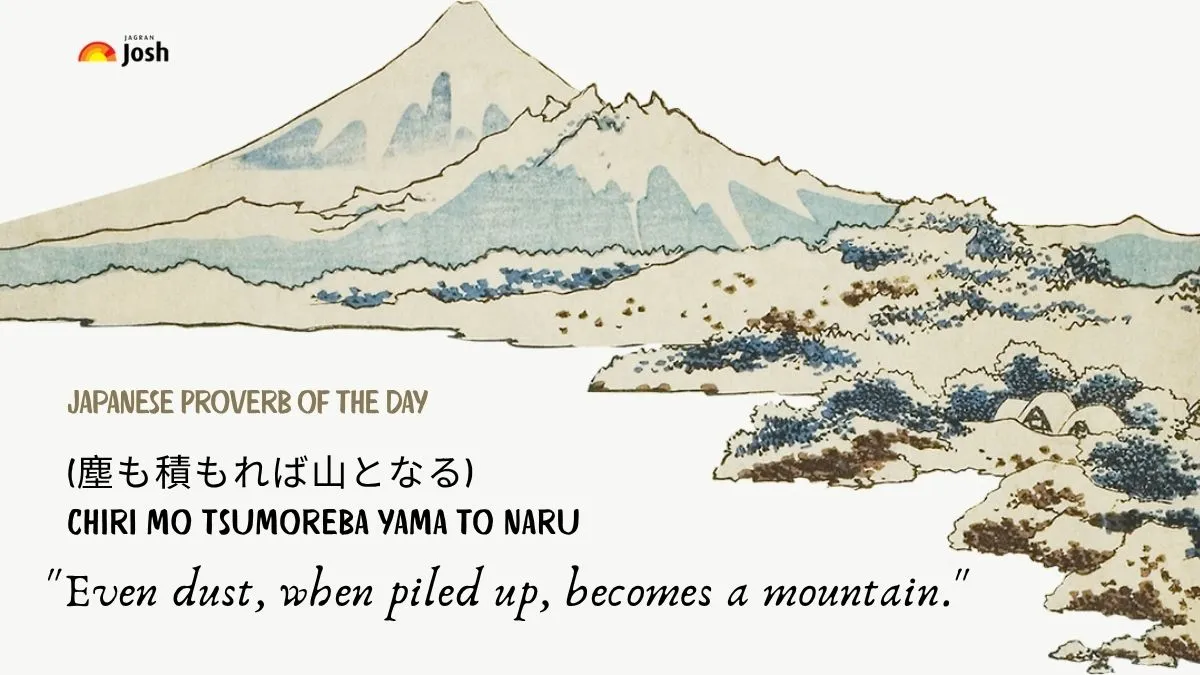
The most formidable structures in the natural world are rarely the result of sudden upheaval; they are the consequence of quiet, relentless accumulation. As you navigate the hyper-specialized landscape of 2026, the Japanese proverb of the day, "Chiri mo tsumoreba yama to naru" (塵も積もれば山となる), translated as "Even dust, when piled up, becomes a mountain", serves as a vital corrective to our obsession with the quantum leap. This isn't just a lesson in persistence; it is an observation of physical and spiritual truth. Whether you are refining a generative model or building a legacy, the dust of your daily labor is currently forming the peak of your eventual mountain.
Japanese Proverb of the Day
Japanese Proverb: Chiri mo tsumoreba yama to naru (塵も積もれば山となる)
Literal English Translation: "Even dust, when piled up, becomes a mountain."
Meaning of the Japanese Proverb "Even dust, when piled up, becomes a mountain"
In Japanese thought, this proverb bypasses the ego of the grand gesture to celebrate the power of the infinitesimal.
The Anatomy of Chiri (塵): While we view dust as something to be swept away, this proverb elevates it to a foundational element. It suggests that even the most negligible effort, one that seems invisible to the naked eye, retains its mass.
The Inevitability of Result: The use of the conditional ~ba suggests a logical certainty. If the accumulation continues, the mountain (Yama) is not a goal to be hoped for, but a mathematical certainty to be realized.
A Counter-Narrative to Instant: Unlike modern viral trends, this wisdom aligns with the Japanese concept of Kaizen (continuous improvement), asserting that greatness is earned through the sheer gravity of repeated action.
Everyday Lessons from this Japanese Proverb in Modern-Day?
In an era of deep-tech and digital noise, the application of Chiri mo tsumoreba is more practical than ever:
| Sector | The Dust (Small Action) |
| Cognitive Health | Reading 5 pages of physical text daily to maintain deep focus. |
| Wealth Management | Contributing micro-shares to diversified portfolios daily. |
| Professional Mastery | Documenting one failed prompt per day to build a personal "logic library." |
| Environmental Impact | Reducing one minute of high-energy compute time daily. |
What is the Origin History of this Japanese Proverb?
This proverb finds its cultural heartbeat in the Edo Period (1603–1867), an era characterized by a rigorous social structure and the rise of the merchant class, who valued thrift and steady growth.
"Do not mock the small, for it is the father of the great. The mountain does not refuse the dust, and thus it achieves its height." — Attributed to traditional Japanese folk wisdom.
Linguists frequently identify its philosophical origins in Buddhist sutras, which often employ metaphors of sand and dust to illustrate the immensity of time and the accumulation of karma. It eventually transitioned from a religious teaching to a secular mantra for the Chonin (townspeople), reinforcing the idea that steady, honest work is the only path to a sustainable mountain.
Also Read - "If you do not enter the tiger's cave, you will not catch its cub."
Is this a Japanese Proverb about Resilience?
While Westerners often view compounding through a financial lens, Chiri mo tsumoreba is fundamentally about resilience. In the modern world, dust also represents our failures. Every minor setback, every rejected draft, and every failed experiment is part of the pile. This proverb suggests that you don't need a perfect streak; you need to keep adding to the mound. The mountain doesn't care if the dust is gold or grey; it only cares that it stays.
Interesting Fact about this Japanese Proverb of the Day
The Japanese language uses specific counters and verbs that add layers to this proverb's meaning.
The verb Tsumoru (積もる) doesn't just mean to pile up; it specifically evokes the way snow accumulates on a roof or how silt settles at the bottom of a river. It implies a quiet, almost silent process that unfolds while the world looks elsewhere.
Furthermore, the kanji for Mountain (山) is a pictograph of three peaks. It serves as a visual reminder that a single peak is never the whole story; a "mountain" is always a collective of various high and low points.
Read More Japanese Proverbs and Their Meanings Here!
“Fall Seven Times, Stand Up Eight.”
"Even monkeys fall from trees."
True authority is built one grain at a time. As you move through your day, remember that no effort is wasted if it is added to the pile. Embody this wisdom today, and return tomorrow for your next Japanese proverb of the day.