Hubble vs James Webb vs Roman Telescope: Differences, Orbit and Wavelength Comparison
Hubble vs James Webb vs Roman Space Telescope: Compare NASA’s 3 major space observatories by mirror size, field of view, orbit and wavelength.
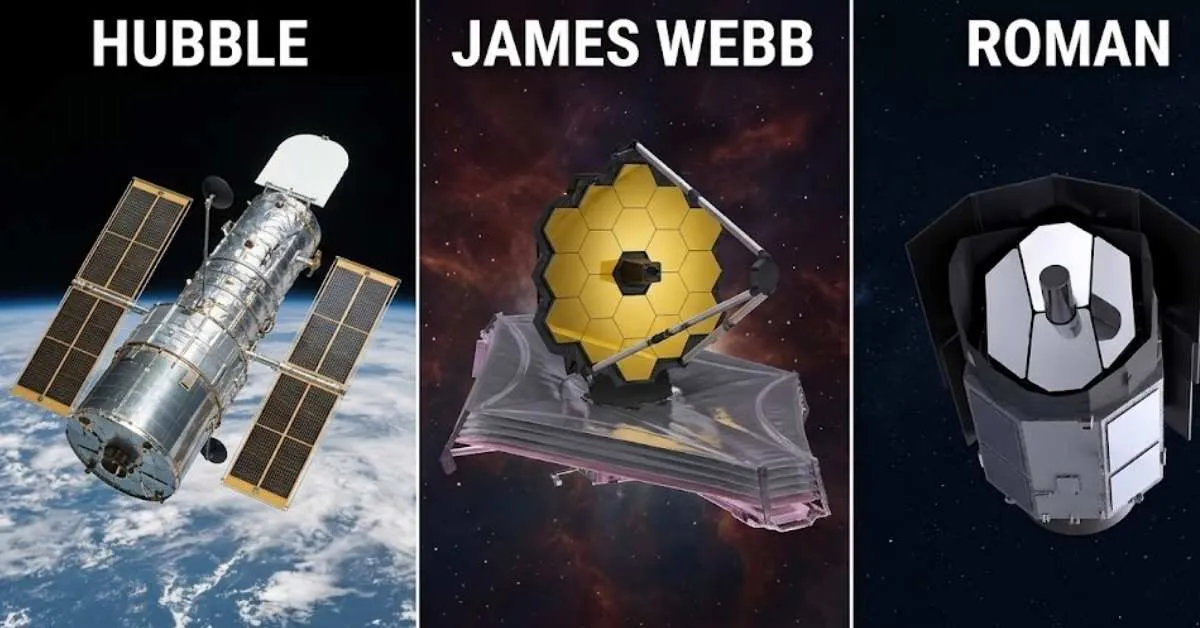
NASA has developed its strategy for space exploration using three observatories which are the Hubble Space Telescope (HST), the James Webb Space Telescope (JWST) and the Nancy Grace Roman Space Telescope which has just been launched.
Hubble has functions in optical wavelengths while Webb operates using infrared waves. Roman Space Telescope provides wide-angle images of space.
| Feature / Parameter | Hubble Space Telescope (HST) | James Webb Space Telescope (JWST) | Nancy Grace Roman Space Telescope |
| Launch Year | 1990 | 2021 | August 2026 |
| Orbit Location | Low Earth Orbit (547 km) | Sun-Earth Lagrange Point 2 (L2) (1.5M km) | Sun-Earth Lagrange Point 2 (L2) (1.5M km) |
| Primary Mirror Diameter | 2.4 meters | 6.5 meters (segmented) | 2.4 meters |
| Primary Wavelength Range | Ultraviolet, Visible, Near-Infrared | Near-Infrared & Mid-Infrared | Near-Infrared and Visible |
| Wavelength Span | 0.1 to 2.5 micrometers (μm ) | 0.6 to 28.5 micrometers (μm ) | 0.5 to 2.3 micrometers (μm ) |
| Field of View (FOV) | Narrow (0.05 sq degrees) | Narrow (0.05 sq degrees) | 100x larger than Hubble |
| Primary Science Goal | General optical/UV cosmology, planetary imaging | First stars, galaxy evolution, exoplanet atmospheres | Dark energy, exoplanet microlensing, wide surveys |
Hubble vs James Webb vs Roman Telescope: Mission Objectives
Hubble: Determining how fast the cosmos is expanding (Hubble constant), evaluating the progress of the galaxies, as well as looking for the planetary dynamics within the solar system.
James Webb: Created to study the formation of stars in the period after the Big Bang, take photographs of stars emerging inside gas clouds, and learn about the conditions in the atmospheres of exoplanets.
Nancy Grace Roman: Designed to investigate dark energy and dark matter in the universe and make a lot of statistical maps as well as perform microlensing surveys for exoplanets.
Hubble vs James Webb vs Roman Telescope: Structural Differences
The Wavelength Spectrum (As Perceived by Each Telescope)
-
The Hubble Space Telescope uses UV and visible light with some ability in the near-infrared range, producing images that are close to the true-to-life colors visible to the human eye.
-
The James Webb Space Telescope is calibrated for mid-infrared and near-infrared wavelengths and can see through clouds of cosmic dust, detecting the redshift of light from the early universe.
-
The Nancy Grace Roman Space Telescope will work in the near-infrared and visible parts of the spectrum, acting as a link between the Hubble’s optical telescopes and the Webb’s deep infrared ones.
Orbit Location and Thermal Requirements
-
Low Earth Orbit (Hubble): The Hubble Space Telescope takes around 95 minutes to make a complete orbit around the Earth at an elevation of nearly 547 kilometers from the surface of the Earth. Due to the proximity of the telescope to the Earth, it has undergone many servicing missions by NASA Space Shuttles.
-
Lagrange Point 2 (Webb & Roman): Both the James Webb Space Telescope as well as the Roman Space Telescope are stationed at the second Lagrange point (L2), which is about 1.5 million kilometers removed from the Earth. The L2 position is excellent since it is a position of gravitational stability and does not experience the thermal radiation of the Earth.
Field of Vision: Deep Zoom vs. Broad Survey
-
Teleportation Lens (Hubble and Webb): Hubble and Webb have lenses designed for capturing highly detailed but narrow and isolated areas of the sky with great precision.
-
Field of Vision (Roman): The main tool of Roman is the Wide Field Instrument (WFI) which has the ability to catch an image 100 times larger than that of the Hubble camera in a single shot with an equal resolution. While the Hubble takes no less than several decades to complete mapping one part of the Universe, Roman is capable of finishing such surveys within weeks.
| Telescope | Primary Wavelength Range | Wavelength Span |
| Hubble (HST) | Ultraviolet, Visible, Near-Infrared | 0.1 to 2.5 μm |
| James Webb (JWST) | Near-Infrared, Mid-Infrared | 0.6 to 28.5 μm |
| Roman Space Telescope | Visible, Near-Infrared | 0.5 to 2.3 μm |
The Hubble, James Webb and Nancy Grace Roman Space Telescopes mark a collaborative, cross-generational initiative in the improvement of telescope technologies and the expansion of their range of capabilities rather than shifting from one technological novelty to another: Hubble detects details in visible and ultraviolet light, James Webb breaks through cosmic dust into the infra-red universe and Roman provides wide-view surveys.
The launch of Nancy Grace Roman Space Telescope in August 2026 has provided astronomers with the coolest quartet of telescopes ever developed in this area. The combined capabilities of team of three telescopes helps to connect very small planetary details with large cosmic maps, which open ways for tremendous discoveries in dark energy, dark matter and exoplanet exploration.

Manisha Waldia is a distinguished content strategist with 5 years of experience crafting premium educational content for UPSC and State PCS, with a focus on deep conceptual analysis across Polity, Geography, History, and Environment. She currently brings this expertise to Jagran Josh, where she covers major national and international events, current affairs, and static general knowledge. Over her career, Manisha's specialized insights have led her to curate high-impact materials and serve as a UPSC Mains answer-evaluator for India’s top institutes—including Drishti IAS, Shubhra Ranjan IAS, Study IQ, GS Score, and PWonlyIAS. She has also worked alongside leading NGOs like Oxfam India and Avani Kumaon.
Contact: manisha.waldia@jagrannewmedia.com


![[Out] UGC NET June 2026 Result Live: यूजीसी नेट रिजल्ट ugcnet.nta.nic.in जारी, डायरेक्ट लिंक से करें चेक](https://img.jagranjosh.com/images/2026/August/2782026/UGC-NET-Result-2026-Marksheet-link-pdf.jpg)