Difference Between a Barcode and a QR Code
Discover the key differences between barcodes and QR codes. Learn how 1D and 2D codes compare on data capacity, scanning tools, error correction, and real-world uses.
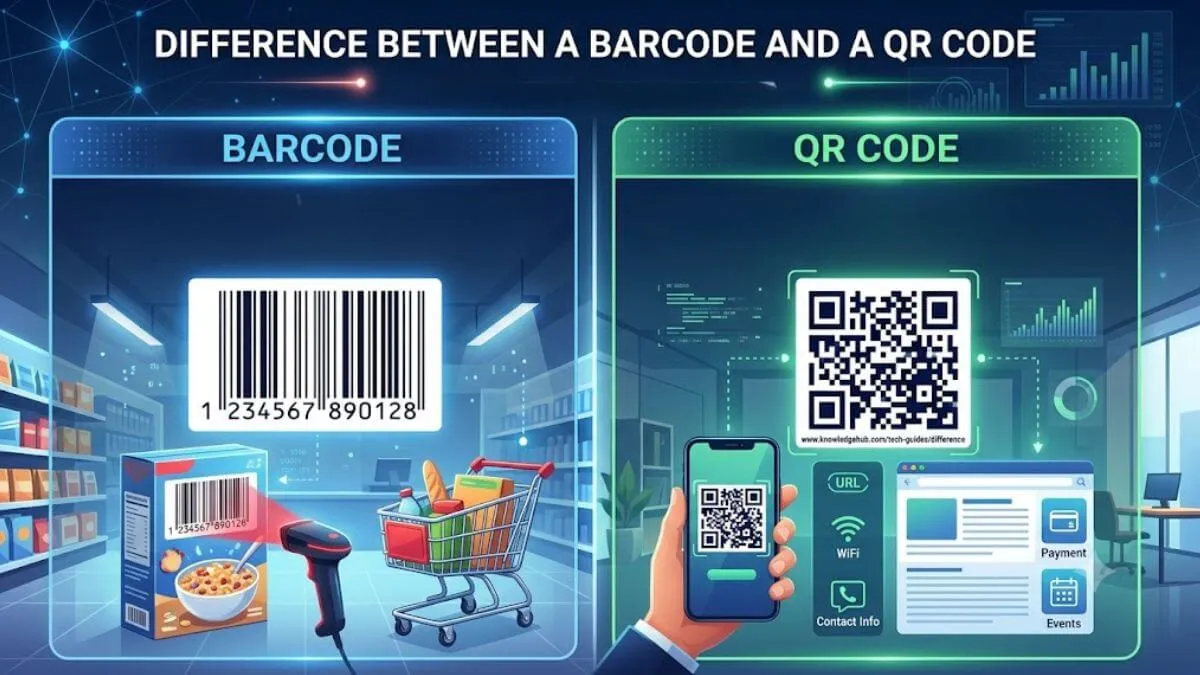
Difference Between a Barcode and a QR Code:
A Barcode is a 1-D code that contains just simple numbers or letters. A QR Code is a 2D square code that can contain a lot more information such as website links, payment information, contact information and so much more. While both codes are machine-readable.
Key Takeaways
-
The Barcode was invented in 1952 by Norman Joseph Woodland. QR Code was first developed by Masahiro Hara of Denso Wave, Japan in 1994.
-
Barcodes are one dimensional and carry limited information – only 8-25 characters. QR codes are 2-D codes and can contain thousands of characters.
-
QR codes can be scanned by any modern smart phone. Usually, a barcode needs its own laser scanner.
-
This QR code has its own error correction, it can still be read if part of the code is dirty or scratched. This is not available for barcodes.
-
Barcodes work well in supermarkets/supply chains. QR codes are more suitable for payment apps, websites, menu and digital contents.
-
QR Code is short for "Quick Response.
-
'QR Code' is a registered trademark of DENSO WAVE INCORPORATED.
What is a Barcode?
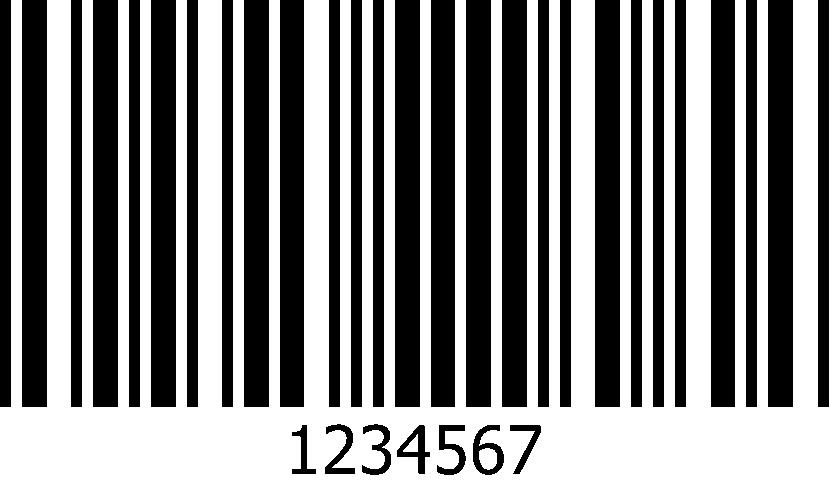
Source: nationwidebarcode
If you've ever purchased an item at a grocery store, you've probably noticed a barcode. It's that little black and white block of vertical stripes on the packaging of products.
The cashier scans the code with a handheld scanner and in a second, the name of the product and the price is displayed on the billing screen.
A barcode is a code that is printed as a series of bars and spaces and then read by a machine.
It was invented in 1952 by Norman Joseph Woodland and Bernard Silver in the USA. The concept was extended from Morse Code, but instead of dots and dashes it was to be "lines".
A barcode is most commonly in the form of a 1-dimensional (1D) barcode. This means that it can only store data from left to right. Those lines’ width and spacing indicate what number or letter is coded there to a scanner.
Where Are Barcodes Used?
-
In supermarkets to monitor products at the cashier's stand
-
In hospitals to keep patient records and medicine labels
-
In libraries to keep books account of
-
For baggage tracking in airlines
-
In renting car services for vehicle tracking,
-
For tracking letter and parcels services in the post sector
Types of Barcodes
Two types of barcodes are:
1. 1D Barcodes (One-Dimensional)
These are the most easily recognisable ones found on everyday products in shops. They draw parallel perpendicular lines. Examples are the UPC (Universal Product Code) barcodes that are printed on consumer goods and the EAN (European Article Number) barcode which is used extensively in India and abroad.
2. 2D Barcodes (Two-Dimensional)
These barcodes can hold information both vertically and horizontally. The QR Code is actually a form of 2D barcode. Other examples are PDF417 codes (used on driving licenses and boarding passes) and Data Matrix codes (used on electronics and healthcare packaging).
Limitations of a Barcode:
-
Has a very small capacity for storing data (8-25 characters only)
-
Requires special laser scanner to read the material and not a phone camera.
-
It is not possible to correct any errors if there is even a small scratch.
-
Does not have colour or logo customisation options
-
Can only be scanned at one particular angle
What is a QR Code?

QR Code, which stand for “Quick Response Code”. The image appears to be a close-up of a white background with black dots and designs arranged in a square-like pattern. Whether it's on a restaurant menu, a UPI payment screen, an event ticket or a product package, you've likely spotted it.
The QR Code was developed by a Japanese firm Denso Wave in 1994 by the team lead by Masahiro Hara. It was originally developed by Denso Wave for use in tracking parts in factories. The aim was to produce a code that could be scanned with ease, from any angle, hence the term "Quick Response.
A QR code is a two dimensional (2D) code, as opposed to a barcode. It is used to store data horizontally and vertically. This is how it gets to store so much in this little square. "QR Code" is a registered trademark of DENSO WAVE INCORPORATED.
Where Are QR Codes Used?
-
UPI and Digital payments (Google Pay, PhonePe, Paytm).
-
Scanning of links to open website or apps
-
Information on restaurant menus and hotels
-
Event tickets and Boarding passes
-
Sharing contact information (vCards)
-
Government services and Aadhaar-linked documents in India
-
COVID-19 vaccination certificates
-
Product authenticity verification
Types of QR Codes
1. Static QR Codes
The information in a static QR code is permanently embedded into the code itself. Its value is set once, and cannot be changed. Since the destination website can change, you need to print a new QR code. These are useful for a single use or for information such as a WiFi password or a product serial number.
2. Dynamic QR Codes
The destination of a dynamic QR can be modified at any time, while the QR remains the same. For instance, a restaurant can have a QR code printed on their menu, and update their online menu as many times as they like without the need to reprint. Dynamic QR codes also provide tracking data such as the number of times the code was scanned, the time that the scan happened, and the location or device used to scan the code. Barcodes don't have this tracking capability in any way.
What is Error Correction in QR Codes?
This is one of the most handy QR code features. Even if a section of the QR code becomes scratched or torn, or has a logo over a portion of it, it can still be scanned; this is called error correction. QR codes can be damaged by up to 30% and function perfectly. Barcodes don't have that ability. A single scratch to a barcode can render it unreadable.
QR codes have four levels of error correction: Level L (7 recovery), Level M (15 recovery), Level Q (25 recovery) and Level H (30 recovery). That's why you might see logos in the middle of QR codes without it interfering with their ability to be scanned.
Barcode vs QR Code:
Here is all the difference between Barcode and QR Code is given below in table:
| Parameter | Barcode | QR Code |
| Full Form | No full form. It is simply called a Barcode. | QR stands for Quick Response Code. |
| Invented In | 1952 | 1994 |
| Inventor | Norman Joseph Woodland | Masahiro Hara (Denso Wave, Japan) |
| Type / Dimension | Mostly 1D (one-dimensional); some 2D variants also exist. | Always 2D (two-dimensional) |
| Shape / Look | Vertical parallel lines (black and white stripes) | Square grid with black dots and squares |
| Data Storage | Stores 8 to 25 characters (numbers/letters only) | Stores up to 7,089 numeric or 4,296 alphanumeric characters |
| Data Direction | Stores data in one direction only (horizontal) | Stores data in two directions (horizontal + vertical) |
| Scanner Needed | Needs a dedicated laser barcode scanner | Any modern smartphone camera can scan it |
| Error Correction | No built-in error correction. A scratch can make it unreadable. | Has built-in error correction. Works even if 30% of the code is damaged. |
| Customisation | Cannot be customised. Must follow strict standard format. | Can include logos, brand colours, and custom designs. |
| Data Types Supported | Numbers and limited alphanumeric text only | Numbers, text, URLs, images, audio, video links, contact info, payments, etc. |
| Common Uses | Supermarkets, hospitals, luggage tracking, library books, rental cars | UPI payments, website links, event tickets, product info, restaurant menus |
| Cost | Very low cost to print and scan | Slightly higher but still very affordable |
| Scanning Angle | Must be aligned properly for scanning | Can be scanned from any angle |
| Internet Needed | Not needed for scanning | Needed if the QR code links to a website or online content |
Interesting Facts About Barcodes and QR Codes
-
Wrigley's chewing gum was the first product ever scanned with a barcode at a Ohio supermarket in the USA on June 26, 1974.
-
The QR code was initially developed to track auto parts in Toyota factories in Japan.
-
The name ‘QR Code' is a registered trademark of DENSO WAVE INCORPORATED which permits the use of the technology free of charge worldwide.
-
A QR code can be read even if 30% of its image is covering or damaged.
-
The three square patterns located in the three corners of a QR code allow the QR code scanner to detect the position, size and direction of the code quickly.
-
QR code technology plays a significant role in powering the fastest-growing digital payment system in the world, India's UPI system.

Prabhat Mishra is a Subject Matter Expert and digital journalist with an extensive background in the competitive exam landscape and over 4 years of experience in education, national and international news, and current affairs. Over his tenure with top knowledge platforms like Mentorship India, IAS BABA, IAS SARTHI, and now Jagran Josh, he has a deep understanding of government exams like UPSC and State PCS, including UP and Bihar, as he has already qualified for the UPPCS 2022 Mains and Bihar 68th Mains. With his core expertise in history, polity, geography & current affairs, he specialises in creating well-researched, aspirant-centric content and simplifying complex topics for competitive examinations.


