Show Key Points
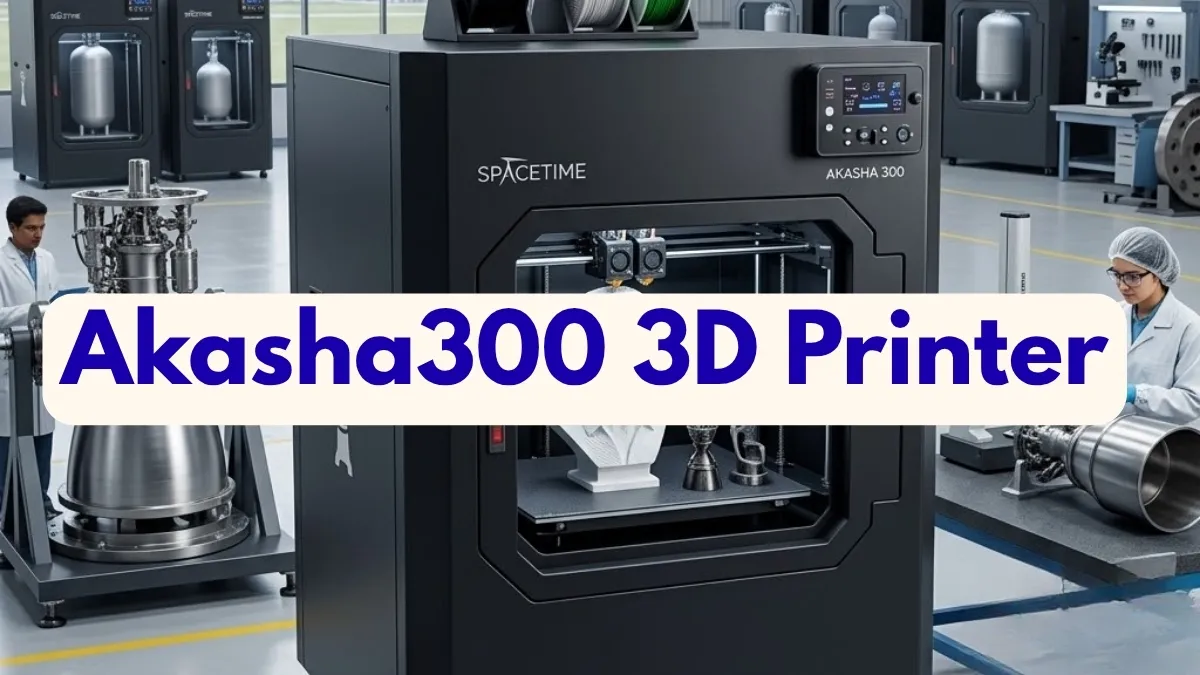
Akasha300 3D printer is an industrial-grade, high-temperature 3D printer developed by Spacetime 4D Printing Solution. Spacetime is a startup based in Kerala which has been recently delivered to ISRO’s Liquid Propulsion Systems Centre (LPSC).
Akasha300 3D Printer machine is designed to manufacture complex aerospace components using advanced polymers and composites with ability to print at temperatures up to 500°C which marks a significant leap in India’s self-reliance (Atmanirbhar Bharat) for space manufacturing.
What is the Akasha300 3D Printer?
The Akasha300 is a high-temperature, multi-material extrusion 3D printer. The Akasha300 is a specialized industrial research platform, engineered to handle engineering-grade thermoplastics and composites that are essential for the extreme environments of space.
It is developed with significant backing from the Space Technology Innovation and Incubation Centre (STIIC) at the Indian Institute of Space Science and Technology (IIST) and the Kerala Startup Mission (KSUM).
The dual-extrusion system allows for simultaneous printing of two different materials—for example, a high-strength polymer for the part and a soluble material for complex support structures.
Key Features:
| Feature | Specification |
| Max Nozzle Temp | 350°CUpgradeable to 550°C |
| Technology | Dual-Extrusion (Multi-material capability) |
| Heated Bed | Up to 110°C Upgradeable to 150°C |
| Chamber Type | Enclosed, temperature-controlled up to 80°C |
| Safety | Integrated Air Filtration and Robust Motion System |
| Design | Modular Extruder Architecture for hybrid manufacturing |
Strengthening the Deep-Tech Ecosystem and its Impotance:
The Akasha300 is a prime example of the success of the IN-SPACe initiative, which encourages collaboration between ISRO and private players.
-
Indigenous Innovation: Founded by Akhil Madhavan and his team in 2020, Spacetime 4D has proved that Indian startups can build world-class industrial hardware.
-
Rapid Prototyping: Engineers can now design, print and test engine components in days rather than months, significantly shortening the development cycle for new propulsion systems.
-
Advanced Material Usage: The high-temperature capability allows ISRO to experiment with materials like PEEK, PEKK, and carbon-fiber-reinforced composites, which offer high strength-to-weight ratios.
-
Cost Efficiency: In-house 3D printing reduces the cost of specialized tooling and minimizes material waste compared to traditional subtractive manufacturing (milling/turning).
-
Aatmanirbhar Bharat: By producing these printers domestically, India reduces its reliance on expensive imports from Europe or the US for additive manufacturing tech.
-
Scale of Research: Positioned as a research platform, the Akasha300 will likely be used to develop next-generation semi-cryogenic engine components and satellite hardware.
The Akasha300 isn't just a machin. It is a testament to the lab-to-launchpad journey of Indian startups as ISRO continues to push toward the Bharatiya Antariksh Station and future lunar missions, tools like the Akasha300 will be the silent workhorses behind the scenes.
Also Read: Asteroid Ryugu: Location, Size, Surface and All DNA/RNA Building Blocks


-1774447541216_t.webp)


Comments
All Comments (0)
Join the conversation