
Key Points
- Union Budget 2026-27 is a 'Yuva Shakti-driven Budget' inspired by young leaders.
- Ministry of Finance received the highest allocation in Union Budget 2026-27.
- Defence Ministry got the second highest allocation: ₹7.85 lakh crore in 2026-27.
Union Budget 2026-27: As per the FM, the Union Budget 2026-27 is termed to be Yuva Shakti-driven Budget. She said in the speech that “In the Viksit Bharat Young Leaders Dialogue 2026, several innovative ideas were shared with our Prime Minister, which have inspired many of the proposals, making this a unique Yuva Shakti-driven Budget”.
The allocations that were made in the Budget were provided after taking into consideration the Sankalp of the government to focus on the poor, underprivileged and the disadvantaged. To fulfil this Sankalp, the Budget provides for 3 Kartavya:
-
To accelerate and sustain economic growth, by enhancing productivity and competitiveness, and building resilience to volatile global dynamics.
-
To fulfil aspirations of our people and build their capacity, making them strong partners in India’s path to prosperity.
-
To ensure that every family, community, region and sector has access to resources, amenities and opportunities for meaningful participation.
Watch this Full Video to Understand Union Budget:
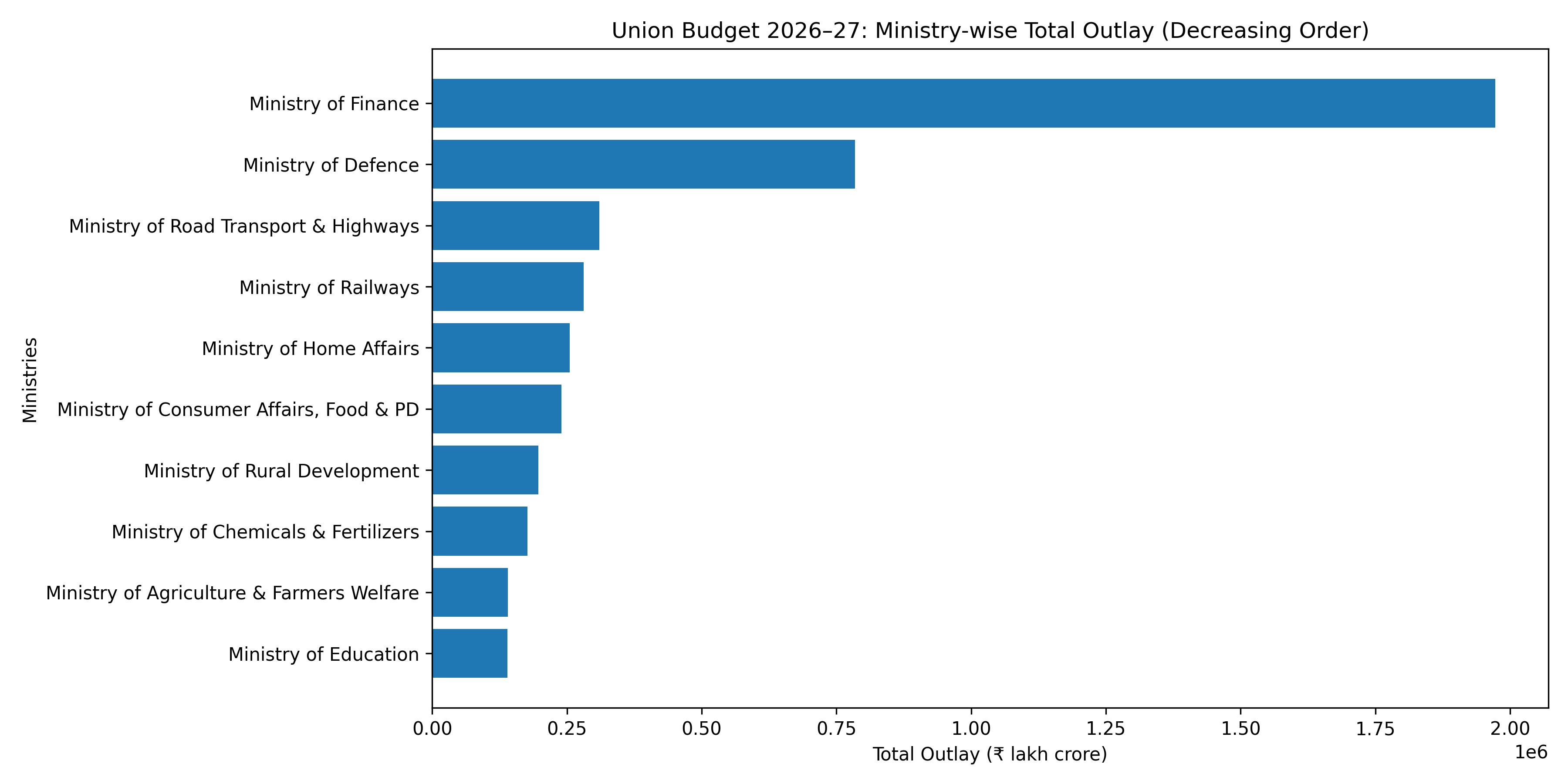
Top 10 Ministries With Highest Allocation In Union Budget 2026-27
The Union Budget 2026 has given the highest allocation to the Ministry of Finance, which is the usual norm and then the second highest allocation was given to the Ministry of Defence with a total outlay of 7.85 lakh crore. Here we have provided the list of top 10 ministries with highest budget allocation in the Union Budget 2026-27.
1. Ministry of Finance
The Ministry of Finance has got the highest allocation with a total outlay of ₹1972509.48 lakh crore. The outlay for revenue expenditure is 17.22 lakh crore and for capital expenditure is 2.50 lakh crore.
2. Ministry of Defence
The Union Budget 2026-27 has allocated a total budget of ₹784678.28 lakh crore to the Ministry of Defence. The revenue budget allocated for the Defence Ministry is ₹5.54lakh crore and the capital budget is ₹2.31 lakh crore.
3. Ministry of Road Transport and Highways
The Road Transport and Highways ministry got the third highest allocation in the Union Budget 2026 with a total outlay of ₹309875.30 lakh crore with the allocation more focused on capital budget for creating road infrastructure, logistics efficiency, etc.
4. Ministry of Railways
The Railway Ministry got the total budget of ₹281377.3 lakh crore which focused again on the capital budget by allocating ₹2.77 lakh crore and the remaining for the revenue budget.
5. Ministry of Home Affairs
The Finance Minister has announced a total outlay of ₹255233.53 lakh crore to the Ministry of Home Affairs with the revenue budget being higher than the capital budget at ₹2.28 lakh crore.
6. Ministry of Consumer Affairs, Food, and Public Distribution
The Union Budget 2026-27 has allocated a total outlay of ₹239521.37 lakh crore for the Ministry of Consumer Affairs, Food, and Public Distribution, with majority allocation is given to the revenue expenditure.
7. Ministry of Rural Development
The Ministry of Rural Development has got the total budget of ₹197023.14 lakh crore, where the total allocation goes to the revenue part of the budget.
8. Ministry of Chemicals and Fertilizers
The allocation to the Ministry of Chemicals and Fertilizers is ₹1.77 lakh crore. The major chunk of the total allocation has been allocated to the revenue budget.
9. Ministry of Agriculture and Farmers Welfare
The Ministry of Agriculture and Farmers Welfare has been allocated a total budget of ₹140528.78 lakh crore in the Union Budget 2026-27. The allocation is majorly towards the revenue budget and it focuses to enhance farmers income, support agri-tech initiatives such as Bharat-VISTAAR, and other allied activities.
10. Ministry of Education
Under the Union-Budget 2026-27, the Ministry of Education has been allocated a total of ₹139289.48 lakh crore totally dedicated for the revenue expenditure to create infrastructure for schools, higher education, research and development, initiatives for girls hostel, STEM education, etc.



Comments
All Comments (0)
Join the conversation