Modern Iraq is a state with antiquities going back to some of the earliest civilizations. It is commonly accepted as being a starting point for mankind. Additionally, agriculture, writing, law, and the rise of towns began to develop here before they occurred anywhere else.
Because of the abundance of fertile soil along its river systems, various groups chose to settle here and construct powerful cities, build extensive trading networks and create governmental systems.
From the time of those early people, the land has been part of multiple empires and each of those empires left behind elsewhere, a culture, a government, or an intellectual contribution. Over the years, without any semblance of permanence, the name this land has been called has changed throughout history and these names, which are often based on geographic location, have changed due to whatever nation was present at the time.
Check Out: What Was the Old Name of Iran?
What is the Old Name of Iraq?
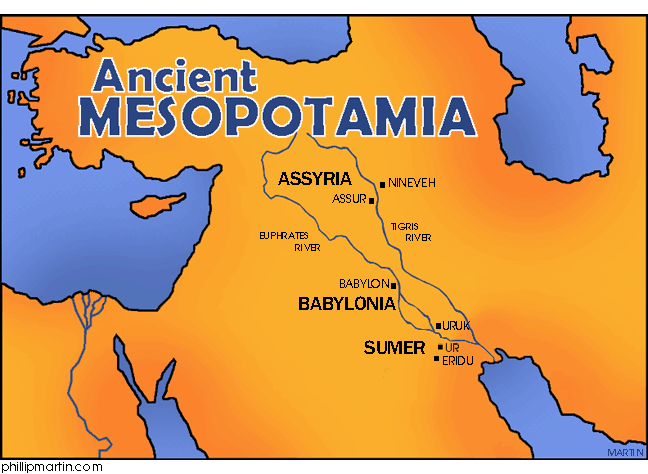
Source: Philip Martin
Iraq was originally named Mesopotamia, which means "the land between two rivers," referring to the Tigris and Euphrates Rivers in Ancient Greece. The Sumerians, Akkadians, Babylonians, and Assyrians built some of the first civilizations in history in Mesopotamia, which is often referred to as the "Cradle of Civilization".
When many of the world's major advancements were made such as the invention of writing, codified laws, and complex cities, Mesopotamia served as a location for these achievements. As political boundaries changed and new powers emerged, the ancient name was eventually lost and replaced with the name “Iraq.”
Why Was Iraq Called Mesopotamia?
The term Mesopotamia refers to the land between the two rivers Tigris and Euphrates. The term is derived from two Greek words: mesos for "between" and potamos for "river", hence "land of rivers".
Due to these 2 rivers being so fertile, agriculture, permanent habitation and even cities arose. As a result of this type of geography within a large part of current-day Iraq, the area was often referred to by historians and other academics as Mesopotamia because it was river-based.
Why Did Mesopotamia Change to Iraq?
The change of the name Mesopotamia to Iraq occurred due to changes in politics, culture, and government over a long period of time. Mesopotamia was the geographical and historical term which the ancient Greeks and later historians used mostly to refer to the area in between the Tigris River and the Euphrates River. Mesopotamia was never an official name of one country.
Through the rise and fall of empires such as the Persian Empire, the Arab Empire, and the Ottoman Empire, people began calling the area by names used in the local language especially Arabic.
Conclusion
To conclude, the name "Mesopotamia" refers to both historical and geographical concepts of an ancient civilization, whereas a new nation-state called Iraq developed through cultural change, regional control, and emerging contemporary political identity throughout the 20th century.
The name Iraq became the most common name used during the early Islamic period and was formally adopted as the name of Iraq when the modern nation-state of Iraq was created in the 20th century after the end of World War I.





Comments
All Comments (0)
Join the conversation