CAG Audit Reveals Major Flaws In IIM Rohtak Fees And Governance


The CAG has flagged several issues at IIM Rohtak, including high fees, poor financial planning and irregular director payment. Read the article to know more details.
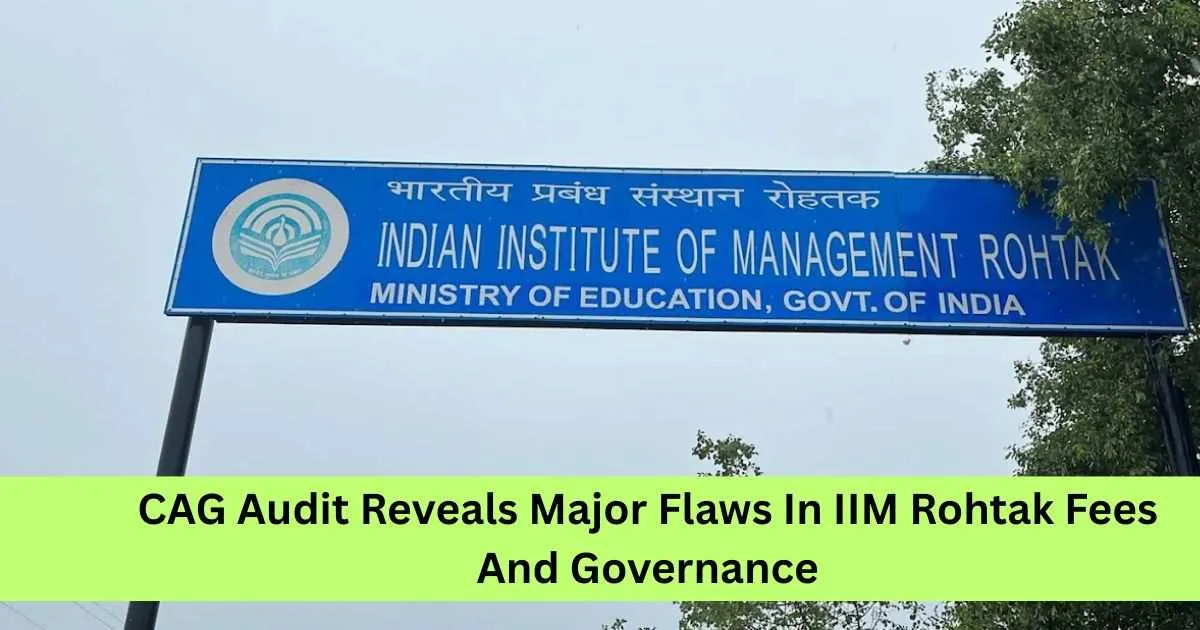
The recent CAG audit report has raised serious questions about the way IIM Rohtak handles its IIM Rohtak fees and overall administration. Once known as one of the best places for management education the institute now faces criticism for many lapses. The report points to problems in fee decisions, board formation rule changes, contracts and even faculty payments. It also flagged accounting issues and a clear lack of rule following at IIM Rohtak. The audit was done at the request of the Union Ministry of Education and the full report on IIM Rohtak has been tabled in parliament.
No Budget Plan Led To High IIM Rohtak Fees
The audit found that IIM Rohtak never made an annual budget to estimate its revenue and expenditure. This is a basic tool for any financial planning. Because there was no proper assessment of money needs the institute ended up with a very high fee structure. This goes against the stated goal of making quality education more affordable. The same concern was already raised in an earlier 2019-21 audit report. Even after being flagged once the institute did not fix the issue. IIM Rohtak claims full financial autonomy but the reasons behind the IIM Rohtak fee increase still remain unclear. The institute has also been running with a large surplus every year which makes the fee hike even harder to justify. There is no clear fee structure or financial plan in place. The case for restructuring IIM Rohtak fees on a need based model is now stronger than ever.
Director Pay and Governance Issues Flagged
The CAG audit into IIM Rohtak fees covered financial records from 2009-10 to 2023-24 and operational data from 2019-20 to 2024-25. In the establishment part of the report the CAG called these problems “systematic violations of financial and governance norms.” The report also spoke about weak internal controls, poor documentation and a general lack of rule following. One of the biggest issues was the variable pay given to the institute directors. The rules for such payments came into effect only in October 2021. Yet the institute applied them in a retroactive way for the years 2018-19 to 2020-21. The ministry of Education agreed with this finding. It noted that there was no proper regulation or paperwork for variable pay. The ministry has now said that all such payments made between 2018-19 and 2024-25 should be recovered.
Faham is an education specialist and has over three years of experience in the education and edtech industry, specializing in digital and educational content creation. He holds an MBA in Marketing and Human Resources from Swami Vivekanand University. Throughout his career, Faham has developed expertise in creating engaging and informative content across diverse educational domains.
In addition to his edtech experience, he worked for two years as a Public Speaking and Creative Writing Expert, helping learners enhance their communication and writing skills. He has also been associated with Testbook and Adda Education as a Content Writer, where he created high-quality content for K–12 education, Management Entrance Examinations, UPSC, Law, and State Defence examinations. His strong understanding of educational content and exam preparation enables him to simplify complex topics and deliver valuable learning resources to students.