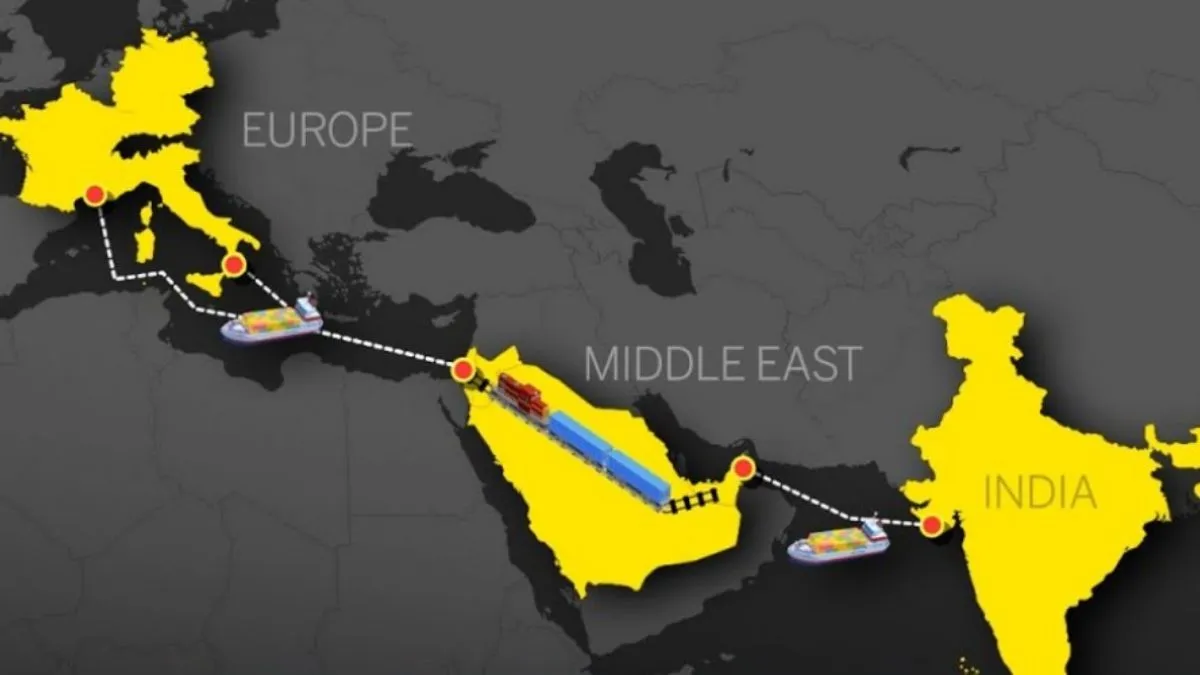
Launched on 9 September 2023 at the G20 Leaders' Summit in New Delhi, the India-Middle East-Europe Economic Corridor, commonly known as IMEC, is a strategic economic corridor to bolster global trade and connectivity between three continents, namely Asia, the Middle East, and Europe.
The India-Middle East-Europe Economic Corridor is a multi-modal transport system, which includes roads, railways, maritime routes, and digital infrastructure. At the core of IMEC's transit network is railway infrastructure. To supplement the railway network, road transport and maritime routes will be developed. Beyond the transit network, the corridor will also include digital connectivity by deploying high-speed data cables, energy grids, and hydrogen pipelines.
The IMEC will comprise two separate corridors: the East Corridor that will connect India to the Arabian Gulf and the North Corridor that will connect the Gulf to Europe. The corridor is seen as a counter to China's Belt and Road Initiative.
Which countries are part of the India–Middle East–Europe Economic Corridor?
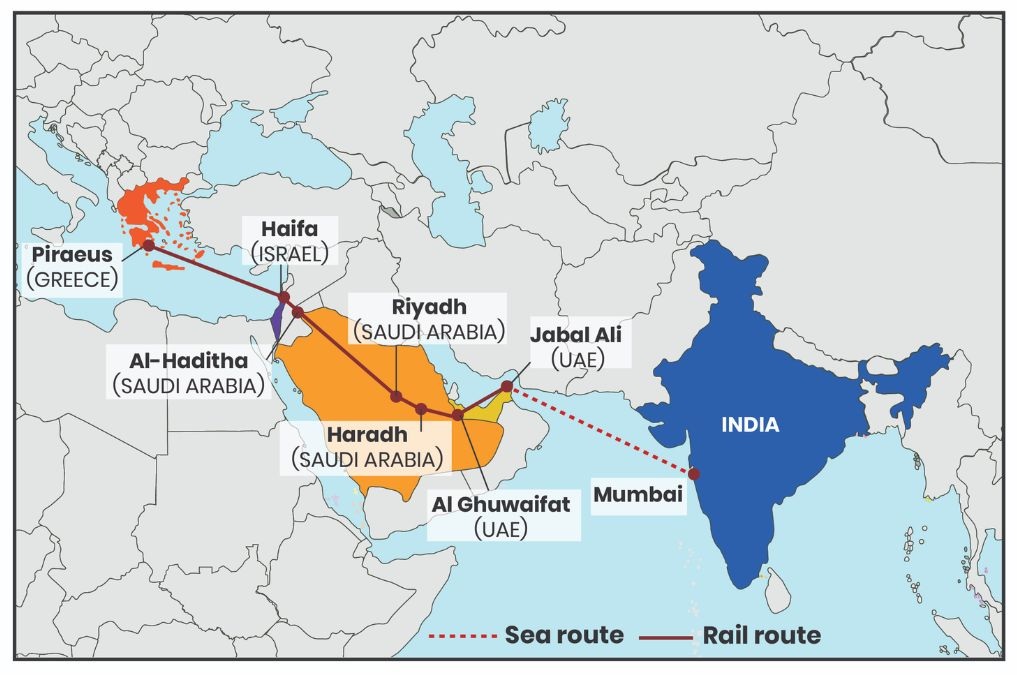
The India-Middle East-Europe Economic Corridor (IMEC) was launched at the G20 Leaders' Summit in New Delhi on 9 September 2023. The Memorandum of Understanding (MoU) was signed during the summit by the governments of:
- India
- United States
- United Arab Emirates
- Saudi Arabia
- France
- Germany
- Italy
- the European Union
Why is India-Middle East-Europe Economic Corridor important for India?
The IMEC, by linking South Asia, the Middle East, and Europe, will not only foster trade relations for India but also reduce reliance on traditional trade routes.
The IMEC aims to reduce the transit time and cost of transporting goods from India to Europe by 40 per cent and 30 per cent, respectively.
The corridor will help India diversify connectivity and trade routes while reducing dependency on the critical maritime chokepoints like the Suez Canal. This can help India mitigate the geopolitical and logistical problems on the traditional Red Sea-Suez Canal route.
IMEC also sets the stage for India to integrate India's west coast ports more into the Mediterranean and Gulf ecosystems while offering a counter to China's Belt and Road Initiative.
Building on plurilateralism, the IMEC also emphasises digital infrastructure and green energy cooperation.
With the European Union (EU) being India's largest trading partner as of 2024-25 with bilateral trade crossing $136 billion, or 11.5 per cent of India's total trade, the IMEC could significantly boost India's export competitiveness.
IMEC also aids strengthening Indo-Gulf trade and economic relations. The corridor also expands on India's 'Act West Policy' and deepen its engagement with the Middle East.
Also read: What were the events that led to the Suez Crisis in 1956?



Comments
All Comments (0)
Join the conversation