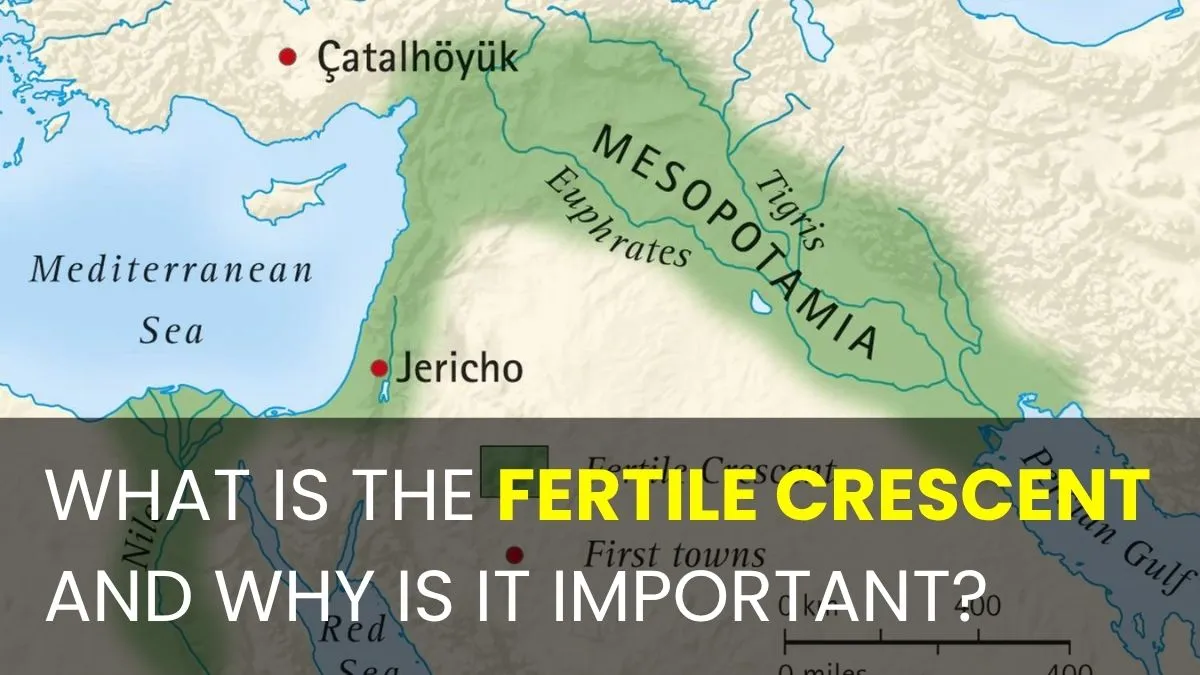
The Fertile Crescent, often called the 'cradle of civilisation', is found in the Middle East. The Fertile Crescent is believed to be the first region where early human civilisations such as Sumer in Mesopotamia flourished. This region, named after its fertile soil, is cited in history as the first region where settled farming emerged.
Early farming settlements began in the Middle East, primarily in the Fertile Crescent owing to its fertile soil and favourable climate. Around the 9th millennium BCE, people shifted from nomadic lifestyles to settlements. Prominent rivers, including the Tigris and Euphrates, along with the Nile River running through the region, provided necessary impetus to irrigation. During rainy seasons, these rivers would flood the valleys.
In this article, we will learn what the Fertile Crescent region is, which countries are a part of it, and its significance.
What is the Fertile Crescent?
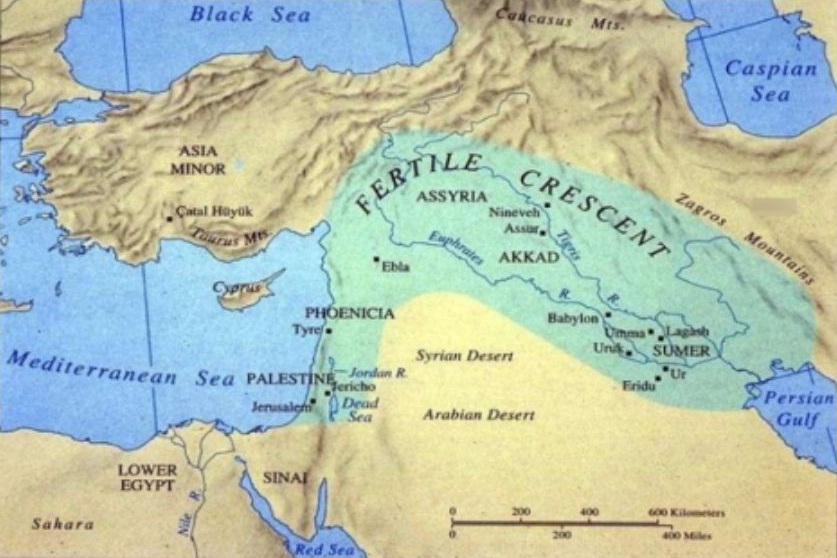
The Fertile Crescent is a crescent-shaped region in the Middle East, spanning modern-day Iraq, Israel, Jordan, Lebanon, Palestine, Syria, Egypt, and some part of Iran and Turkey.
The term 'Fertile Crescent' was popularised by the American Orientalist James Henry Breasted.
The Fertile Crescent is named for its crescent-shaped geographical aspest and its incredibly fertile, agriculturally rich soil despite being a sandy, dry area.
The Fertile Crescent stretches from the eastern Mediterranean coast (including the Levant) through Mesopotamia and extrending southeast toward the Persian Gulf.
This region was first first populated in 10,000 BCE when cultivation of crops began in the region.
The Fertile Crescent region includes two major areas:
i. Mesopotamia, referred to as land between rivers, is the area between the Tigris and Euphrates rivers. The region includes all of modern-day Iraq as well as parts of Syria, Iran, and Turkey.
ii. The Levant and Nile valley comprising the eastern Mediterranean coast and the lower Nile region. The Levant includes the eastern Mediterranean coastal lands (modern-day Syria, Lebanon, Israel, Jordan, and Palestine).
What civilizations were located in the Fertile Crescent?
Major civilisation of the Fertile Crescent include:
- Sumerians (c. 4000-2000 BCE)
- Akkadians (c. 2300-2100 BCE)
- Babylonian (c. 1900-1500 BCE)
- Assyrians (c. 900-600 BCE)
- Phoenicians (c. 1500-300 BCE)
- Egyptians (c. 3100-30 BCE)
Why is the significance of the Fertile Crescent in history?
The Fertile Crescent region played a pivotal role in the development of economic systems in ancient civilisations. The region is regarded as the 'cradle of civilisation', where humans first transitioned from nomadic lifestyles to settlements.
The region inhabited by Sumer, the earliest known civilisation that existed as early as the 6th to 5th millennium BCE before the construction of the Great Pyramids of Giza, is credited for most fundamental human inventions, including the wheel, first known writing system called cuneiform, mathematics, and large scale architecture.
Key agricultural developments in the Fertile Crescent region include:
- Cultivation of cereals such as barley, wheat, and legumes such as lentils, peas, etc and animal domestication.
- Irrigation systems to control flooding
- Trade networks and exchange of surplus crops, goods, technologies, and ideas between regions.



-1775042380438_t.webp)
Comments
All Comments (0)
Join the conversation