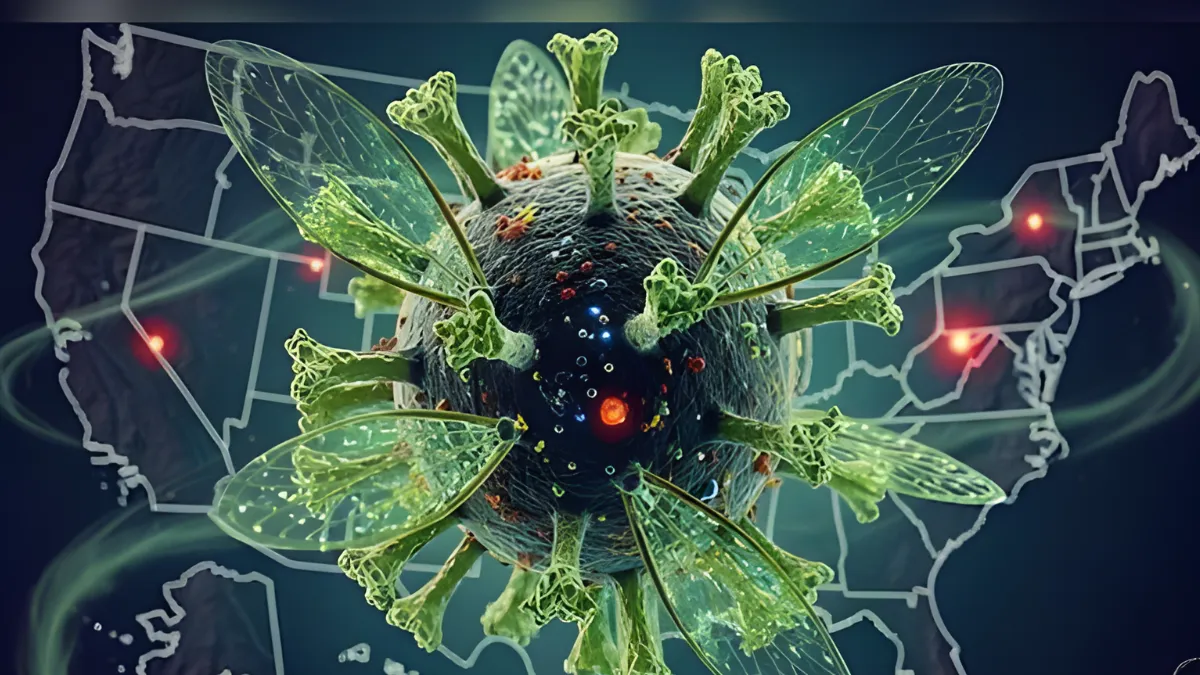
The 'Cicada' variant is an informal name given to the sub-lineage of the SARS-CoV-2 virus, formally known as the 'BA.3.2' variant. The 'Cicada' variant is a strain of the coronavirus, part of the Omicron family, responsible for COVID-19. The 'Cicada' variant is not a newly developed variant, but rather part of the Omicron variant, which was first detected in 2022.
On 5 December 2025, the World Health Organization (WHO) classified the 'BA.3.2' variant as a 'Variant Under Monitoring.' The variant contains genetic differences that could affect the behavior of the virus, although no evidence exists to show that the variant is more likely to spread than other variants.
How Did the Cicada Variant Originate?
The 'Cicada' variant, also known as the 'BA.3.2' variant, is derived from the 'BA.3' variant, part of the Omicron family, and contains an enormous number of mutations, especially in the spike protein, which the coronavirus uses to attach itself to human cells.
The mutations in the 'Cicada' variant are the main reason behind the alarm, leading the WHO to put the variant under close observation.
The variant was first detected in South Africa in late 2024, and shortly after, evidence was found of the variant in the United States, Europe, and other countries.
According to reports from various health-tracking tools, evidence of the 'Cicada' variant, also known as the 'BA.3.2' variant, was found in more than 20-23 countries across the world, as reported in late March 2026.
WHO and CDC Classification and Risk Level
According to the WHO, the BA.3.2 variant is classified as a 'Variant Under Monitoring' (VUM).This is the lowest level of classification by the WHO. It also implies that the subvariant has been placed under some form of scrutiny.
Variants of Interest and Variants of Concern are the next classifications and are reserved for those variants of the virus which have been proven to cause more severe disease, more contagious disease, and more immune-evading disease. Cicada has been classified at none of these levels.
According to WHO and the US’s Centers for Disease Control and Prevention (CDC), there has been no clear evidence to suggest that BA.3.2 causes more severe disease. It is more dangerous than other recent variants of the Omicron variant of the virus. BA.3.2 has therefore been placed under some form of scrutiny due to the presence of some mutations.
How Is Cicada Spreading Globally?
According to some data, including wastewater data, there has been evidence which shows that BA.3.2 has been present in various countries and therefore some form of community transmission of the subvariant has occurred.
This evidence shows that there has been gradual transmission of the virus in some countries where the other variants of the Omicron variant of the virus are present.
Health authorities have not linked BA.3.2 to a sharp, sudden surge in hospitalisations or deaths at the global level. Instead, it is being monitored as part of the broader pattern of evolving SARS‑CoV‑2 circulation.
Local health agencies in some countries are watching for any uptick in cases that cluster with BA.3.2 to detect early changes in behaviour.
What’s Next?
There is no strong evidence yet that BA.3.2 produces a distinct or uniquely severe symptom profile compared with earlier Omicron sub‑variants. Most cases appear to be mild to moderate, especially in people who are vaccinated or have previous immunity.
Nevertheless, because BA.3.2 may partially evade prior immunity, it can still fuel fresh waves of infections, particularly among unvaccinated or under‑vaccinated people and those whose last dose or infection was long ago. In regions with high‑density populations or limited healthcare capacity, even a moderate wave can temporarily increase pressure on hospitals and outpatient services.
Also read: Where does India get PNG from?



-1775042380438_t.webp)
Comments
All Comments (0)
Join the conversation