What is Strait of Hormuz? Check its Map, Countries, Location and Importance in West Asia
What is Strait of Hormuz? Discover the Strait of Hormuz and its map, location, Countries, key facts and importance in West Asia and role as a vital chokepoint for global oil transit like Persian Gulf and Which countries control the Strait of Hormuz?. Explore Its critical importance in the 2026 global energy crisis due to the Iran-Us-Israel conflict. Learn why this narrow chokepoint is vital for oil transit and Allies strait of hormuz and Strait of hormuz coalition.
Show Key Points
The Strait of Hormuz is the world's most critical energy chokepoint in Persian Gulf, act as the sole maritime gateway for roughly 20% of global oil and LNG shipments from the Persian Gulf. As of March 2026, the area is effectively experiencing a de facto closure due to the conflict between Iran and a US-Israeli alliance, causing insurance premiums to spike and commercial shipping to halt. This disruption poses a severe threat to global energy security, as there are no large-scale alternatives to replace the millions of barrels that transit this narrow passage daily.
The world economy would suffer greatly if it were blocked, as trade would be disrupted and oil prices would rise. The action would run the danger of escalating the conflict and sending oil prices skyrocketing in the world market. Why is the closing of the Hormuz Strait a global concern? Let's take a look at its geographical and economic importance.
Hormuz Strait: Latest Update
-
The Strait is effectively closed to commercial traffic due to Iranian missile strikes and naval mines, stranding over 3,000 vessels and 20,000 seafarers.
- The US-Israel-Iran conflict has transitioned from terrestrial strikes to active maritime denial. On March 10, 2026, U.S. Central Command (CENTCOM) confirmed the neutralization of 16 Iranian mine-laying vessels in the vicinity of the Hormuz Strait, in the response Islamic Revolutionary Guard Corps (IRGC) deploying naval mines to formalize a "layered blockade,".
-
The disruption has cascaded into a systemic production crisis. QatarEnergy officially declared Force Majeure on its Liquefied Natural Gas (LNG)contracts in early March, halting production due to the inability to export.
-
Similarly, Iraq has reported a 70% reduction in output at its southern fields dropping from 4.3 million to 1.3 million barrels per day because of a total exhaustion of onshore storage capacity, as tankers remain physically unable to egress the Persian Gulf.
-
Global energy prices have spiked, with Brent crude reaching $117 per barrel following retaliatory attacks on regional oil and gas infrastructure.
- Supply chain paralysis and logistics surcharges, Global shipping giants, including Maersk, MSC, and COSCO, have formally suspended all new cargo bookings to and from major Allies strait of hormuz UAE, Saudi Arabia, Kuwait, Qatar, and Iraq).
- This has triggered an "Emergency Contingency Surcharge" and forced the rerouting of vessels around the Cape of Good Hope, adding approximately 10–14 days to transit times and dramatically increasing the global Baltic Dirty Tanker Index (BDTI).
- India faces a critical energy security threat, with approximately 37 Indian-flagged oil and LPG tankers currently stranded in the region to mitigate the shock and proposing naval escorts for its energy assets, and launched the RELIEF Scheme to support the Indian Exporters who are engage in the trade with West Asean Countries.
- Analysts from Moody’s warn that a prolonged closure will result in a significant widening of India's current account deficit and a weakening of the Rupee.
What is a Strait?
A strait is a narrow waterway that frequently divides two landmasses and links two huge bodies of water, like the sea or ocean. It is a naturally occurring substance. The Strait of Hormuz serves as the global economy’s premier maritime chokepoint, facilitating the transit of over 20% of the world's petroleum and significant LNG volumes.
As the sole maritime egress from the Persian Gulf, its strategic criticality is underscored by its vulnerability to geopolitical volatility. Consequently, escalating hostilities between Iran and the United States have once again rendered this narrow corridor a focal point of international energy security and military concern.
Where is the Strait of Hormuz?

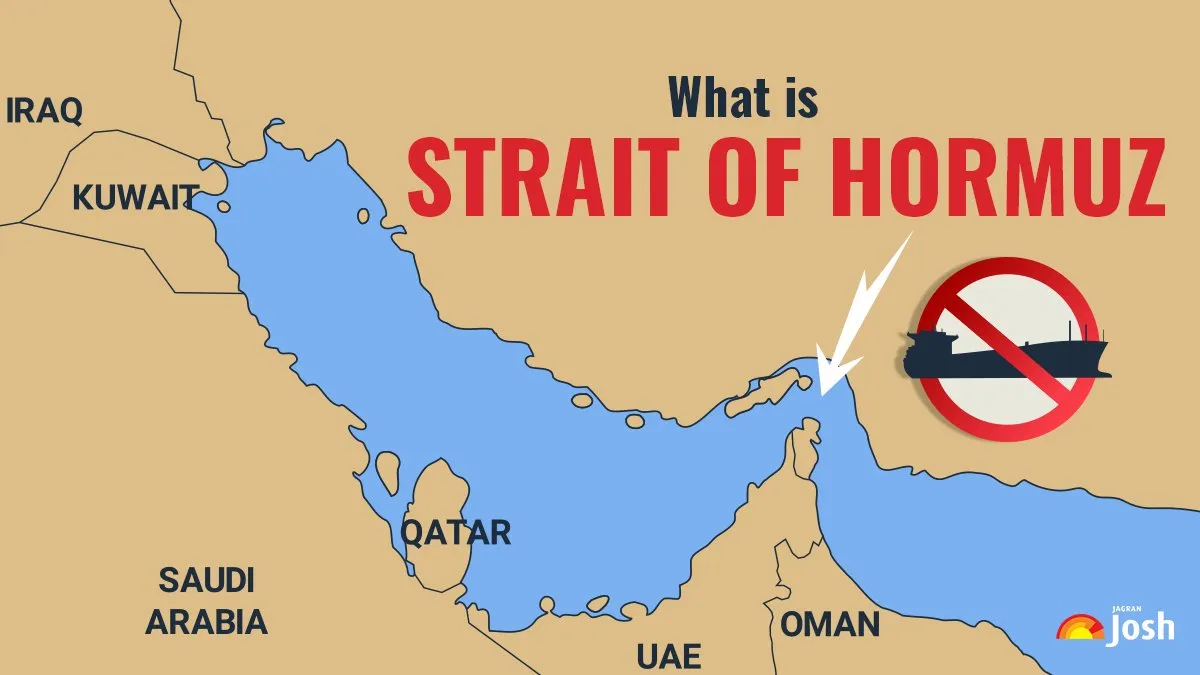
The Strait is a curved narrow waterway that serves as the sole maritime egress from the Persian Gulf to the open ocean connect the Gulf of Oman and the Arabian Sea. It separates the Islamic Republic of Iran to the north from the Musandam Peninsula (an exclave of Oman) and the United Arab Emirates to the south
The Strait connects the Persian Gulf to the Gulf of Oman and the Arabian Sea in the Indian Ocean, dividing Iran on one side and Oman and the United Arab Emirates on the other know as Allies strait of hormuz.
Physical Dimenstions Of Strait of Hormuz:
-
Width: Approximately 33 kilometers (21 miles) at its narrowest point.
-
Shipping Lanes: Due to the high volume of traffic and the presence of islands/reefs, ships must use a Traffic Separation Scheme (TSS). This consists of two-mile-wide inbound and outbound lanes, separated by a two-mile-wide buffer zone to prevent collisions.
-
Depth: It is deep enough to accommodate the world’s largest vessels, including Ultra Large Crude Carriers (ULCCs).
Which Countries Control the Strait of Hormuz?
The Strait of Hormuz is primarily bordered and controlled by Iran to the north and Oman know as Allies strait of hormuz specifically its Musandam exclave to the south while the United Arab Emirates from the southern coast. the most critical shipping lanes fall within the territorial waters of Oman and Iran because of its vital role in global energy trade in the West Asia international naval forces often patrol the area to ensure safe passage under international maritime law.
Why is the Strait of Hormuz important to the world?
The Strait of Hormuz is the "world's most important oil transit chokepoint," according to the US Energy Information Administration, which estimates that 20% of the world's oil consumption passes through it. It is 33 km (21 miles) wide at its narrowest point, but the waterway's shipping lanes are significantly more constricted, leaving them open to attacks and closure threats. It is the primary export route for Gulf nation countries like Saudi Arabia, the UAE, Kuwait, Iraq, and Qatar.
- The Strait is a vital route for Liquefied Natural Gas (LNG) around 20% of the world’s global Liquefied Natural Gas (LNG) supply.
- Oil Flow: Approximately 20–21 million barrels of petroleum liquids pass through daily, accounting for roughly one-fifth of global consumption.
- The International Energy Agency (IEA) estimates that in 2023, over 20 million barrels per day (mb/d) of crude oil and refined products or nearly 30% of the world's total oil trade passed through the Strait of Hormuz
- Asian Dependency: Over 80% of the oil transiting the Strait is destined for Asian markets, specifically China, India, Japan, and South Korea being top beneficiaries
Legal Dimensions: International Maritime Law
-
The Right of Transit Passage: Under the UN Convention on the Law of the Sea (UNCLOS), 1982 the Strait is an international waterway. Iran’s "layered blockade" is a direct violation of Article 38, which guarantees the right of continuous and expeditious navigation.
-
The Strait's Unique Status: Note that while the shipping lanes fall within the territorial waters of Iran and Oman, they are subject to international law. A formal closure constitutes an act of war under international legal frameworks, justifying the "neutralization" efforts by CENTCOM you mentioned earlie
Major Global Maritime Chokepoints
| Chokepoint | Primary Connection | Strategic Importance & Significance |
| Strait of Hormuz | Persian Gulf ↔ Arabian Sea | The Energy Heart: Facilitates 21% of global oil and 20% of LNG, the only sea exit for major producers like Kuwait and Qatar. |
| Strait of Malacca | Indian Ocean ↔ South China Sea | The Industrial Pipeline: The shortest sea route between the Middle East and the massive manufacturing hubs of China, Japan, and South Korea. |
| Bab-el-Mandeb | Red Sea ↔ Gulf of Aden | The Gateway to the West: Controls the southern entrance to the Suez Canal; critical for oil moving from the Gulf toward European markets. |
| Suez Canal | Red Sea ↔ Mediterranean | The Global Shortcut: Connects Asian markets to Europe without circumnavigating Africa, slashing transit time by roughly 10–14 days. |
| Panama Canal | Atlantic Ocean ↔ Pacific Ocean | The Western Pivot: Vital for U.S. shale gas and grain exports reaching Asian markets, essential for North American trade efficiency. |
| Turkish Straits | Black Sea ↔ Mediterranean | The Regional Lifeline: The sole maritime route for oil and grain exports from Russia, Ukraine, and the Caspian Sea region. |
What will happen if the Strait of Hormuz Closes?
According to the IEA, only 4.2 million barrels per day of crude oil can be diverted by overland routes, like the Abu Dhabi Crude Oil Pipeline to Fujairah in the United Arab Emirates and the East-West pipeline in Saudi Arabia to the Red Sea.
The Strait of Hormuz is currently experiencing a de facto closure due to military escalation between Iran and the US-Israeli alliance. Here is how this crisis is reshaping the global landscape as of March, 2026:
-
Global Energy Price Shock: With roughly 20% of global oil and LNG flows effectively blocked, market volatility has surged. Analysts expect Brent crude prices to climb rapidly from current levels toward $100–$130 per barrel if the disruption persists, fueling global inflationary pressures.
-
Commercial Shipping Paralysis: While the Strait remains technically open, maritime insurers have effectively withdrawn or prohibitively priced war-risk coverage. Consequently, major shipping lines have suspended transits, forcing tankers to drop anchor or reroute around the Cape of Good Hope, which adds weeks to delivery times and drastically increases freight costs.
-
Economic Crisis for Asian Importers: Major Asian economies, including India, China, Japan, and South Korea, rely on this route for 70–80% of their energy imports a prolonged blockade threatens to widen these nations' current account deficits, spike domestic fuel prices, and force governments to tap into strategic petroleum reserves.
-
Failure of Alternative Routes: Existing bypass pipelines, such as those in Saudi Arabia and the UAE, offer only limited capacity nowhere near the volume required to replace the 20 million barrels that usually transit the Strait daily. This structural bottleneck means there is no immediate, efficient way to compensate for the lost supply.
-
Broad Supply Chain Contagion: The disruption extends beyond energy, as tankers also carry essential chemicals and fertilizers. A sustained closure threatens to trigger a secondary crisis in agricultural production and manufacturing output, leading to wider industrial slowdowns and increased costs for basic consumer goods.
- Impact on Global Food Security: The Persian Gulf is a massive exporter of urea and phosphates (essential for fertilizers) as the Strait of Hormuz closed, the global supply of nitrogen-based fertilizers has been slashed by 15%. This is expected to trigger a secondary food price spike in late 2026, particularly affecting the Global South and agrarian economies like Vietnam, Brazil, and parts of Africa.

Manisha Waldia is an accomplished content writer with 4+ years of experience dedicated to UPSC, State PCS, and current affairs. She excels in creating expert content for core subjects like Polity, Geography, and History. Her work emphasises in-depth conceptual understanding and rigorous analysis of national and international affairs. Manisha has curated educational materials for leading institutions, including Drishti IAS, Shubhara Ranjan IAS, Study IQ, and PWonly IAS. Email ID: manisha.waldia@jagrannewmedia.com


-1779280115186_t.webp)