Show Key Points
The study of earthquakes called Seismology, relies on the fact that different materials within the Earth react differently to stress. When a fault slips, energy radiates outward from the focus (the point of origin). This energy is carried by waves that move through the Earth’s interior. These are known as body waves: Primary (P) and Secondary (S) waves.
What is an Earthquake?
An earthquake in simple words is the shaking of the earth. It is a natural event. It is caused due to release of energy, which generates waves that travel in all directions.
Why does the Earth shake?
The release of energy occurs along a fault. A fault is a sharp break in the crustal rocks. Rocks along a fault tend to move in opposite directions. As the overlying rock strata press them, the friction locks them together. However, their tendency to move apart at some point of time overcomes the friction. As a result, the blocks get deformed and eventually, they slide past one another abruptly. This causes a release of energy, and the energy waves travel in all directions.
-
The point where the energy is released is called the focus of an earthquake, alternatively, it is called the hypocentre.
-
The energy waves travelling in different directions reach the surface. The point on the surface, nearest to the focus, is called epicentre. It is the first one to experience the waves. It is a point directly above the focus.
What are Earthquake/Seismic Waves?
Seismic waves are mechanical waves of energy that propagate through the Earth’s layers, especially the lithosphere. They are generated at the Focus (Hypocenter) and radiated outward. As they travel, they undergo reflection, refraction, and absorption depending on the density and elasticity of the medium (rocks/magma).
The earth waves are measured by the Seismograph when the waves reach the surface. A curve of waves recorded on the seismograph shows three distinct sections each representing different types of wave patterns such as Body Wave and Surface Waves.
What are Body waves?
Body waves are generated due to the release of energy at the focus and move in all directions travelling through the body of the earth. Hence, the name body waves. The body waves interact with the surface rocks and generate new sets of waves called surface waves. There are two types of Body waves
-
P-waves
-
S-waves
What are P-Waves(Primary Waves)?
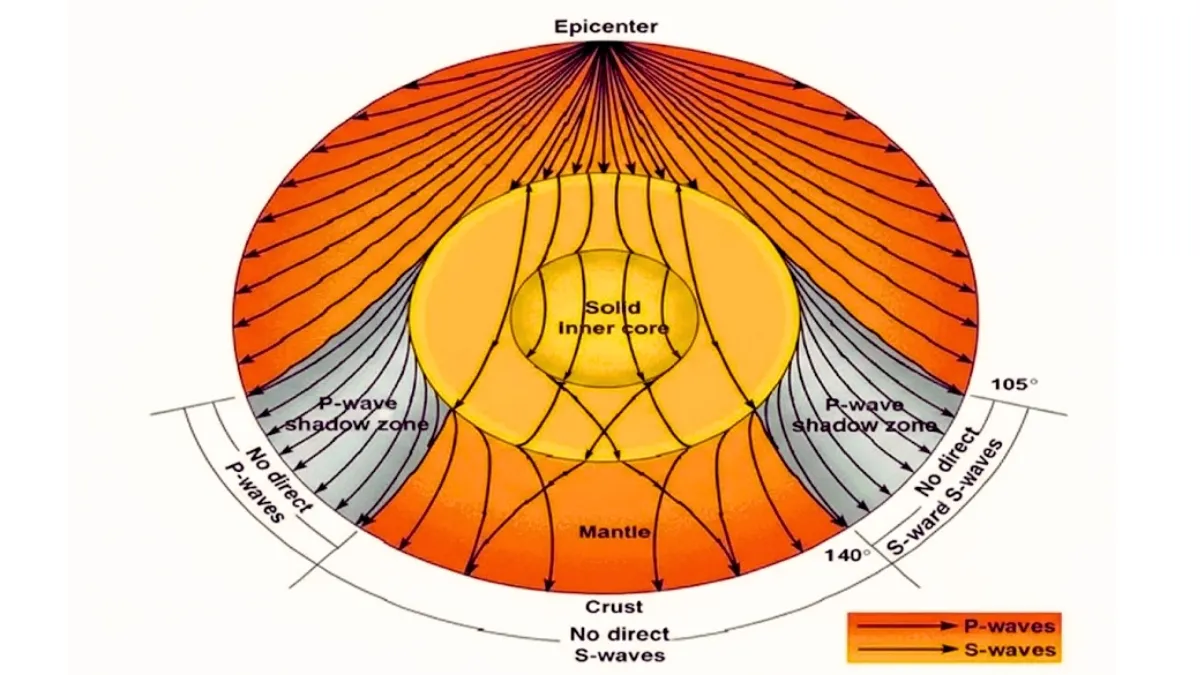
P waves are the "first responders" of an earthquake or P-waves move faster and are the first to arrive at the surface. These are also called ‘primary waves’. The P-waves are similar to sound waves. They travel through gaseous, liquid and solid materials, and are the first signals to be recorded by a seismograph. P-waves vibrate parallel to the direction of the wave.
P waves are Longitudinal or compressional waves. They push and pull the ground in the same direction the wave is traveling (think of a Slinky being pushed and pulled). P waves can travel through solids, liquids, and gases. This is why they can pass through the Earth's liquid outer core. Because P waves move through the air, they can sometimes be heard by animals or humans as a low rumble before the actual shaking begins.
What are S-Waves (Secondary Waves)?
S-waves arrive at the surface with some time lag or the "second act." They arrive after the P waves and are responsible for much of the structural damage felt during an earthquake. They are a type of transverse or shear wave. They move the ground up and down or side to side, perpendicular to the direction of the wave's travel (think of a rope being shaken up and down).
S waves can only travel through solids. S-waves are perpendicular to the wave direction in the vertical plane. They cannot pass through liquids or gases because fluids do not support shear stress, which helped scientists to understand the structure of the interior of the earth. Reflection causes waves to rebound whereas refraction makes waves move in different directions. The surface waves are the last to report on seismographs. These waves are more destructive. They cause displacement of rocks, and hence, the collapse of structures occurs
Difference Between P-Waves vs. S-Waves
| Feature | P Waves (Primary) | S Waves (Secondary) |
| Arrival Order | First | Second |
| Movement Type | Compression / Longitudinal | Shear / Transverse |
| Speed | Faster Vp | Slower Vs |
| Travels Through | Solids, Liquids, Gases | Solids Only |
| Physical Feel | Sharp thud or "jolt" | Side-to-side swaying |
Seismology studies earthquakes, which are Earth's shaking caused by energy release along faults. This energy generates seismic waves, including body waves (P and S) and surface waves. P-waves are faster, travel through all states, and are compressional. S-waves are slower, travel only through solids, and are shear waves, causing more damage. Understanding these waves helps analyze Earth's interior.
Also Read: National Large Solar Telescope: Key Objectives, Features & Latest Updates


-1771247919671_t.webp)


Comments
All Comments (0)
Join the conversation