
Scientific name of horse: The relationship between humans and horses has changed from one dependent on survival-based hunting to one based on a complex partnership that includes sports, farming, and therapy.
We just call them horses, but in the biological world, they have a special binomial name that shows where they came from and how they were domesticated.
Recent paleogenetic studies in 2025 have even mapped the genomes of 300,000-year-old horses found in Germany. This has pushed the limits of what we know about the horse's scientific name and its family tree.
If you want to learn about animals, the first step is to learn about the taxonomy of these beautiful animals, whether you are a student getting ready for a test or a nature lover.
What is Scientific Name?
A scientific name is a formal system of naming species using two parts, typically derived from Latin or Greek. Known as Binomial Nomenclature, this system was popularized by Carl Linnaeus.
The first part identifies the Genus (the group the animal belongs to), and the second part identifies the Species (the specific identity). According to the International Code of Zoological Nomenclature (ICZN), these names are universal.
This ensures that a researcher in India and a biologist in Brazil are talking about the exact same organism, regardless of local language differences.
Also Read - What is a Group of Horses Called?
What is the Scientific Name of a horse?
The scientific name for horses is Equus caballus. In modern taxonomy, though, you will often see it written as Equus ferus caballus.
The distinction lies in their domestic status. The caballus refers specifically to the domestic horse, while ferus represents the wild ancestor.
According to Britannica, all modern horse breeds, from the tiny Shetland pony to the massive Clydesdale, fall under this single species.
Interestingly, the word Equus is Latin for horse, while caballus was a term used by ancient poets to describe a riding horse.
Classification of Horse
The biological classification is set up in a hierarchy. The Integrated Taxonomic Information System (ITIS) recognizes the horse's taxonomic breakdown as follows:
| Rank | Taxon |
| Kingdom | Animalia |
| Phylum | Chordata |
| Class | Mammalia |
| Order | Perissodactyla (Odd-toed ungulates) |
| Family | Equidae |
| Genus | Equus |
| Species | Equus caballus |
Check Out - What is the Scientific Name of Human Beings?
Different Types of Horses and Their Scientific Name
While all domestic horses share the same primary scientific name, the genus Equus includes other distinct species. In late 2025, census reports from organizations like the Department of Agriculture highlighted that while domestic populations are stable, their wild cousins remain rare.
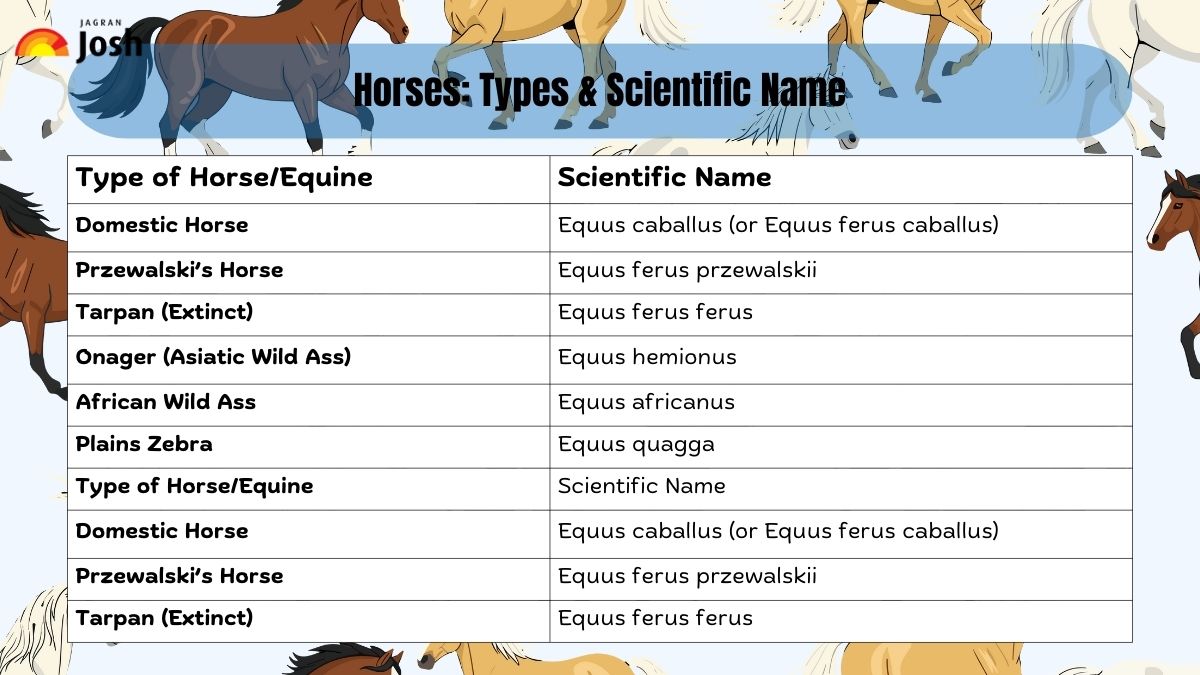
| Type of Horse/Equine | Scientific Name | Key Characteristic |
| Domestic Horse | Equus caballus (or Equus ferus caballus) | Includes all breeds like Arabians, Thoroughbreds, and Ponies. |
| Przewalski’s Horse | Equus ferus przewalskii | The last truly "wild" horse species is native to Mongolia. |
| Tarpan (Extinct) | Equus ferus ferus | The prehistoric wild horse of Europe, ancestor to modern breeds. |
| Onager (Asiatic Wild Ass) | Equus hemionus | Native to Asia; known for being extremely fast and untamable. |
| African Wild Ass | Equus africanus | The wild ancestor of the domestic donkey (Equus asinus). |
| Plains Zebra | Equus quagga | The most common and geographically widespread zebra species. |
Check Out - What is the Scientific Name of a Pine Tree?
As of 2026, the global horse population is estimated at approximately 58 million. While their roles have changed from war-front companions to icons of leisure and sport, the scientific name of the horse remains a vital link to their 55-million-year evolutionary success story.





Comments
All Comments (0)
Join the conversation