Key Points
- Blood Falls are red due to iron-rich nanospheres, confirmed by 2023-2024 study.
- Discovered in 1911, Blood Falls are a subglacial ecosystem sealed for ~2 million years.
- 2025 data confirms constant brine flow, suggesting liquid water in cold glaciers.
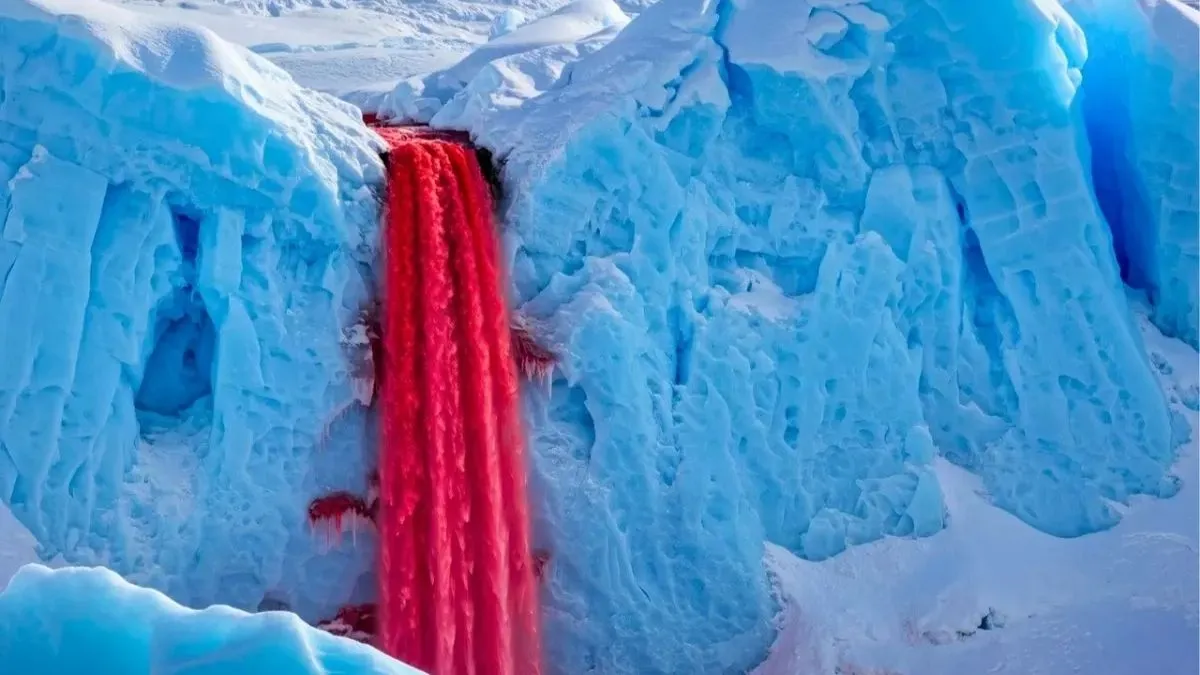
In the heart of the world's coldest desert, a grizzly sight pierces the monochromatic white of the Taylor Glacier. Known as the blood falls in Antarctica, this natural wonder looks like a scene straight out of a horror movie.
However, as of early 2026, researchers have solidified our understanding of this time capsule from the Earth's past. Discovered by Australian geologist Thomas Griffith Taylor over a century ago, Antarctica’s blood falls are not the result of ancient battles or red algae, as once feared.
Instead, they represent a rare subglacial ecosystem that has been sealed off for nearly two million years. This living laboratory provides a glimpse into how life might survive on other planets, making the Blood Falls glacier one of the most significant research sites on the planet.
What are the Blood Water Falls in Antarctica?
The blood falls are a bright red discharge of hypersaline water (brine) that seeps from the tongue of the Taylor Glacier onto the ice-covered surface of West Lake Bonney. Standing roughly five stories high, this blood waterfall is the only one of its kind known on Earth.
According to research cited by the National Science Foundation (NSF), the source is a subglacial pool trapped 400 meters beneath the ice. This water is roughly three times saltier than the ocean, which prevents it from freezing even in the sub-zero temperatures of the blood waterfalls in Antarctica.
Scientists have identified that this water contains a unique community of microbes that breathe iron and sulfur to survive in total darkness without oxygen.
| Feature | Details about Blood Falls |
| Location | Taylor Glacier, McMurdo Dry Valleys, East Antarctica |
| Discovered By | Griffith Taylor (1911) |
| Primary Cause | Oxidation of iron-rich subglacial brine |
| Microbial Life | Extremophile bacteria (Autotrophic) |
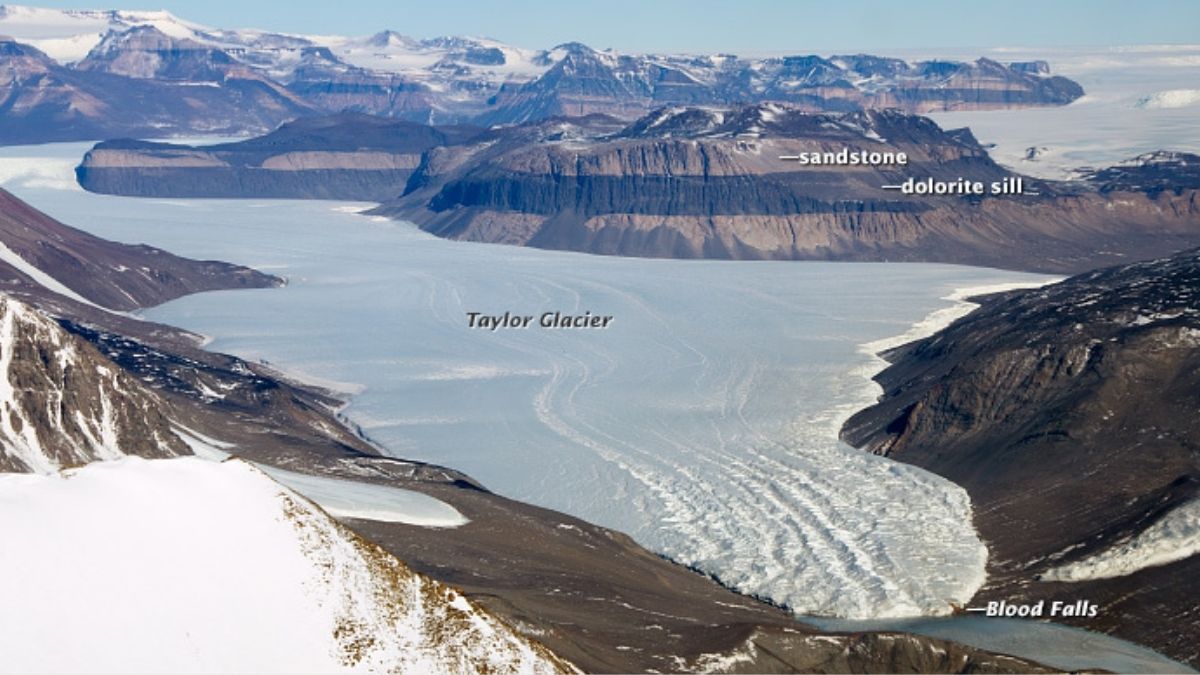
Taylor Glacier and Blood Falls in Antarctica. Courtesy - Wikimedia
Also Read - Which River Is Known As The Red River Of India?
The Phenomenon behind Antarctica’s Blood Falls
Advanced microscopy recently solved the mystery of why the red waterfall looks bloody. It used to be thought that iron oxide (rust) was the cause, but a study published in the Journal of Glaciology in 2023–2024 found that the water is full of tiny, iron-rich nanospheres. These spheres are 100 times smaller than a human red blood cell.
There is a simple but dramatic chemical reaction that gives the blood falls of Antarctica their color:
-
Isolation: Brine is trapped in an oxygen-free reservoir under the glacier.
-
Oxidation: When the pressurized brine escapes through cracks in the ice, it hits the Antarctic air.
-
The Bleeding Effect: The dissolved iron reacts instantly with oxygen, turning the clear liquid into a vivid crimson hue.
Check Out - The Hawaiian Happy Face Spider: The Smiling Arachnid of the Rainforest
The blood falls in Antarctica are still a big part of figuring out how life might exist on other planets. They are similar to the cold moons of Jupiter and Saturn. Recent data from 2025 confirms that the brine’s flow is sporadic but constant, proving that liquid water systems can exist deep inside cold-based glaciers previously thought to be frozen solid.




Comments
All Comments (0)
Join the conversation