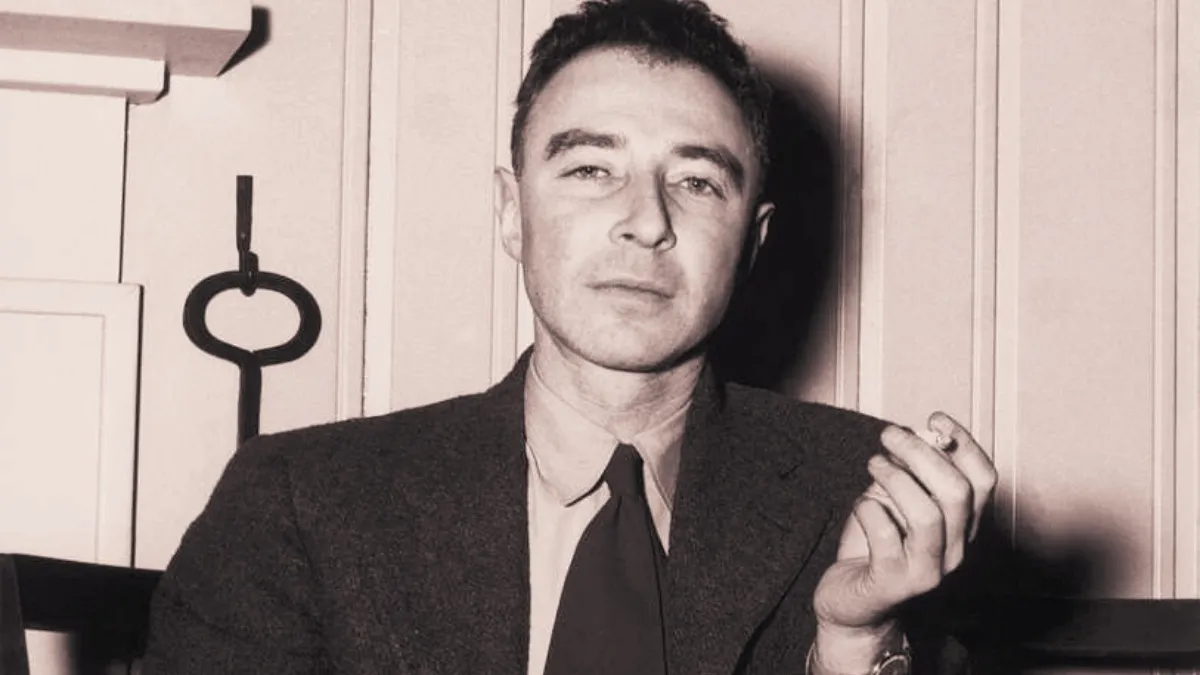
The person known as the “Father of the Atomic Bomb” is the physicist, J. Robert Oppenheimer. He was given this name because during World War II, he led the Los Alamos lab for the Manhattan Project, which built the first nuclear weapons.
The “Father of Atomic Bomb” reflects his scientific leadership in unleashing atomic power, forever changing warfare and ethics debates. More than 200,000 people were killed by bombs dropped on Japan in 1945, which ended WWII but inaugurated the nuclear age, according to the U.S. Department of Energy.
Read this article below to know about the “Father of Atomic Bomb”, reason behind this nickname, Manhattan Project and 5 facts about J. Oppenheimer.
Who is Known as the "Father of Atomic Bomb"?
J. Robert Oppenheimer (1904-1967) was named "Father of the Atomic Bomb" as scientific director at the Los Alamos Laboratory, managing 6,000+ scientists developing and testing the first atomic bombs.
Born in New York City to Jewish immigrants, Oppenheimer was a man of both great intellect and great moral ambiguity. Time magazine helped popularize it as the post-Trinity test. His leadership transformed theory into practicality with the 1945 explosion at Trinity.
Read the Quote of the Day by J. Robert Oppenheimer here.
Why is J. Oppenheimer known as the "Father of Atomic Bomb"?
J. Oppenheimer headed bomb design for the Manhattan Project between 1942-1945, recruiting genius-level minds such as Fermi and Bohr while working through the problems associated with fission.
He was handpicked by Groves despite no administrative experience due to his command of physics. He quoted Bhagavad Gita, "I am becoming Death" while observing the fireball created by Trinity. He also advocated for arms control.
What was the Manhattan Project and What Did it Do?
The Manhattan Project was America's top-secret WWII program that was initiated in 1942 to build the first atomic bombs for the nation before the Germans were able to build them. The $2 billion program, valued today at over $30 billion, brought the country's best scientists under the umbrella of the U.S. Army Corps of Engineers.
They carried out their mission at massive facilities such as Oak Ridge (Tennessee), for uranium enrichment; Hanford (Washington), for plutonium development; and Los Alamos (New Mexico), for bomb assembly under the leadership of J. Robert Oppenheimer.
The project was an instant success, and they designed and built the "Gadget," the plutonium device that would be part of the first nuclear test, Trinity, on July 16, 1945.
This also included two bombs that went off at Hiroshima ("Little Boy," uranium) and Nagasaki ("Fat Man," plutonium implosion), on August 6 and 9. This ended WWII but killed 200,000+ people instantly and left radiation effects.
Solve this GK Questions and Answers on World War II here.
5 Facts about the Father of Atomic Bomb
The “Father of Atomic Bomb”, J. Oppenheimer’s is life mixed with genius and controversy but also redemption. Read 5 interesting facts about the Father of the Atomic Bomb.
-
He studied at Harvard, Cambridge, Göttingen and by the 1930s gained fame in quantum physics.
-
He is Polyglot fluent, meaning he knows and is able to use several languages. He knows Sanskrit, he read Gita influencing Trinity reaction.
-
Oppenheimer’s security clearance was revoked due to the 1954 hearings about ties to left-leaning organizations.
-
He directed Princeton's Institute for Advanced Study 1947-1966.
-
President Kennedy gave him the Enrico Fermi Prize days before the 1963 assassination.
Know about the Most Affordable City for International Students.
J. Robert Oppenheimer represents the dual edges of science-power and peril-as the father of the atomic bomb. The legacy of the Manhattan Project that he directed impels nuclear talks to this day, reminding us that brilliance demands responsibility for the sake of humanity.




Comments
All Comments (0)
Join the conversation