Nepal Flash Flood: The Science Behind the Himalayan Glacial Collapse
Learn what led to the tragic Nepal flash flood. Find out the basic science behind Himalayan glacier collapse and ice-rock avalanches and why the Himalayas are easily prone to quick floods.
When the news about the destructive flash flood spreading around the Himalayan valleys located at great heights came out, the whole world was shocked.
The first readings taken on the seismograph indicated strong vibrations on the ground, and reports of an earthquake that occurred with a magnitude of 4.4 emerged. But later, the scientists and the satellite monitoring systems proved that it was not an earthquake.
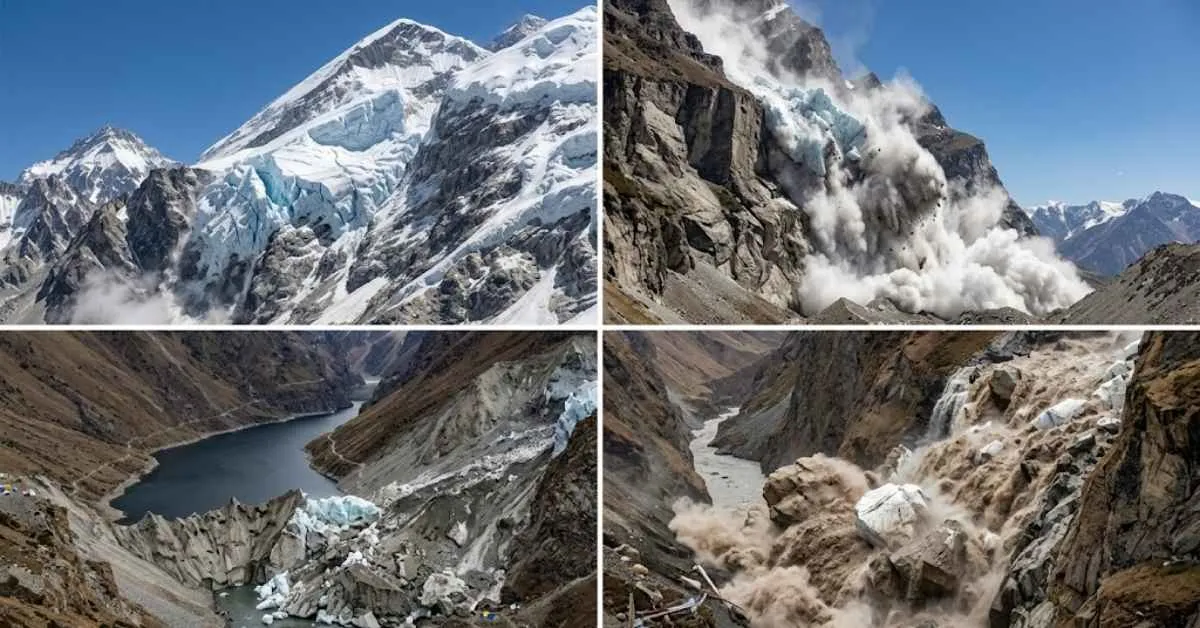
What happened became possible due to the large destruction of a glacier the ice and stones were torn from the mountaintop destroying the valley and bringing debris and rocks with the water to the region.
What is a Flash Flood?
In order to comprehend the concept of flash floods it is necessary to distinguish this phenomenon from standard flooding. Standard flooding
Imagine a big river overflowing due to some gentle rain lasting for days. It is a normal situation when people get ample time to cover their houses with sandbags and leave.
Flash flooding takes place like a huge bucket of water turned over at the top of the hill. It is a process that happens very quickly.
Flash floods carry water, but they can also move cars, uproot trees, destroy bridges and carry large boulders.
How the Disaster Took Place: Step by Step
1. Glacier Break Loose
At an altitude of about 5200 meters above sea level, an estimated millions of tons of soil, ice and rocks broke loose from the top of the mountain entirely. The impact of the avalanche hitting the ground was so strong that scientists believed initially that it was a medium earthquake taking place.
2. The Heavy Drops
The mass of ice and rocks fell down a distance of 1.2 kilometers in the upper gorge of the river. As the mass fell down, the released energy crumbled the rocks into fine silt and melted huge amounts of ice, turning the melting ice and falling rocks into a fast-flowing slushy.
3. The Natural Water Blockage
When the mass reached the width of the river valley, it blocked the river. For a few moments, this mass of rocks worked like a dam, catching the river water and causing rapid water build-up.
4. The Sudden Destruction
Since loose ice and soil cannot hold so much water under pressure, the dam structured by the avalanche collapsed and the river water went down with a huge wave of 9 meters high.
What Are the Causes of Vulnerability in the Himalayan Region?
The Himalayas have a number of geographical factors that make them particularly vulnerable to extreme weather phenomena. Below explains why the region is prone to such disasters:
-
Extreme Topography: Because of the steep formation of this region, the altitude falls suddenly over a small horizontal distance, giving the water too much speed and leaving no chance of issuing warnings.
-
Narrow Gorges: The deep-cut valleys help concentrate the water flow in a narrow space, which creates the depth of it and leads to the disaster.
-
Melting of Permafrost: The temperature rise is responsible for melting permafrost that keeps rocks bound with each other; therefore, as soon as the need for the permafrost disappears, the mountains will collapse.
-
Riverbank Facilities: As flat parts of land are not common in mountainous territories, cities and power plants are built on riverbanks directly in the flow of floodwaters.
The flash flood in Nepal serves as a perfect example of the dynamic nature of mountainous regions. It was not a result of a simple rainstorm or an earthquake but rather of mountain hydrology: the destabilization of ice and rock, which temporarily blocked river flow and created a torrential liquid mass of mud and water running down steep slopes.
The issue of pid changes in the mountain landscape due to climate warming remains crucial for mountain areas.

Manisha Waldia is a distinguished content strategist with 5 years of experience crafting premium educational content for UPSC and State PCS, with a focus on deep conceptual analysis across Polity, Geography, History, and Environment. She currently brings this expertise to Jagran Josh, where she covers major national and international events, current affairs, and static general knowledge. Over her career, Manisha's specialized insights have led her to curate high-impact materials and serve as a UPSC Mains answer-evaluator for India’s top institutes—including Drishti IAS, Shubhra Ranjan IAS, Study IQ, GS Score, and PWonlyIAS. She has also worked alongside leading NGOs like Oxfam India and Avani Kumaon.
Contact: manisha.waldia@jagrannewmedia.com