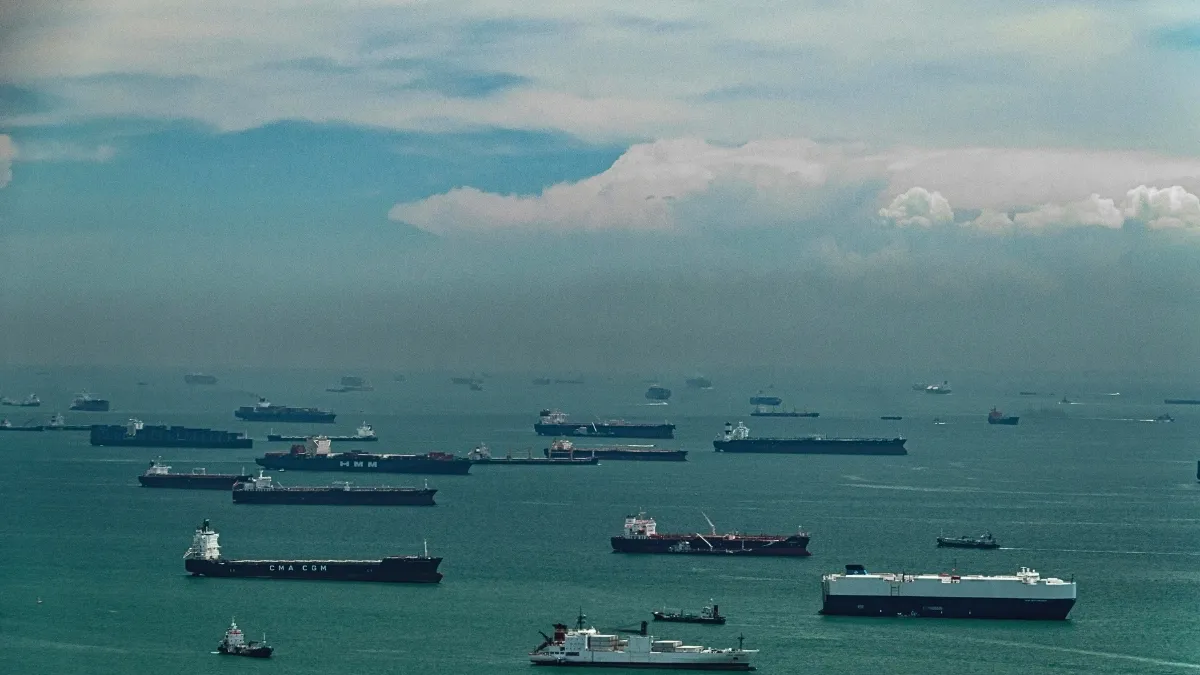
A naval blockade is a strategic military measure used to control sea routes and restrict the movement of ships during conflicts. It often impacts global trade and energy security. Its relevance becomes critical in the context of the Strait of Hormuz, a key maritime chokepoint through which a large share of the world’s oil supply flows.
A potential blockade here could arise due to regional conflicts, rising tensions, sanctions, or military confrontation involving countries like Iran and the United States, making it a major geopolitical concern.
What is a Naval Blockade?
A naval blockade is a military operation where a power uses its navy to prevent any vessels commercial or military from entering or leaving a defined maritime area. A blockade is enforced by physical presence, acts as a "maritime gate" designed to cut off an adversary's economy and supply lines.
Iran has effectively closed the Strait to vessels allied with the U.S. and Israel, using mines and fast-attack craft since March 2026.
The United States has also imposed the Counter-Blockade to intercept vessels paying "tolls" to Iran, aiming to cut off Tehran’s ability to monetize the waterway.
Strait of Hormuz on Map
The Strait of Hormuz is a curved narrow waterway that connects the Persian Gulf to the Gulf of Oman and the Arabian Sea in the Indian Ocean, dividing Iran on one side and Oman and the United Arab Emirates on the other know as Allies strait of hormuz.

Image: Strait of Hormuz on Map
How Would a Naval Blockade Work in the Strait of Hormuz?
Operating a blockade in the Strait of Hormuz is unique because the waterway is extremely narrow; the shipping lanes are only about two miles wide in each direction. A blockade operates through several military layers which includes:
Sea or Naval Mines Warfare:
Naval mine warfare is the most likely first step by deploying underwater mines that can effectively "close" the Strait because commercial tankers will not risk the high probability of a hull breach.
Iran has deployed "influence mines" and moored mines in the strait of Hormuz as reported by the U.S. Central Command.
Fast-Attack Craft:
Using small, agile boats to swarm and intercept larger tankers, forcing them to change course or face boarding.
Coastal Defense Missiles:
Utilizing land-based anti-ship missiles (ASCMs) positioned along the rugged coastline to target any vessel that attempts to run the blockade.
The Islamic Revolutionary Guard Corps (IRGC) uses fast-attack craft and drone boats (USVs) to swarm tankers.
Submarine Presence:
Using small, "midget" submarines that are difficult to detect in the shallow, noisy waters of the Gulf to monitor and strike targets. Launch torpedoes in the shallow Gulf waters.
Electronic Warfare:
Widespread GNSS (GPS) interference has been reported throughout the Strait, forcing ships to rely on degraded navigation systems.
Is a Naval Blockade Legal Under International Law?
The legality of a blockade is a complex issue governed by the San Remo Manual on International Law Applicable to Armed Conflicts at Sea for the legality
A blockade must be formally declared and notified to all neutral nations. It must be applied to the ships of all nations equally to avoid the partiality. A blockade is considered illegal if its sole purpose is to starve a civilian population or if it prevents the passage of essential medical supplies and food.
The United Nations Convention on the Law of the Sea (UNCLOS) grants ships "transit passage" through international straits. Many experts argue that closing the Strait of Hormuz would violate this international treaty, as it is a vital artery for global commerce.
Why is the Strait of Hormuz Important for Global Oil Supply?
According to the International Energy Agency (IEA) and U.S. Energy Information Administration (EIA), the Strait of Hormuz is the world's most important oil chokepoint.
-
Approximately 21 million barrels of oil pass through the Strait every day that accounts for 20-21% of global oil consumption.
-
LNG Shipments: It is the primary route for Liquefied Natural Gas (LNG). Around 20% of its LNG comes from Qatar, which supplies a significant portion of Europe and Asia's energy.
-
In April 2026, Iran began charging "transit fees" called a 'Hormuz Toll' of over $1 million per ship, attempting to turn the international strait into a revenue source.
-
Major producers like Kuwait, Iraq, and Qatar have seen exports drop by over 10 million barrels per day since the crisis began in March.
What Would Happen if the Strait of Hormuz is Blocked?
If a blockade were successfully implemented, the global consequences would be immediate and severe:
-
Global oil prices would likely see an unprecedented spike, potentially reaching over $150 per barrel within days which could cause massive inflation.
-
Maritime insurance companies would likely cancel "war risk" coverage, effectively grounding the global tanker fleet even outside the immediate conflict zone.
-
Supply chain disruptions beyond oil, the Strait handles significant container traffic. A blockade would delay the delivery of consumer goods and industrial components between Europe, the Middle East, and Asia.
-
A blockade is widely considered an act of war. Its implementation would likely trigger a direct military intervention from a coalition of international forces such as the U.S. and its allies to reopen the shipping lanes.
The 2026 crisis in the Strait of Hormuz has demonstrated that a naval blockade in this region is not just a military maneuver, but a global economic weapon. As long as the waterway remains contested by the U.S. and Iran, the world faces a prolonged period of energy instability and heightened risk of large-scale maritime conflict.
Also Read: What is Strait of Hormuz? Check its Map, Countries, Location and Importance in West Asia



Comments
All Comments (0)
Join the conversation