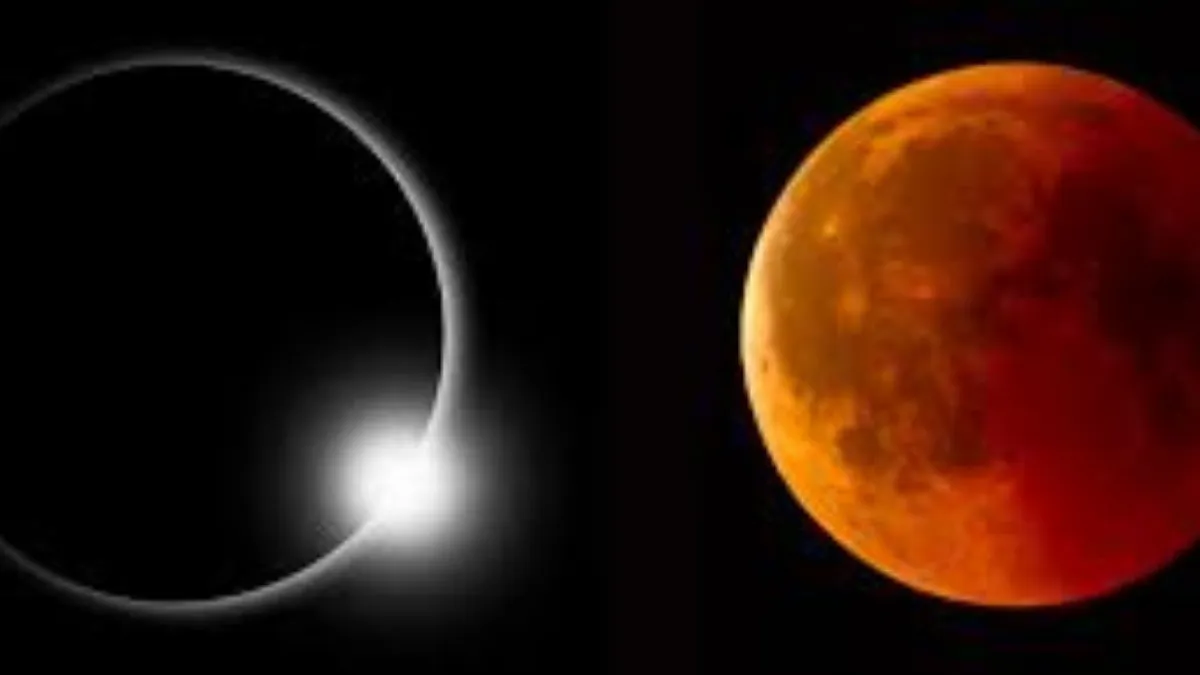
2026 is a rewarding year if you are looking to watch the night sky. There are four eclipses in total, two solar and two lunar. All of these offer several opportunities for observers across different parts of the world. In this article, learn more about what’s happening and where you will need to be to see them.
List of Solar and Lunar Eclipses in 2026
The year includes an annular solar eclipse in February, a total solar eclipse in August, a total lunar eclipse in March and a partial lunar eclipse later in August. The list of all the solar eclipses is given below:
| Date | Eclipse Type | Visibility |
| 17 February 2026 | Annular solar eclipse of February 17, 2026 | Primarily Antarctica |
| 3 March 2026 | Total lunar eclipse of March 3, 2026 | North & South America, eastern Asia, Australia |
| 12 August 2026 | Total solar eclipse of August 12, 2026 | Arctic, Greenland, Iceland, northern Spain |
| 27–28 August 2026 | Partial lunar eclipse of August 27–28, 2026 | North & South America, western Europe, Africa |
Source: NASA Science
When is the Annular Solar Eclipse in 2026?
On 17 February 2026, an Annular solar eclipse will take place. This type of eclipse happens when the Moon passes in front of the Sun but appears slightly smaller. It leaves a bright “ring of fire” visible around the edge.
This particular event will be visible primarily from Antarctica, with the maximum phase lasting around 2 minutes and 20 seconds.
At its peak, up to 96% of the Sun will be obscured. Because of its remote viewing location, only scientific teams and specialist travellers are likely to witness it in person.
As with all solar eclipses, proper eye protection is essential. Certified eclipse glasses or indirect viewing methods must be used.
When is the Total Solar Eclipse in 2026?
The headline event of the year is the Total solar eclipse of August 12, 2026, occurring on 12 August 2026.
This dramatic eclipse will be visible across parts of the Arctic, Greenland, Iceland, and northern Spain.
Observers within the path of totality will see the Moon completely cover the Sun, briefly revealing the solar corona, which is a rare and unforgettable sight.
Northern Spain is expected to be one of the most accessible viewing locations in Europe, and early travel planning is strongly advised. Weather prospects in mid-August are generally favourable, particularly along Spain’s northern coastline.
What Lunar Eclipses Will Occur in 2026?
For many regions in the Americas, the eclipse will occur in the early morning hours.
When is the Total Lunar Eclipse in March 2026?
A total lunar eclipse of March 3, 2026, takes place on 3 March 2026.
This eclipse will be visible from North and South America, eastern Asia and Australia. During totality, the Moon will turn a deep reddish hue, which is often referred to as a “blood moon”. Unlike solar eclipses, lunar eclipses are completely safe to watch with the naked eye.
When Is the Partial Lunar Eclipse in August 2026?
Later in the year, a Partial lunar eclipse of August 27–28, 2026, will occur on the night of 27–28 August 2026.
This event will be visible from North and South America, western Europe and parts of Africa.
Only a portion of the Moon will pass through Earth’s shadow, resulting in a noticeable darkening on one side of the lunar surface.
While less dramatic than a total eclipse, it is still a worthwhile event for casual stargazers and photographers.
Why is 2026 a Notable Year for Eclipses?
Although four eclipses in a year are not unusual astronomically, 2026 stands out because of the accessible total solar eclipse crossing parts of Europe.
Events like this draw global attention and provide valuable opportunities for scientific observation.
If you are planning to view any of these eclipses, check local timing updates closer to the dates, monitor weather forecasts and prepare viewing equipment in advance.
Check Out: List of Countries with Most Arable Land 2026
To conclude, for skywatchers, 2026 promises several memorable moments, whether under the midday shadow of a total solar eclipse or beneath a copper-coloured Moon in the quiet hours before dawn.



Comments
All Comments (0)
Join the conversation